Geography
Size snapshot: slightly less than one-fourth the size of the US.
CIA 2026
Loading TerraBrawl
Data as of May 28, 2026
Among all countries, Congo, Democratic Republic stands 1st in renewable energy. Can you guess its other standout statistics?
Among all countries, Congo, Democratic Republic stands 1st in renewable energy. This achievement puts it ahead of the vast majority of countries. Can you guess its other standout statistics?
Area
2.3M km²
Pop.
119.04M
Stats
120
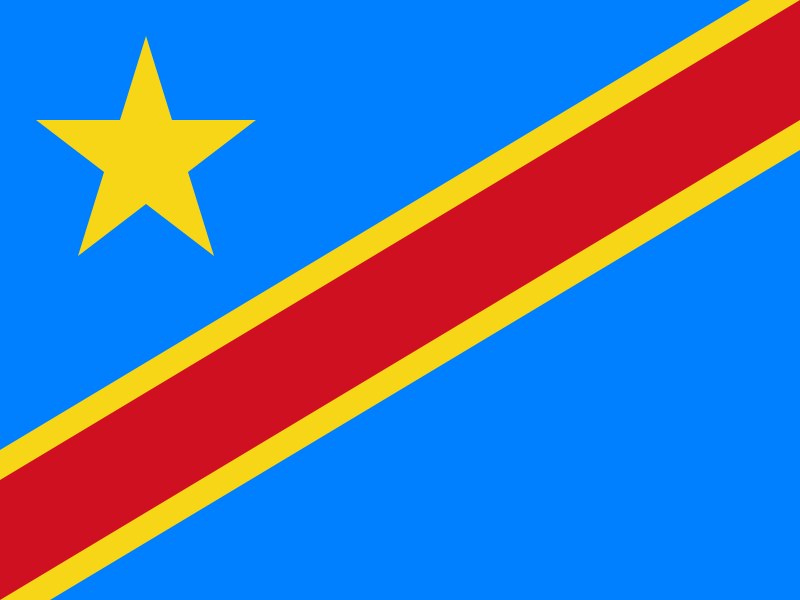
Congo, Democratic Republic is a country in Africa with a population of 119.04M and an area of 2,344,858 km². Life expectancy is 61.9 years.
Short factual summary generated from the same country data used in game rounds.
Core numbers
Fast scan first, deep dive later.
Land Area
2.27M km²Total land area in square kilometers, excluding lakes, rivers, and territorial waters.
Population Density
46.66 /km²How many people live in each square kilometer of land.
Human Development Index
0.52Composite 0-1 index of life expectancy, education, and income, from Our World in Data using the latest available country values in TerraBrawl.
Internet Users (%)
31%The percentage of people who have used the internet in the last 3 months.
Life Expectancy
61.9 yearsAverage number of years a newborn would be expected to live if current mortality patterns stayed the same, from Our World in Data.
Country briefing
A quick real-world briefing before you dive deeper into rankings, surprises, and matchups.
Geography
Size snapshot: slightly less than one-fourth the size of the US.
Culture
Major languages include French (official), Lingala (a trade language), Kingwana (a dialect of Kiswahili or Swahili), Kikongo, and more.
Identity
Formal name: Democratic Republic of the Congo.
Cities
Browse this country's cities before City Detective asks you to guess.
Kinshasa
Congo, Democratic Republic
Lubumbashi
Haut-Katanga, Congo, Democratic Republic
Mbuji-Mayi
East Kasai, Congo, Democratic Republic
Kananga
Kasai-Central, Congo, Democratic Republic
Kolwezi
Lualaba, Congo, Democratic Republic
Matadi
Bas-Congo, Congo, Democratic Republic
Kisangani
Tshopo, Congo, Democratic Republic
Butembo
North Kivu, Congo, Democratic Republic
Top stats
The strongest source-backed stats before the deeper data table.
Renewable Energy (%)
96.3%The percentage of energy consumption that comes from renewable sources like solar, wind, and hydro.
Fertility Rate
5.4 children/womanThe average number of children a woman would have over her lifetime based on current birth rates.
Dependency Ratio
96.5% of working-age pop.Dependents as a share of the working-age population, from World Bank Open Data.
Land Border Length
11.0K kmTotal length of land borders with neighboring countries from the frozen public-domain CIA World Factbook snapshot.
Inflation Rate
41.5%How much prices increased over the year, based on the cost of everyday goods and services.
Reality checks
The stats that tend to surprise players in real rounds.
Keeps co2 per capita unusually low
Annual carbon dioxide emissions in tonnes per person, from Our World in Data using the latest available country values in TerraBrawl.
Only ranks #215 in broadband access (%)
Fixed broadband subscriptions per 100 people, from World Bank Open Data.
Ranks #6 globally in youth population (%)
The percentage of the population aged 0 to 14.
Only ranks #231 in median age
The age that splits the population in half: half are younger, half are older. UN WPP estimate as of 1 July 2023.
Ranks #7 globally in forest area
Total forest area in square kilometers, including natural and planted trees at least 5 meters tall.
Compared with the region
Country vs continent vs world averages
GDP per person, adjusted for purchasing power parity (PPP) so costs of living are comparable across countries.
How many years a newborn can expect to live, based on current mortality rates.
Composite 0-1 index of life expectancy, education, and income, from Our World in Data using the latest available country values in TerraBrawl.
The percentage of people who have used the internet in the last 3 months.
Think you can guess which countries rank higher?
Play this countryFactbook notes
Country briefing
Bantu, Sudanic, and other migrants from West and Northeastern Africa arrived in the Congo River Basin between 2000 B.C.
Bantu, Sudanic, and other migrants from West and Northeastern Africa arrived in the Congo River Basin between 2000 B.C. and A.D. 500. The territory that is now the Democratic Republic of the Congo has more than 200 ethnic groups that trace their histories to many communal organizations and kingdoms. The Kingdom of Kongo, for example, ruled the area around the mouth of the Congo River from the 14th to 19th centuries. Meanwhile, the Kingdoms of Luba and Lunda, located to the south and east, were also notable political groupings in the territory and ruled from the 16th and 17th centuries to the 19th century. European prospectors in the Congo Basin invaded and splintered these kingdoms in the late 1800’s, sponsored by King LEOPOLD II of Belgium, and the kingdoms were eventually forced to grant Leopold the rights to the Congo territory as his private property. During this period, known as the Congo Free State, the king's private colonial military forced the local population to produce rubber. From 1885 to 1908, millions of Congolese people died as a result of disease and inhumane treatment. International condemnation finally forced LEOPOLD to cede the land to the state of Belgium, creating the Belgian Congo.
The Republic of the Congo gained its independence from Belgium in 1960, but its early years were marred by instability. Col. Joseph MOBUTU seized power and declared himself president in a 1965 coup. He subsequently changed his name to MOBUTU Sese Seko and the country's name to Zaire. MOBUTU retained his position for 32 years, using sham elections and brute force. In 1994, a massive inflow of refugees from conflict in neighboring Rwanda and Burundi sparked ethnic strife and civil war. A rebellion backed by Rwanda and Uganda and fronted by Laurent KABILA toppled the MOBUTU regime in 1997. KABILA renamed the country the Democratic Republic of the Congo (DRC). In 1998, another insurrection -- again backed by Rwanda and Uganda -- challenged the KABILA regime, but troops from Angola, Chad, Namibia, Sudan, and Zimbabwe helped quell the uprising.
In 2001, KABILA was assassinated, and his son, Joseph KABILA, was named head of state. In 2002, the new president negotiated the withdrawal of Rwandan forces occupying the eastern DRC; the remaining warring parties subsequently signed the Pretoria Accord to end the fighting and establish a government of national unity. KABILA was elected as president in 2006 and 2011. The DRC constitution barred him from running for a third term, so in 2016, the DRC Government delayed national elections for two years. This fueled significant civil and political unrest, with sporadic street protests and exacerbation of tensions in the eastern DRC regions.
The results of the 2018 elections were disputed, but opposition candidate Felix TSHISEKEDI, son of long-time opposition leader Etienne TSHISEKEDI, was announced as the election winner. This was the first transfer of power to an opposition candidate without significant violence or a coup since 1960. In 2023, the DRC held its fourth electoral cycle since independence; TSHISEKEDI was proclaimed the winner despite some allegations of fraud, with his Sacred Union alliance retaining a large parliamentary majority.
The DRC continues to experience violence -- particularly in the East -- perpetrated by more than 100 armed groups active in the region, including the March 23 (M23) rebel group, the ISIS-affiliated Allied Democratic Forces (ADF, or ISIS-DRC), the Democratic Forces for the Liberation of Rwanda (FDLR), and assorted local militias known as Mai Mai militias. The UN Organization Stabilization Mission in the DRC (MONUSCO) has operated in the region since 1999 and is the largest and most expensive UN peacekeeping mission in the world.
Data vault
Every tracked stat, grouped for fast scanning.
Keep exploring
Open the head-to-head pages people naturally search after reading this profile.
Jump straight to the rankings where this country has its strongest edge.
Turn Congo, Democratic Republic's strongest number into a challenge card.
The total number of people living in the country.
Congo, Democratic Republic has a population of 119.04M, ranking #13 globally by population.
Congo, Democratic Republic is located in Africa. It has an area of 2,344,858 km².
Life expectancy in Congo, Democratic Republic is 61.9 years, ranking #203 globally.
Congo, Democratic Republic's GDP per capita (PPP) is $1,821.05, ranking #194 globally.
Congo, Democratic Republic ranks particularly high in Population (#13), Land Area (#11), Population Density (#155).
Congo, Democratic Republic has an HDI of 0.522, ranking #171 globally. The HDI combines life expectancy, education, and income indicators.
Congo, Democratic Republic has a population density of 46.7 people per km², ranking #155 globally.