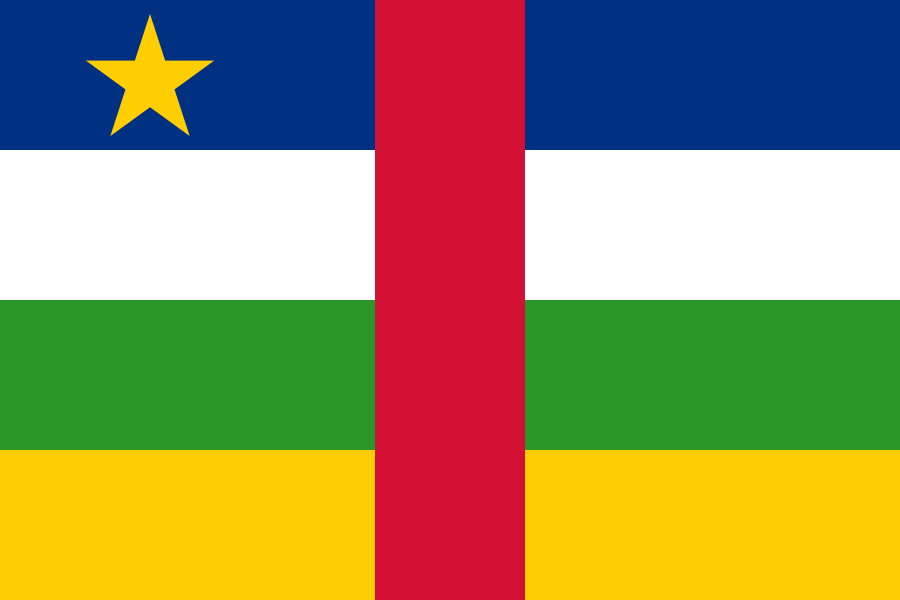
Geography
Climate: tropical.
CIA 2026
Loading TerraBrawl
Data as of May 28, 2026
Few places match Central African Republic's #5 ranking in renewable energy. See if you can spot its other strengths.
Few places match Central African Republic's #5 ranking in renewable energy. With 90.9%, the numbers speak for themselves. See if you can spot its other strengths.
Area
623K km²
Pop.
5.75M
Stats
106
Central African Republic is a country in Africa with a population of 5.75M and an area of 622,984 km². Life expectancy is 57.4 years.
Short factual summary generated from the same country data used in game rounds.
Core numbers
Fast scan first, deep dive later.
Land Area
623.0K km²Total land area in square kilometers, excluding lakes, rivers, and territorial waters.
Life Expectancy
57.4 yearsAverage number of years a newborn would be expected to live if current mortality patterns stayed the same, from Our World in Data.
Human Development Index
0.41Composite 0-1 index of life expectancy, education, and income, from Our World in Data using the latest available country values in TerraBrawl.
Country briefing
A quick real-world briefing before you dive deeper into rankings, surprises, and matchups.
Geography
Climate: tropical.
Culture
Major languages include French (official), Sangho (lingua franca and national language), tribal languages.
Economy
Key industries include gold and diamond mining, logging, brewing, sugar refining.
Cities
Browse this country's cities before City Detective asks you to guess.
Top stats
The strongest source-backed stats before the deeper data table.
Teen Birth Rate
163.09 per 1kThe number of births per 1,000 women aged 15-19.
Dependency Ratio
104.73% of working-age pop.Dependents as a share of the working-age population, from World Bank Open Data.
Renewable Energy (%)
90.9%The percentage of energy consumption that comes from renewable sources like solar, wind, and hydro.
Broadband Access (%)
202 per 100 peopleFixed broadband subscriptions per 100 people, from World Bank Open Data.
Reality checks
The stats that tend to surprise players in real rounds.
Only ranks #236 in median age
The age that splits the population in half: half are younger, half are older. UN WPP estimate as of 1 July 2023.
Only ranks #232 in internet users (%)
The percentage of people who have used the internet in the last 3 months.
Only ranks #197 in gdp per capita
GDP per person adjusted for purchasing power in constant 2017 international dollars, from Our World in Data using the latest available country values in TerraBrawl.
Only ranks #197 in gdp per capita (ppp)
GDP per person, adjusted for purchasing power parity (PPP) so costs of living are comparable across countries.
Only ranks #210 in electricity access (%)
The percentage of the population with access to electricity.
Compared with the region
Country vs continent vs world averages
GDP per person, adjusted for purchasing power parity (PPP) so costs of living are comparable across countries.
How many years a newborn can expect to live, based on current mortality rates.
Composite 0-1 index of life expectancy, education, and income, from Our World in Data using the latest available country values in TerraBrawl.
The percentage of people who have used the internet in the last 3 months.
Think you can guess which countries rank higher?
Play this countryFactbook notes
Country briefing
The Central African Republic (CAR) is a perennially weak state that sits at the crossroads of ethnic and linguistic groups in the center of the African continent.
The Central African Republic (CAR) is a perennially weak state that sits at the crossroads of ethnic and linguistic groups in the center of the African continent. Among the last areas of Sub-Saharan Africa to be drawn into the world economy, its introduction into trade networks around the early 1700s fostered significant competition among its population. The local population sought to benefit from the lucrative Atlantic, trans-Saharan, and Indian Ocean trade in enslaved people and ivory. Slave raids aided by the local populations fostered animosity between ethnic groups that remains today. The territory was established as a French colony named Ubangui-Shari in 1903, and France modeled its administration of the colony after the Belgian Congo, subcontracting control of the territory to private companies that collected rubber and ivory. Although France banned the domestic slave trade in CAR in the 1910s, the private companies continued to exploit the population through forced labor. The colony of Ubangi-Shari gained independence from France as the Central African Republic in 1960, but the death of independence leader Barthelemy BOGANDA six months prior led to an immediate struggle for power.
CAR’s political history has since been marred by a series of coups, the first of which brought Jean-Bedel BOKASSA to power in 1966. Widespread corruption and intolerance for any political opposition characterized his regime. In an effort to prolong his mandate, BOKASSA named himself emperor in 1976 and changed the country’s name to the Central African Empire. His regime’s economic mismanagement culminated in widespread student protests in 1979 that were violently suppressed by security forces. BOKASSA fell out of favor with the international community and was overthrown in a French-backed coup in 1979. After BOKASSA’s departure, the country’s name once again became the Central African Republic.
CAR’s fifth coup in 2013 unseated President Francois BOZIZE after the Seleka, a mainly Muslim rebel coalition, seized the capital and forced BOZIZE to flee the country. The Seleka's widespread abuses spurred the formation of mainly Christian self-defense groups that called themselves the anti-Balaka, which have also committed human rights abuses against Muslim populations in retaliation. Since the rise of these groups, conflict in CAR has become increasingly ethnoreligious, although focused on identity rather than religious ideology. Elections in 2016 installed independent candidate Faustin-Archange TOUADERA as president; he was reelected in 2020. A peace agreement signed in 2019 between the government and the main armed factions has had little effect, and armed groups remain in control of large swaths of the country's territory. TOUADERA's United Hearts Movement has governed the country since 2016, and a new constitution approved by referendum on 30 July 2023 effectively ended term limits, creating the potential for TOUADERA to extend his rule.
Data vault
Every tracked stat, grouped for fast scanning.
Keep exploring
Open the head-to-head pages people naturally search after reading this profile.
Jump straight to the rankings where this country has its strongest edge.
Turn Central African Republic's strongest number into a challenge card.
Total land area in square kilometers, excluding lakes, rivers, and territorial waters.
Central African Republic has a population of 5.75M, ranking #116 globally by population.
Central African Republic is located in Africa. It has an area of 622,984 km².
Life expectancy in Central African Republic is 57.4 years, ranking #212 globally.
Central African Republic's GDP per capita (PPP) is $1,263.1, ranking #197 globally.
Central African Republic ranks particularly high in Land Area (#43), Population (#116), Population Density (#203).
Central African Republic has an HDI of 0.414, ranking #191 globally. The HDI combines life expectancy, education, and income indicators.
Central African Republic has a population density of 8.3 people per km², ranking #203 globally.