Geography
Climate: temperate.
CIA 2026
Loading TerraBrawl
Data as of May 28, 2026
The numbers tell two very different stories about Rwanda. Think you can explain the gap?
The numbers tell two very different stories about Rwanda. #1 in women in parliament but near the bottom in urban population. Think you can explain the gap?
Area
26K km²
Pop.
13.62M
Stats
123
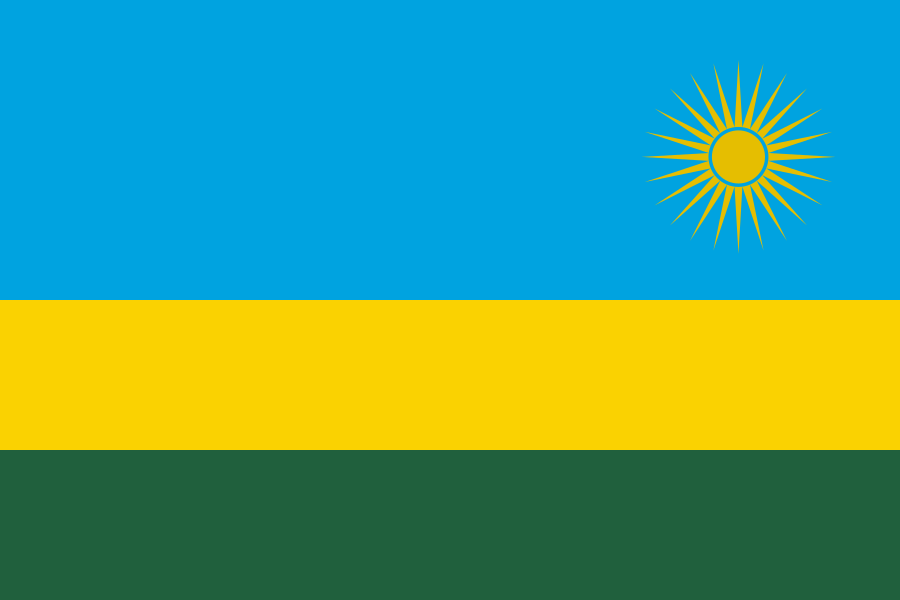
Rwanda is a country in Africa with a population of 13.62M and an area of 26,338 km². Life expectancy is 67.8 years.
Short factual summary generated from the same country data used in game rounds.
Core numbers
Fast scan first, deep dive later.
Population Density
565.65 /km²How many people live in each square kilometer of land.
Land Area
24.7K km²Total land area in square kilometers, excluding lakes, rivers, and territorial waters.
Life Expectancy
67.8 yearsHow many years a newborn can expect to live, based on current mortality rates.
Human Development Index
0.58Composite 0-1 index of life expectancy, education, and income, from Our World in Data using the latest available country values in TerraBrawl.
Country briefing
A quick real-world briefing before you dive deeper into rankings, surprises, and matchups.
Geography
Climate: temperate.
Culture
Major languages include Kinyarwanda (official, universal Bantu vernacular) 93.2%, French (official) <0.1%, English (official) <0.1%, and more.
Identity
Formal name: Republic of Rwanda.
Cities
Browse this country's cities before City Detective asks you to guess.
Top stats
The strongest source-backed stats before the deeper data table.
Women in Parliament (%)
63.75%The percentage of parliament seats held by women.
Lowest Elevation
950 mLowest point elevation from CIA World Factbook.
Renewable Energy (%)
79.9%The percentage of energy consumption that comes from renewable sources like solar, wind, and hydro.
Broadband Access (%)
202 per 100 peopleFixed broadband subscriptions per 100 people, from World Bank Open Data.
Reality checks
The stats that tend to surprise players in real rounds.
Only ranks #192 in obesity rate
Share of adults with obesity, from Our World in Data using the latest available country values in TerraBrawl.
Only ranks #130 in foreign patents
How many patent applications are filed by non-residents each year.
Only ranks #227 in coastline length
Total coastline length from CIA World Factbook.
Only ranks #193 in doctors (per 1,000)
The number of doctors per 1,000 people.
Keeps co2 per capita unusually low
Annual carbon dioxide emissions in tonnes per person, from Our World in Data using the latest available country values in TerraBrawl.
Compared with the region
Country vs continent vs world averages
GDP per person, adjusted for purchasing power parity (PPP) so costs of living are comparable across countries.
How many years a newborn can expect to live, based on current mortality rates.
Composite 0-1 index of life expectancy, education, and income, from Our World in Data using the latest available country values in TerraBrawl.
The percentage of people who have used the internet in the last 3 months.
Think you can guess which countries rank higher?
Play this countryFactbook notes
Country briefing
Rwanda -- a small and centralized country dominated by rugged hills and fertile volcanic soil -- has exerted disproportionate influence over the African Great Lakes region for centuries.
Rwanda -- a small and centralized country dominated by rugged hills and fertile volcanic soil -- has exerted disproportionate influence over the African Great Lakes region for centuries. A Rwandan kingdom increasingly dominated the region from the mid-18th century onward, with the Tutsi monarchs gradually extending the power of the royal court into peripheral areas and expanding their borders through military conquest. While the current ethnic labels Hutu and Tutsi predate colonial rule, their flexibility and importance have varied significantly over time and often manifested more as a hierarchical class distinction than an ethnic or cultural distinction. The majority Hutu and minority Tutsi have long shared a common language and culture, and intermarriage was frequent.
The Rwandan royal court centered on the Tutsi king (mwami), who relied on an extensive network of political, cultural, and economic relationships. Social categories became more rigid during the reign of RWABUGIRI (1860-1895), who focused on aggressive expansion and solidifying Rwanda’s bureaucratic structures. German colonial conquest began in the late 1890s, but the territory was ceded to Belgian forces in 1916 during World War I. Both European nations quickly realized the benefits of ruling through the already centralized Rwandan Tutsi kingdom. Colonial rule reinforced existing trends toward autocratic and exclusionary rule, leading to the elimination of traditional positions of authority for Hutus. Belgian administrators significantly increased requirements for communal labor and instituted harsh taxes, which fed the population's frustration. Changing political attitudes in Belgium contributed to colonial and Catholic officials shifting their support from Tutsi to Hutu leaders in the years leading up to independence.
Simmering resentment of minority rule exploded in 1959, three years before independence from Belgium, when Hutus overthrew the Tutsi king. Thousands of Tutsis were killed over the next several years, and some 150,000 were driven into exile in neighboring countries. Army Chief of Staff Juvenal HABYARIMANA seized power in a coup in 1973 and ruled Rwanda as a single-party state for two decades. HABYARIMANA increasingly discriminated against Tutsis, and extremist Hutu factions gained prominence after multiple parties were introduced in the early 1990s. The children of Tutsi exiles later formed a rebel group, the Rwandan Patriotic Front (RPF) and began a civil war in 1990. The civil war exacerbated ethnic tensions and culminated in the shooting down of HABYARIMANA’s private jet in 1994. The event sparked a state-orchestrated genocide in which Rwandans killed more than 800,000 of their fellow citizens, including approximately three-quarters of the Tutsi population. The genocide ended later the same year when the predominantly Tutsi RPF, operating out of Uganda and northern Rwanda, defeated the national army and Hutu militias and established an RPF-led government of national unity. Rwanda held its first local elections in 1999 and its first post-genocide presidential and legislative elections in 2003, formalizing President Paul KAGAME’s de facto role as head of government. KAGAME was formally elected in 2010, and again in 2017 after changing the constitution to allow him to run for a third term.
Data vault
Every tracked stat, grouped for fast scanning.
Keep exploring
Open the head-to-head pages people naturally search after reading this profile.
Jump straight to the rankings where this country has its strongest edge.
Turn Rwanda's strongest number into a challenge card.
How many people live in each square kilometer of land.
Rwanda has a population of 13.62M, ranking #77 globally by population.
Rwanda is located in Africa. It has an area of 26,338 km².
Life expectancy in Rwanda is 67.8 years, ranking #164 globally.
Rwanda's GDP per capita (PPP) is $3,710.86, ranking #173 globally.
Rwanda ranks particularly high in Population Density (#17), Population (#77), Land Area (#146).
Rwanda has an HDI of 0.578, ranking #159 globally. The HDI combines life expectancy, education, and income indicators.
Rwanda has a population density of 565.6 people per km², ranking #17 globally.