Geography
Natural resources include hydropower, tin, phosphates, iron ore, and more.
CIA 2026
Loading TerraBrawl
Data as of May 28, 2026
Strong in one area, surprising in another — that's Tanzania. How well do you know Tanzania's stats?
Strong in one area, surprising in another — that's Tanzania. At #17 in fertility rate, you'd never guess its low mark in internet access. How well do you know Tanzania's stats?
Area
947K km²
Pop.
69.15M
Stats
122
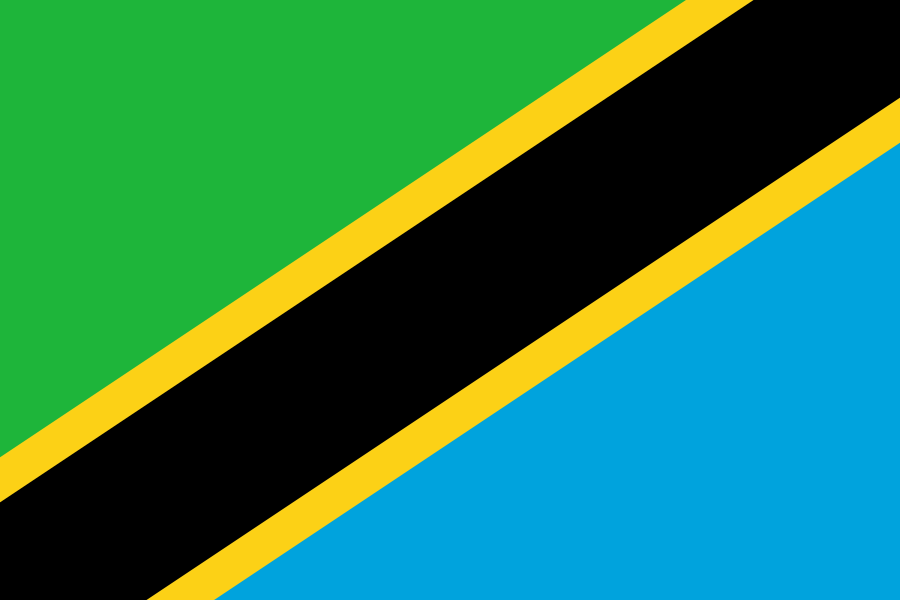
Tanzania is a country in Africa with a population of 69.15M and an area of 947,303 km². Life expectancy is 67.0 years.
Short factual summary generated from the same country data used in game rounds.
Core numbers
Fast scan first, deep dive later.
Land Area
885.8K km²Total land area in square kilometers, excluding lakes, rivers, and territorial waters.
Population Density
75.21 /km²How many people live in each square kilometer of land.
Life Expectancy
67.0 yearsHow many years a newborn can expect to live, based on current mortality rates.
GDP Per Capita
$3,713.26GDP per person adjusted for purchasing power in constant 2017 international dollars, from Our World in Data using the latest available country values in TerraBrawl.
Country briefing
A quick real-world briefing before you dive deeper into rankings, surprises, and matchups.
Geography
Natural resources include hydropower, tin, phosphates, iron ore, and more.
Culture
Major languages include Kiswahili or Swahili (official), Kiunguja (name for Swahili in Zanzibar), English (official, primary language of commerce, and more.
Identity
Formal name: United Republic of Tanzania.
Cities
Browse this country's cities before City Detective asks you to guess.
Dar es Salaam
Dar es Salaam Region, Tanzania
Dodoma
Tanzania
Zanzibar
Zanzibar Urban/West, Tanzania
Mbeya
Tanzania
Mwanza
Tanzania
Arusha
Tanzania
Morogoro
Tanzania
Tanga
Tanzania
Top stats
The strongest source-backed stats before the deeper data table.
Protected Land (%)
40%The percentage of land area designated as protected natural reserves or parks.
Teen Birth Rate
113.21 per 1kThe number of births per 1,000 women aged 15-19.
Dependency Ratio
83.76% of working-age pop.Dependents as a share of the working-age population, from World Bank Open Data.
Highest Elevation
5.9K mHighest point elevation from CIA World Factbook.
Alcohol Consumption
10.95 L/adult/yrLiters of pure alcohol the average adult aged 15+ consumes per year, from Our World in Data using the latest available country values in TerraBrawl.
Reality checks
The stats that tend to surprise players in real rounds.
Only ranks #151 in university enrollment rate
Total university and college enrollment as a percentage of the typical college-age population.
Keeps youth unemployment rate unusually low
Share of the labor force ages 15-24 that is unemployed from the World Bank latest available country value.
Only ranks #223 in median age
The age that splits the population in half: half are younger, half are older. UN WPP estimate as of 1 July 2023.
Ranks #13 globally in youth population (%)
The percentage of the population aged 0 to 14.
Ranks #16 globally in forest area
Total forest area in square kilometers, including natural and planted trees at least 5 meters tall.
Compared with the region
Country vs continent vs world averages
GDP per person, adjusted for purchasing power parity (PPP) so costs of living are comparable across countries.
How many years a newborn can expect to live, based on current mortality rates.
Composite 0-1 index of life expectancy, education, and income, from Our World in Data using the latest available country values in TerraBrawl.
The percentage of people who have used the internet in the last 3 months.
Think you can guess which countries rank higher?
Play this countryFactbook notes
Country briefing
Tanzania contains some of Africa’s most iconic national parks and famous paleoanthropological sites, and its diverse cultural heritage reflects the multiple ethnolinguistic groups that live in the country.
Tanzania contains some of Africa’s most iconic national parks and famous paleoanthropological sites, and its diverse cultural heritage reflects the multiple ethnolinguistic groups that live in the country. Its long history of integration into trade networks spanning the Indian Ocean and the African interior led to the development of Swahili as a common language in much of east Africa and the introduction of Islam into the region. A number of independent coastal and island trading posts in what is now Tanzania came under Portuguese control after 1498 when they began to take control of much of the coast and Indian Ocean trade. By 1700, the Sultanate of Oman had become the dominant power in the region after ousting the Portuguese, who were also facing a series of local uprisings. During the next hundred years, Zanzibar -- an archipelago off the coast that is now part of Tanzania -- became a hub of Indian Ocean trade, with Arab and Indian traders establishing and consolidating trade routes with communities in mainland Tanzania that contributed to the expansion of the slave trade. Zanzibar briefly became the capital of the Sultanate of Oman before it split into separate Omani and Zanzibar Sultanates in 1856. Beginning in the mid-1800s, European explorers, traders, and Christian missionaries became more active in the region. The Germans eventually established control over mainland Tanzania -- which they called Tanganyika -- and the British established control over Zanzibar. Tanganyika came under British administration after the German defeat in World War I.
Tanganyika gained independence from Great Britain in 1961, and Zanzibar followed in 1963 as a constitutional monarchy. In Tanganyika, Julius NYERERE, a charismatic and idealistic socialist, established a one-party political system that centralized power and encouraged national self-reliance and rural development. In 1964, a popular uprising overthrew the Sultan in Zanzibar and either killed or expelled many of the Arabs and Indians who had dominated the isles for more than 200 years. Later that year, Tanganyika and Zanzibar combined to form the United Republic of Tanzania, but Zanzibar retained considerable autonomy. Their two ruling parties combined to form the Chama Cha Mapinduzi (CCM) party in 1977, which has since won every presidential election. Tanzania held its first multi-party elections in 1995, but CCM candidates have continued to dominate politics. The ruling party has claimed victory in four contentious elections since 1995, despite international observers' claims of voting irregularities. In 2001, 35 people died in Zanzibar when soldiers fired on protestors. John MAGUFULI won the 2015 and 2020 presidential elections, and the CCM won over two-thirds of the seats in Parliament in both elections. MAGUFULI died in 2021 while in office and was succeeded by his vice president, Samia Suluhu HASSAN.
Data vault
Every tracked stat, grouped for fast scanning.
Keep exploring
Open the head-to-head pages people naturally search after reading this profile.
Jump straight to the rankings where this country has its strongest edge.
Turn Tanzania's strongest number into a challenge card.
The total number of people living in the country.
Tanzania has a population of 69.15M, ranking #21 globally by population.
Tanzania is located in Africa. It has an area of 947,303 km².
Life expectancy in Tanzania is 67.0 years, ranking #173 globally.
Tanzania's GDP per capita (PPP) is $4,220.8, ranking #170 globally.
Tanzania ranks particularly high in Population (#21), Land Area (#31), Population Density (#129).
Tanzania has an HDI of 0.555, ranking #165 globally. The HDI combines life expectancy, education, and income indicators.
Tanzania has a population density of 75.2 people per km², ranking #129 globally.