Geography
Climate: tropical.
CIA 2026
Loading TerraBrawl
Data as of May 28, 2026
Strong in one area, surprising in another — that's Vanuatu. How well do you know Vanuatu's stats?
Strong in one area, surprising in another — that's Vanuatu. Strong at #10 for education spending, it stumbles on urban population. How well do you know Vanuatu's stats?
Area
12K km²
Pop.
318.0K
Stats
105
Vanuatu is a country in Oceania with a population of 318.0K and an area of 12,189 km². Life expectancy is 71.5 years.
Short factual summary generated from the same country data used in game rounds.
Core numbers
Fast scan first, deep dive later.
Life Expectancy
71.5 yearsHow many years a newborn can expect to live, based on current mortality rates.
Land Area
12.2K km²Total land area in square kilometers, excluding lakes, rivers, and territorial waters.
Human Development Index
0.62Composite 0-1 index of life expectancy, education, and income, from Our World in Data using the latest available country values in TerraBrawl.
Internet Users (%)
46%The percentage of people who have used the internet in the last 3 months.
Country briefing
A quick real-world briefing before you dive deeper into rankings, surprises, and matchups.
Geography
Climate: tropical.
Culture
Major languages include indigenous languages (more than 100) 82.6%, Bislama (official; creole) 14.5%, English (official) 2.1%, French (official) 0.8% (2020 est.).
Identity
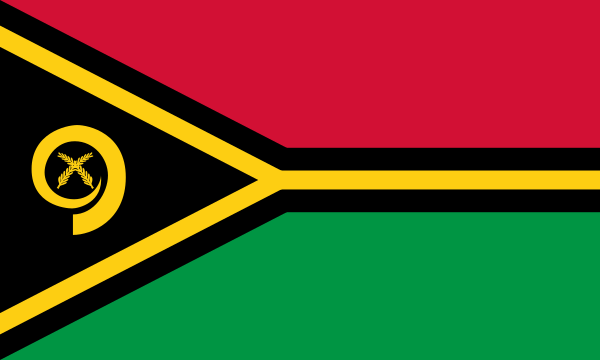
Formal name: Republic of Vanuatu.
Top stats
The strongest source-backed stats before the deeper data table.
Education Spending (% GDP)
7.6% of GDPGovernment education spending as a share of GDP, from World Bank Open Data.
Suicide Rate
15.73 per 100kSuicide mortality rate per 100,000 people, from World Bank Open Data.
Dependency Ratio
74.25% of working-age pop.Dependents as a share of the working-age population, from World Bank Open Data.
Inflation Rate
11.2%How much prices increased over the year, based on the cost of everyday goods and services.
Coastline Length
2.5K kmTotal coastline length from CIA World Factbook.
Reality checks
The stats that tend to surprise players in real rounds.
Only ranks #215 in irrigated land
Irrigated land area from CIA World Factbook.
Only ranks #239 in land border length
Total length of land borders with neighboring countries from the frozen public-domain CIA World Factbook snapshot.
Only ranks #187 in women in parliament (%)
The percentage of parliament seats held by women.
Only ranks #218 in urban population (%)
The percentage of people living in cities and urban areas.
Only ranks #197 in gdp (nominal)
The country's total economic output in current US dollars.
Compared with the region
Country vs continent vs world averages
GDP per person, adjusted for purchasing power parity (PPP) so costs of living are comparable across countries.
How many years a newborn can expect to live, based on current mortality rates.
Composite 0-1 index of life expectancy, education, and income, from Our World in Data using the latest available country values in TerraBrawl.
The percentage of people who have used the internet in the last 3 months.
Think you can guess which countries rank higher?
Play this countryFactbook notes
Country briefing
Austronesian speakers from the Solomon Islands first settled Vanuatu around 2000 B.C.
Austronesian speakers from the Solomon Islands first settled Vanuatu around 2000 B.C. By around 1000, localized chieftain systems began to develop on the islands. Around 1600, Melanesian Chief ROI MATA united some of the islands of modern-day Vanuatu under his rule. In 1606, a Portuguese explorer was the first European to see Vanuatu's Banks Islands and Espiritu Santo, setting up a short-lived settlement on the latter. The next European explorers arrived in the 1760s, and the islands -- then known as the New Hebrides -- were frequented by whalers in the 1800s. European interest in harvesting the islands’ sandalwood trees caused conflict with the inhabitants. In the 1860s, European planters in Australia, Fiji, New Caledonia, and Samoa needed labor and kidnapped almost half the adult males on the islands to work as indentured servants.
With growing and overlapping interests in the islands, France and the UK agreed that the New Hebrides would be neutral in 1878 and established a joint naval commission in 1887. In 1906, the two countries created the UK-France condominium to jointly administer the islands, with separate laws, police forces, currencies, and education and health systems. The condominium arrangement was dysfunctional, and the UK used France’s initial defeat in World War II to assert greater control over the islands. During the war, the US stationed up to 50,000 soldiers in Vanuatu. In 1945, they withdrew and sold their equipment, leading to the rise of political and religious movements known as "cargo cults," such as the John Frum movement.
The UK-France condominium was reestablished after World War II. The UK was interested in moving the condominium toward independence in the 1960s, but France was hesitant. Political parties agitating for independence began to form, largely divided along linguistic lines. France eventually relented, and elections were held in 1974, with independence granted to the newly named Vanuatu in 1980 under English-speaking Prime Minister Walter LINI. The Nagriamel Movement, with support from French-speaking landowners, then declared the island of Espiritu Santo independent from Vanuatu, but the short-lived state was dissolved 12 weeks later. Linguistic divisions have lessened over time, but highly fractious political parties have led to weak coalition governments that require support from both Anglophone and Francophone parties. Since 2008, prime ministers have been ousted more than a dozen times through no-confidence motions or temporary procedural issues.
Data vault
Every tracked stat, grouped for fast scanning.
Keep exploring
Open the head-to-head pages people naturally search after reading this profile.
Jump straight to the rankings where this country has its strongest edge.
Turn Vanuatu's strongest number into a challenge card.
How many years a newborn can expect to live, based on current mortality rates.
Vanuatu has a population of 318.0K, ranking #177 globally by population.
Vanuatu is located in Oceania. It has an area of 12,189 km².
Life expectancy in Vanuatu is 71.5 years, ranking #141 globally.
Vanuatu's GDP per capita (PPP) is $3,605.61, ranking #175 globally.
Vanuatu ranks particularly high in Life Expectancy (#141), Life Expectancy (#159), Land Area (#158).
Vanuatu has an HDI of 0.621, ranking #146 globally. The HDI combines life expectancy, education, and income indicators.
Vanuatu has a population density of 26.3 people per km², ranking #178 globally.