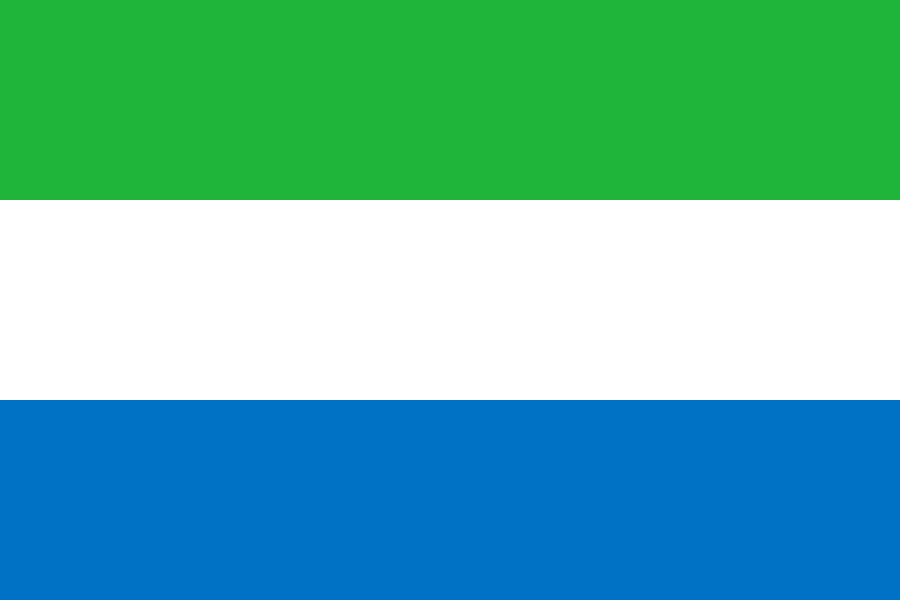
Identity
Name origin: Portuguese explorer Pedro de SINTRA is usually credited with naming the country "Serra da Leao" (Lion Mountains) in 1462, but Venetian explorer Alvise CA' D…
CIA 2026
Loading TerraBrawl
Data as of May 28, 2026
Sierra Leone defies simple categorization. Test your assumptions about Sierra Leone.
Sierra Leone defies simple categorization. #25 in renewable energy but near the bottom in life expectancy. Test your assumptions about Sierra Leone.
Area
72K km²
Pop.
9.33M
Stats
112
Sierra Leone is a country in Africa with a population of 9.33M and an area of 71,740 km². Life expectancy is 61.8 years.
Short factual summary generated from the same country data used in game rounds.
Core numbers
Fast scan first, deep dive later.
Population Density
117.21 /km²How many people live in each square kilometer of land.
Land Area
72.2K km²Total land area in square kilometers, excluding lakes, rivers, and territorial waters.
GDP Per Capita
$3,092.83GDP per person adjusted for purchasing power in constant 2017 international dollars, from Our World in Data using the latest available country values in TerraBrawl.
GDP Per Capita (PPP)
$3,522.31GDP per person, adjusted for purchasing power parity (PPP) so costs of living are comparable across countries.
CO2 Per Capita
0.17 t/person/yrAnnual carbon dioxide emissions in tonnes per person, from Our World in Data using the latest available country values in TerraBrawl.
Country briefing
A quick real-world briefing before you dive deeper into rankings, surprises, and matchups.
Identity
Name origin: Portuguese explorer Pedro de SINTRA is usually credited with naming the country "Serra da Leao" (Lion Mountains) in 1462, but Venetian explorer Alvise CA' D…
Geography
Size snapshot: slightly smaller than South Carolina.
Culture
Major languages include English (official, regular use limited to literate minority), Mende (principal vernacular in the south), Temne (principal vernacular in the north…
Cities
Browse this country's cities before City Detective asks you to guess.
Top stats
The strongest source-backed stats before the deeper data table.
Child Mortality
94.3 per 1k birthsDeaths before age 5 per 1,000 live births, from World Bank Open Data.
Infant Mortality
56.2 per 1k birthsInfant deaths before age 1 per 1,000 live births, from World Bank Open Data.
Inflation Rate
28.6%How much prices increased over the year, based on the cost of everyday goods and services.
Teen Birth Rate
93.59 per 1kThe number of births per 1,000 women aged 15-19.
Renewable Energy (%)
71.6%The percentage of energy consumption that comes from renewable sources like solar, wind, and hydro.
Reality checks
The stats that tend to surprise players in real rounds.
Only ranks #185 in human development index
Composite 0-1 index of life expectancy, education, and income, from Our World in Data using the latest available country values in TerraBrawl.
Only ranks #204 in electricity access (%)
The percentage of the population with access to electricity.
Only ranks #225 in life expectancy
Average number of years a newborn would be expected to live if current mortality patterns stayed the same, from Our World in Data.
Only ranks #217 in internet users (%)
The percentage of people who have used the internet in the last 3 months.
Only ranks #148 in military spending
Military expenditure as a share of GDP, from World Bank Open Data.
Compared with the region
Country vs continent vs world averages
GDP per person, adjusted for purchasing power parity (PPP) so costs of living are comparable across countries.
How many years a newborn can expect to live, based on current mortality rates.
Composite 0-1 index of life expectancy, education, and income, from Our World in Data using the latest available country values in TerraBrawl.
The percentage of people who have used the internet in the last 3 months.
Think you can guess which countries rank higher?
Play this countryFactbook notes
Country briefing
Continuously populated for at least 2,500 years, the area now known as Sierra Leone is covered with dense jungle that allowed the region to remain relatively protected from invading West African empires.
Continuously populated for at least 2,500 years, the area now known as Sierra Leone is covered with dense jungle that allowed the region to remain relatively protected from invading West African empires. Traders introduced Sierra Leone to Islam, which occupies a central role in Sierra Leonean culture and history. In the 17th century, the British set up a trading post near present-day Freetown. The trade originally involved timber and ivory but later expanded to enslaved people. In 1787, after the American Revolution, Sierra Leone became a destination for Black British loyalists from the new United States. When Britain abolished the slave trade in 1807, British ships delivered thousands of liberated Africans to Sierra Leone. During the 19th century, the colony gradually expanded inland.
In 1961, Sierra Leone became independent of the UK. Sierra Leone held free and fair elections in 1962 and 1967, but Siaka STEVENS -- Sierra Leone’s second prime minister -- quickly reverted to authoritarian tendencies, outlawing most political parties and ruling from 1967 to 1985. In 1991, Sierra Leonean soldiers launched a civil war against STEVENS’ ruling party. The war caused tens of thousands of deaths and displaced more than 2 million people (about one third of the population). In 1998, a Nigerian-led West African coalition military force intervened, installing Tejan KABBAH -- who was originally elected in 1996 -- as prime minister. In 2002, KABBAH officially announced the end of the war. Since 1998, Sierra Leone has conducted democratic elections dominated by the two main political parties, the Sierra Leone People’s Party (SLPP) and the All People’s Congress (APC) party. In 2018, Julius Maada BIO of the Sierra Leone People’s Party won the presidential election that saw a high voter turnout despite some allegations of voter intimidation. BIO won again in June 2023, although irregularities were noted that called into question the integrity of the results. In October 2023, the Government of Sierra Leone and the main opposition party, the All People’s Congress, signed the Agreement for National Unity to boost cooperation between political parties and begin the process of reforming the country’s electoral system.
Data vault
Every tracked stat, grouped for fast scanning.
Keep exploring
Open the head-to-head pages people naturally search after reading this profile.
Jump straight to the rankings where this country has its strongest edge.
Turn Sierra Leone's strongest number into a challenge card.
How many people live in each square kilometer of land.
Sierra Leone has a population of 9.33M, ranking #99 globally by population.
Sierra Leone is located in Africa. It has an area of 71,740 km².
Life expectancy in Sierra Leone is 61.8 years, ranking #204 globally.
Sierra Leone's GDP per capita (PPP) is $3,522.31, ranking #176 globally.
Sierra Leone ranks particularly high in Population Density (#90), Population (#99), Land Area (#117).
Sierra Leone has an HDI of 0.467, ranking #185 globally. The HDI combines life expectancy, education, and income indicators.
Sierra Leone has a population density of 117.2 people per km², ranking #90 globally.