Identity
Name origin: the Fijians called their home Viti, but the neighboring Tongans called it Fisi.
CIA 2026
Loading TerraBrawl
Data as of May 28, 2026
Fiji tops Oceania for university enrollment. How does it compare to its neighbors?
Fiji tops Oceania for university enrollment. Neighbors look to it as a regional benchmark. How does it compare to its neighbors?
Area
18K km²
Pop.
951.6K
Stats
115
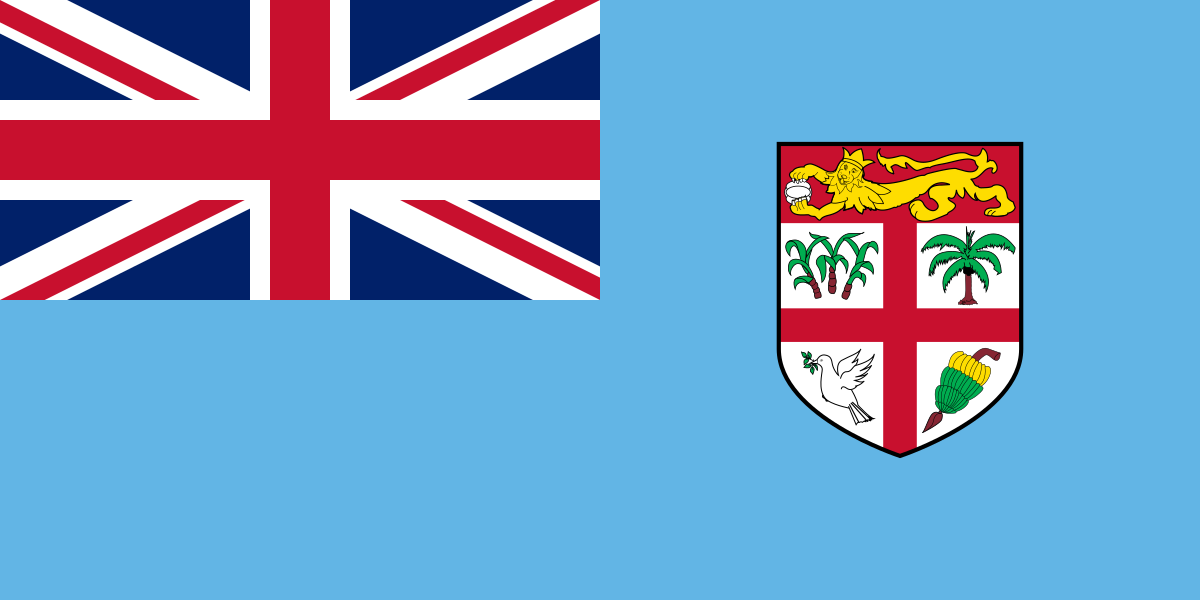
Fiji is a country in Oceania with a population of 951.6K and an area of 18,272 km². Life expectancy is 67.3 years.
Short factual summary generated from the same country data used in game rounds.
Core numbers
Fast scan first, deep dive later.
University Enrollment Rate
75.01%Total university and college enrollment as a percentage of the typical college-age population.
Internet Users (%)
79%The percentage of people who have used the internet in the last 3 months.
GDP Per Capita
$14,104.44GDP per person adjusted for purchasing power in constant 2017 international dollars, from Our World in Data using the latest available country values in TerraBrawl.
Human Development Index
0.73Composite 0-1 index of life expectancy, education, and income, from Our World in Data using the latest available country values in TerraBrawl.
GDP Per Capita (PPP)
$15,450.3GDP per person, adjusted for purchasing power parity (PPP) so costs of living are comparable across countries.
CO2 Per Capita
1.6 t/person/yrAnnual carbon dioxide emissions in tonnes per person, from Our World in Data using the latest available country values in TerraBrawl.
Country briefing
A quick real-world briefing before you dive deeper into rankings, surprises, and matchups.
Identity
Name origin: the Fijians called their home Viti, but the neighboring Tongans called it Fisi.
Geography
Size snapshot: slightly smaller than New Jersey.
Culture
Major languages include English (official), iTaukei (official), Fiji Hindi (official).
Cities
Browse this country's cities before City Detective asks you to guess.
Top stats
The strongest source-backed stats before the deeper data table.
Mobile Subscriptions (%)
574 per 100 peopleMobile cellular subscriptions per 100 people, from World Bank Open Data.
Forest Coverage (%)
63.5%The percentage of land covered by forests - natural or planted trees at least 5 meters tall (excludes orchards and urban parks).
Obesity Rate
33.84%Share of adults with obesity, from Our World in Data using the latest available country values in TerraBrawl.
Reality checks
The stats that tend to surprise players in real rounds.
Only ranks #172 in women in parliament (%)
The percentage of parliament seats held by women.
Only ranks #189 in protected land (%)
The percentage of land area designated as protected natural reserves or parks.
Only ranks #169 in health spending (% gdp)
Current health expenditure as a share of GDP, from World Bank Open Data.
Only ranks #186 in broadband access (%)
Fixed broadband subscriptions per 100 people, from World Bank Open Data.
Only ranks #148 in armed forces personnel
Total armed forces personnel from the World Bank latest available country value.
Compared with the region
Country vs continent vs world averages
GDP per person, adjusted for purchasing power parity (PPP) so costs of living are comparable across countries.
How many years a newborn can expect to live, based on current mortality rates.
Composite 0-1 index of life expectancy, education, and income, from Our World in Data using the latest available country values in TerraBrawl.
The percentage of people who have used the internet in the last 3 months.
Think you can guess which countries rank higher?
Play this countryFactbook notes
Country briefing
Austronesians settled Fiji around 1000 B.C., followed by successive waves of Melanesians starting around the first century A.D.
Austronesians settled Fiji around 1000 B.C., followed by successive waves of Melanesians starting around the first century A.D. Fijians traded with Polynesian groups in Samoa and Tonga, and by about 900, much of Fiji was in the Tu’i Tongan Empire’s sphere of influence. The Tongan influence declined significantly by 1200, while Melanesian seafarers continued to periodically arrive in Fiji, further mixing Melanesian and Polynesian cultural traditions. The first European spotted Fiji in 1643 and by the 1800s, European merchants, missionaries, traders, and whalers frequented the islands. Rival kings and chiefs competed for power, at times aided by Europeans, and in 1865, Seru Epenisa CAKOBAU united many groups into the Confederacy of Independent Kingdoms of Viti. The arrangement proved weak, however, and in 1871 CAKOBAU formed the Kingdom of Fiji in an attempt to centralize power. Fearing a hostile takeover by a foreign power as the kingdom’s economy began to falter, CAKOBAU ceded Fiji to the UK in 1874.
The first British governor set up a plantation-style economy and brought in more than 60,000 Indians as indentured laborers, most of whom chose to stay in Fiji rather than return to India when their contracts expired. In the early 1900s, society was divided along ethnic lines, with iTaukei (indigenous Fijians), Europeans, and Indo-Fijians living in separate areas and maintaining their own languages and traditions. ITaukei fears of an Indo-Fijian takeover of government delayed independence through the 1960s; Fiji achieved independence in 1970 with agreements to allocate parliamentary seats by ethnic groups. After two coups in 1987, a new constitution in 1990 cemented iTaukei control of politics, leading thousands of Indo-Fijians to leave. A reformed constitution in 1997 was more equitable and led to the election of an Indo-Fijian prime minister in 1999, who was ousted in a coup the following year. In 2005, the new prime minister put forward a bill that would grant pardons to the coup perpetrators, leading Josaia Voreqe "Frank" BAINIMARAMA to launch a coup in 2006. BAINIMARAMA appointed himself prime minister in 2007 and retained the position after elections in 2014 and 2018 that international observers deemed credible. BAINIMARAMA's party lost control of the prime minister position after elections in 2022 with former opposition leader Sitiveni Ligamamada RABUKA winning the office by a narrow margin.
Data vault
Every tracked stat, grouped for fast scanning.
Keep exploring
Open the head-to-head pages people naturally search after reading this profile.
Jump straight to the rankings where this country has its strongest edge.
Turn Fiji's strongest number into a challenge card.
Total university and college enrollment as a percentage of the typical college-age population.
Fiji has a population of 951.6K, ranking #161 globally by population.
Fiji is located in Oceania. It has an area of 18,272 km².
Life expectancy in Fiji is 67.3 years, ranking #169 globally.
Fiji's GDP per capita (PPP) is $15,450.3, ranking #118 globally.
Fiji ranks particularly high in University Enrollment Rate (#43), Internet Users (%) (#123), GDP Per Capita (#115).
Fiji has an HDI of 0.731, ranking #112 globally. The HDI combines life expectancy, education, and income indicators.
Fiji has a population density of 50.6 people per km², ranking #151 globally.