Identity
Name origin: named after British Captain John MARSHALL, who charted many of the islands in 1788.
CIA 2026
Loading TerraBrawl
Data as of May 28, 2026
Marshall Islands excels and struggles in equal measure. See what other surprises Marshall Islands holds.
Marshall Islands excels and struggles in equal measure. It leads on education spending (#9) while trailing on life expectancy. See what other surprises Marshall Islands holds.
Area
181 km²
Pop.
82.0K
Stats
76
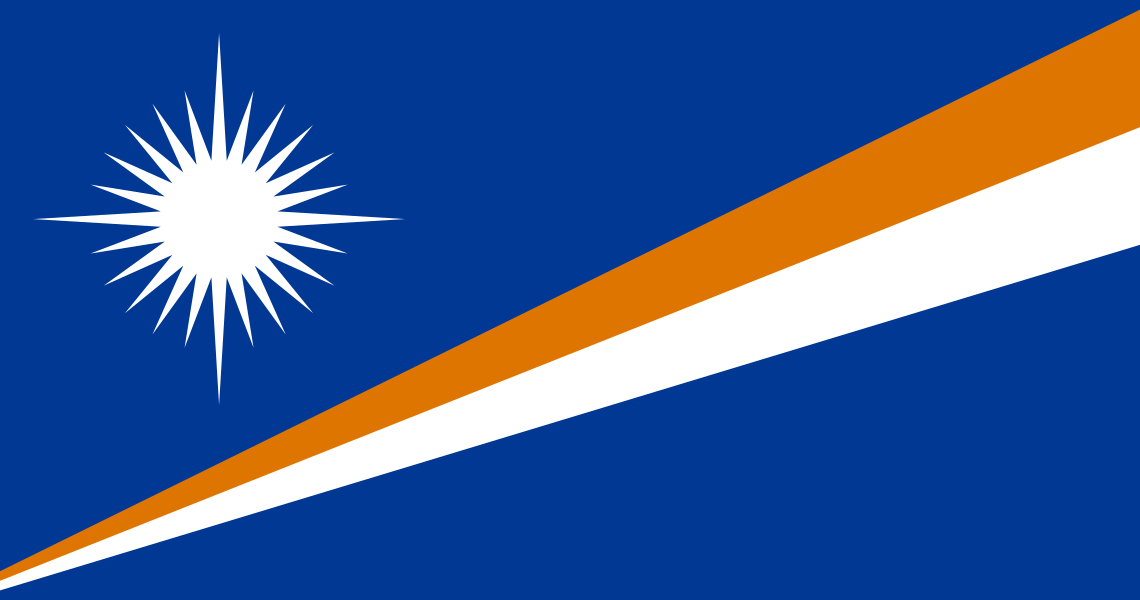
Marshall Islands is a country in Oceania with a population of 82.0K and an area of 181 km². Life expectancy is 66.9 years.
Short factual summary generated from the same country data used in game rounds.
Core numbers
Fast scan first, deep dive later.
Population Density
215.71 /km²How many people live in each square kilometer of land.
CO2 Per Capita
4.1 t/person/yrAnnual carbon dioxide emissions in tonnes per person, from Our World in Data using the latest available country values in TerraBrawl.
Human Development Index
0.73Composite 0-1 index of life expectancy, education, and income, from Our World in Data using the latest available country values in TerraBrawl.
University Enrollment Rate
37.69%Total university and college enrollment as a percentage of the typical college-age population.
Internet Users (%)
66%The percentage of people who have used the internet in the last 3 months.
GDP Per Capita
$7,212.33GDP per person adjusted for purchasing power in constant 2017 international dollars, from Our World in Data using the latest available country values in TerraBrawl.
Country briefing
A quick real-world briefing before you dive deeper into rankings, surprises, and matchups.
Identity
Name origin: named after British Captain John MARSHALL, who charted many of the islands in 1788.
Geography
Size snapshot: about the size of Washington, D.C.
Culture
Major languages include Marshallese (official) 98.2%, other languages 1.8% (1999).
Top stats
The strongest source-backed stats before the deeper data table.
Merchant Fleet Size
4.2KNumber of merchant marine ships from the frozen public-domain CIA World Factbook snapshot.
Education Spending (% GDP)
7.7% of GDPGovernment education spending as a share of GDP, from World Bank Open Data.
Obesity Rate
47.29%Share of adults with obesity, from Our World in Data using the latest available country values in TerraBrawl.
Forest Coverage (%)
52.22%The percentage of land covered by forests - natural or planted trees at least 5 meters tall (excludes orchards and urban parks).
Reality checks
The stats that tend to surprise players in real rounds.
Only ranks #206 in gdp (nominal)
The country's total economic output in current US dollars.
Keeps total co2 emissions unusually low
Total carbon dioxide emissions excluding LULUCF from the World Bank latest available country value.
Only ranks #216 in mobile subscriptions (%)
Mobile cellular subscriptions per 100 people, from World Bank Open Data.
Only ranks #230 in highest elevation
Highest point elevation from CIA World Factbook.
Only ranks #148 in air passengers
Total passengers carried by airlines registered in that country, regardless of where flights originated or ended.
Compared with the region
Country vs continent vs world averages
GDP per person, adjusted for purchasing power parity (PPP) so costs of living are comparable across countries.
How many years a newborn can expect to live, based on current mortality rates.
Composite 0-1 index of life expectancy, education, and income, from Our World in Data using the latest available country values in TerraBrawl.
The percentage of people who have used the internet in the last 3 months.
Think you can guess which countries rank higher?
Play this countryFactbook notes
Country briefing
Humans arrived in the Marshall Islands in the first millennium B.C.
Humans arrived in the Marshall Islands in the first millennium B.C. and gradually created permanent settlements on the various atolls. The early inhabitants were skilled navigators who frequently traveled between atolls using stick charts to map the islands. Society became organized under two paramount chiefs, one each for the Ratak (Sunrise) Chain and the Ralik (Sunset) Chain. Spain formally claimed the islands in 1592. Germany established a supply station on Jaluit Atoll and bought the islands from Spain in 1884, although paramount chiefs continued to rule.
Japan seized the Marshall Islands in 1914 and was granted a League of Nations Mandate to administer the islands in 1920. The US captured the islands in heavy fighting during World War II, and the islands came under US administration as part of the Trust Territory of the Pacific Islands (TTPI) in 1947. Between 1946 and 1958, the US resettled populations from Bikini and Enewetak Atolls and conducted 67 nuclear tests; people from Ailinginae, Rongelap, and Utrik Atolls were also evacuated because of nuclear fallout, and Bikini and Rongelap remain largely uninhabited. In 1979, the Marshall Islands drafted a constitution separate from the rest of the TTPI and declared independence under President Amata KABUA, a paramount chief. In 2000, Kessai NOTE became the first commoner elected president. In 2016, Hilda HEINE was the first woman elected president.
Data vault
Every tracked stat, grouped for fast scanning.
Keep exploring
Open the head-to-head pages people naturally search after reading this profile.
Jump straight to the rankings where this country has its strongest edge.
Turn Marshall Islands's strongest number into a challenge card.
How many people live in each square kilometer of land.
Marshall Islands has a population of 82.0K, ranking #198 globally by population.
Marshall Islands is located in Oceania. It has an area of 181 km².
Life expectancy in Marshall Islands is 66.9 years, ranking #174 globally.
Marshall Islands's GDP per capita (PPP) is $8,194.64, ranking #143 globally.
Marshall Islands ranks particularly high in Population Density (#63), CO2 Per Capita (#84), Human Development Index (#110).
Marshall Islands has an HDI of 0.733, ranking #110 globally. The HDI combines life expectancy, education, and income indicators.
Marshall Islands has a population density of 215.7 people per km², ranking #63 globally.