Geography
Natural resources include small deposits of gold, copper, molybdenum, zinc, and more.
CIA 2026
Loading TerraBrawl
Data as of May 28, 2026
Strong in one area, surprising in another — that's Armenia. How well do you know Armenia's stats?
Strong in one area, surprising in another — that's Armenia. It ranks #24 in high-tech exports, yet surprisingly lags in education spending. How well do you know Armenia's stats?
Area
30K km²
Pop.
2.96M
Stats
129
Armenia is a country in Europe with a population of 2.96M and an area of 29,743 km². Life expectancy is 77.5 years.
Short factual summary generated from the same country data used in game rounds.
Core numbers
Fast scan first, deep dive later.
Human Development Index
0.81Composite 0-1 index of life expectancy, education, and income, from Our World in Data using the latest available country values in TerraBrawl.
Life Expectancy
77.5 yearsHow many years a newborn can expect to live, based on current mortality rates.
GDP Per Capita
$20,078.78GDP per person adjusted for purchasing power in constant 2017 international dollars, from Our World in Data using the latest available country values in TerraBrawl.
GDP Per Capita (PPP)
$22,823.18GDP per person, adjusted for purchasing power parity (PPP) so costs of living are comparable across countries.
Population Density
105.12 /km²How many people live in each square kilometer of land.
Country briefing
A quick real-world briefing before you dive deeper into rankings, surprises, and matchups.
Geography
Natural resources include small deposits of gold, copper, molybdenum, zinc, and more.
Culture
Major languages include Armenian 97.2%, Russian 1.4%, Ezidian 1.0%; less than 1%: other, unknown (2022).
Identity
Formal name: Republic of Armenia.
Cities
Browse this country's cities before City Detective asks you to guess.
Top stats
The strongest source-backed stats before the deeper data table.
Electricity Access (%)
100%The percentage of the population with access to electricity.
Lowest Elevation
400 mLowest point elevation from CIA World Factbook.
Military Spending
5.5% of GDPMilitary expenditure as a share of GDP, from World Bank Open Data.
Unemployment Rate
13.33%The percentage of the workforce that is unemployed but actively looking for work.
Health Spending (% GDP)
10.0% of GDPCurrent health expenditure as a share of GDP, from World Bank Open Data.
Reality checks
The stats that tend to surprise players in real rounds.
Keeps inflation rate unusually low
How much prices increased over the year, based on the cost of everyday goods and services.
Ranks #18 globally in protected land (%)
The percentage of land area designated as protected natural reserves or parks.
Keeps suicide rate unusually low
Suicide mortality rate per 100,000 people, from World Bank Open Data.
Keeps inequality (gini) unusually low
A measure of income inequality where 0 means everyone earns the same and 100 means one person has everything.
Has one of the highest youth unemployment rate figures
Share of the labor force ages 15-24 that is unemployed from the World Bank latest available country value.
Compared with the region
Country vs continent vs world averages
GDP per person, adjusted for purchasing power parity (PPP) so costs of living are comparable across countries.
How many years a newborn can expect to live, based on current mortality rates.
Composite 0-1 index of life expectancy, education, and income, from Our World in Data using the latest available country values in TerraBrawl.
The percentage of people who have used the internet in the last 3 months.
Think you can guess which countries rank higher?
Play this countryFactbook notes
Country briefing
Armenia prides itself on being the first state to formally adopt Christianity (early 4th century).
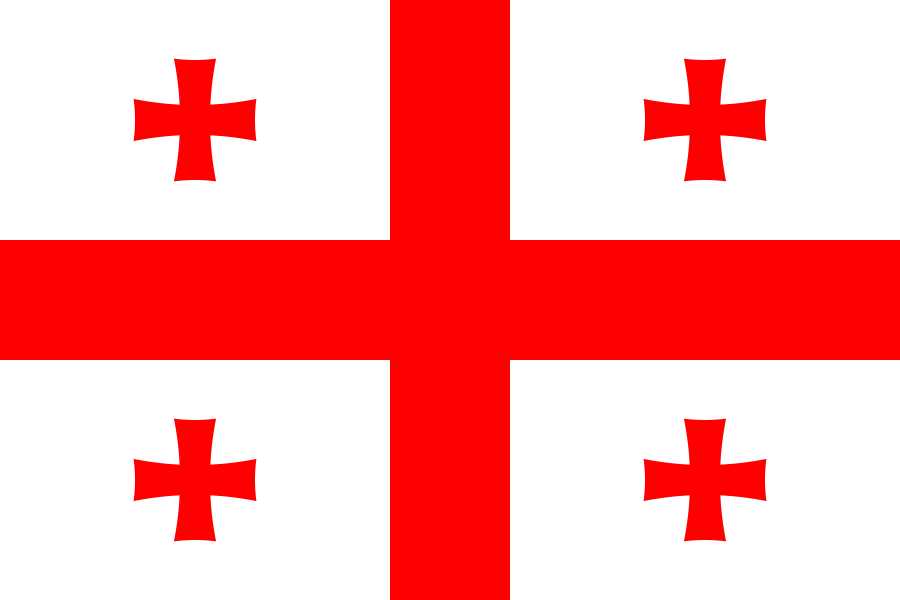
Armenia prides itself on being the first state to formally adopt Christianity (early 4th century). Armenia has existed as a political entity for centuries, but for much of its history it was under the sway of various empires, including the Roman, Byzantine, Arab, Persian, Ottoman, and Russian. During World War I, the Ottoman Empire instituted a policy of forced resettlement that, coupled with other harsh practices targeting its Armenian subjects, resulted in at least 1 million deaths; these actions have been widely recognized as constituting genocide. During the early 19th century, significant Armenian populations fell under Russian rule. Armenia declared its independence in 1918 in the wake of the Bolshevik Revolution in Russia, but it was conquered by the Soviet Red Army in 1920. Armenia, along with Azerbaijan and Georgia, was initially incorporated into the USSR as part of the Transcaucasian Federated Soviet Socialist Republic; in 1936, the republic was separated into its three constituent entities, which were maintained until the dissolution of the Soviet Union in 1991.
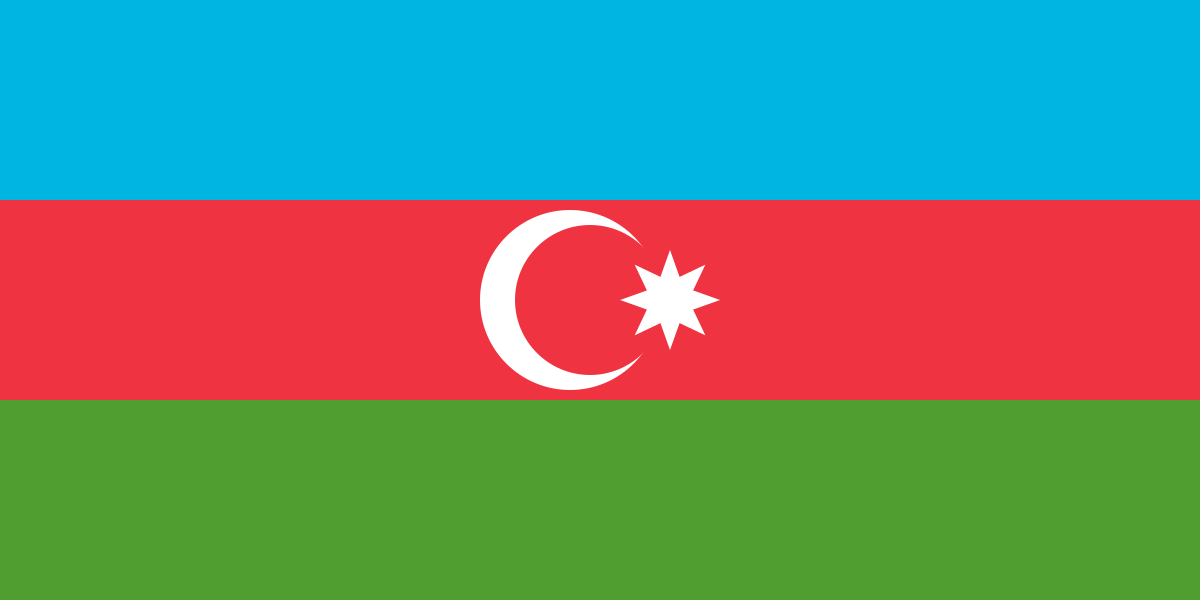
For over three decades, Armenia had a longstanding conflict with neighboring Azerbaijan about the status of the Nagorno-Karabakh region, which historically had a mixed Armenian and Azerbaijani population, although ethnic Armenians have constituted the majority since the late 19th century. In 1921, Moscow placed Nagorno-Karabakh within Soviet Azerbaijan as an autonomous oblast. In the late Soviet period, a separatist movement developed that sought to end Azerbaijani control over the region. Fighting over Nagorno-Karabakh began in 1988 and escalated after Armenia and Azerbaijan declared independence from the Soviet Union in 1991. By the time a cease-fire took effect in 1994, separatists with Armenian support controlled Nagorno‑Karabakh and seven surrounding Azerbaijani territories. Armenia and Azerbaijan engaged in a second military conflict over Nagorno-Karabakh in 2020; Armenia lost control over much of the territory it had previously captured, returning the southern part of Nagorno-Karabakh and the territories around it to Azerbaijan. In September 2023, Azerbaijan took military action to regain control over Nagorno-Karabakh; after an armed conflict that lasted only one day, nearly the entire ethnic Armenian population of Nagorno-Karabakh fled to Armenia.
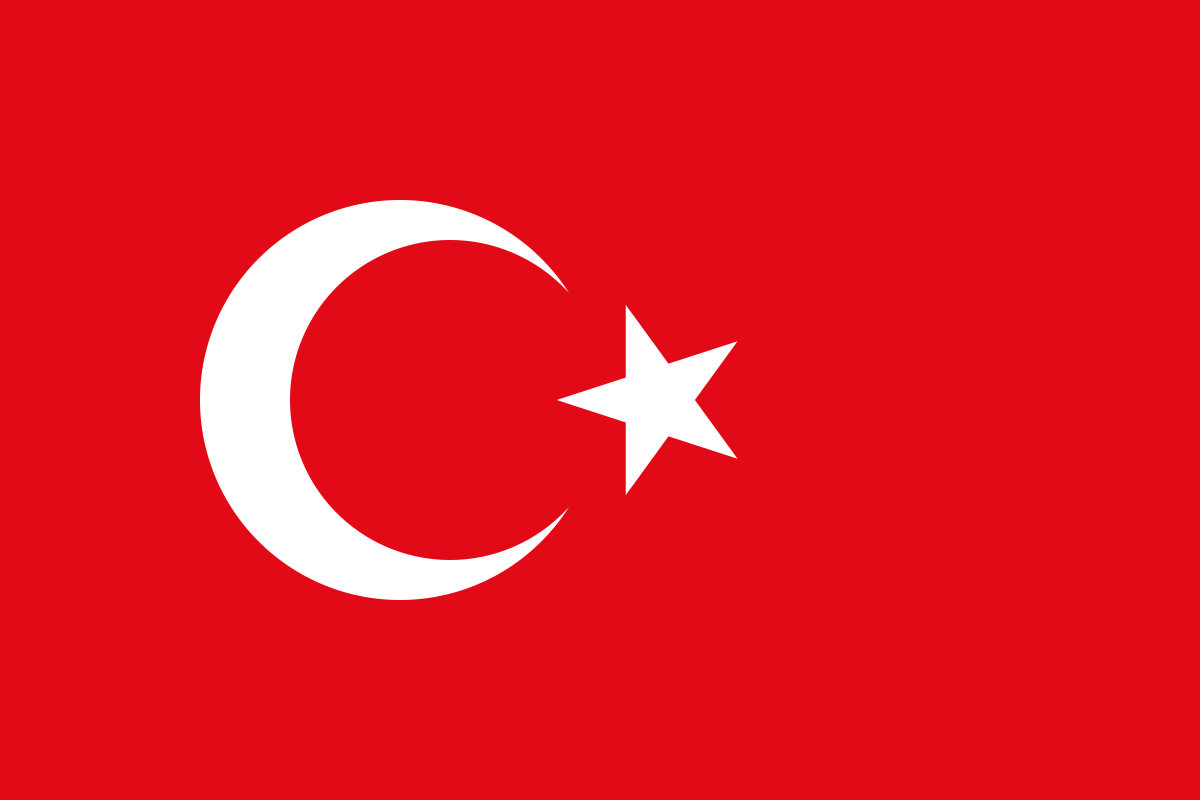
Turkey closed its border with Armenia in 1993 in support of Azerbaijan during the first period of conflict with Armenia and has since maintained a closed border, leaving Armenia with closed borders both in the west (with Turkey) and east (with Azerbaijan). Armenia and Turkey engaged in intensive diplomacy to normalize relations and open the border in 2009, but the signed agreement was not ratified in either country. In 2015, Armenia joined the Eurasian Economic Union alongside Russia, Belarus, Kazakhstan, and Kyrgyzstan. In 2017, Armenia signed a Comprehensive and Enhanced Partnership Agreement (CEPA) with the EU.
In 2018, former President of Armenia (2008-18) Serzh SARGSIAN of the Republican Party of Armenia (RPA) tried to extend his time in power, prompting protests that became known as the “Velvet Revolution.” After SARGSIAN resigned, the National Assembly elected the leader of the protests, Civil Contract party chief Nikol PASHINYAN, as the new prime minister. PASHINYAN’s party has prevailed in subsequent legislative elections, most recently in 2021.
Data vault
Every tracked stat, grouped for fast scanning.
Keep exploring
Open the head-to-head pages people naturally search after reading this profile.
Jump straight to the rankings where this country has its strongest edge.
Turn Armenia's strongest number into a challenge card.
Composite 0-1 index of life expectancy, education, and income, from Our World in Data using the latest available country values in TerraBrawl.
Armenia has a population of 2.96M, ranking #138 globally by population.
Armenia is located in Europe. It has an area of 29,743 km².
Life expectancy in Armenia is 77.5 years, ranking #76 globally.
Armenia's GDP per capita (PPP) is $22,823.18, ranking #92 globally.
Armenia ranks particularly high in Human Development Index (#69), Life Expectancy (#76), GDP Per Capita (#90).
Armenia has an HDI of 0.811, ranking #69 globally. The HDI combines life expectancy, education, and income indicators.
Armenia has a population density of 105.1 people per km², ranking #100 globally.