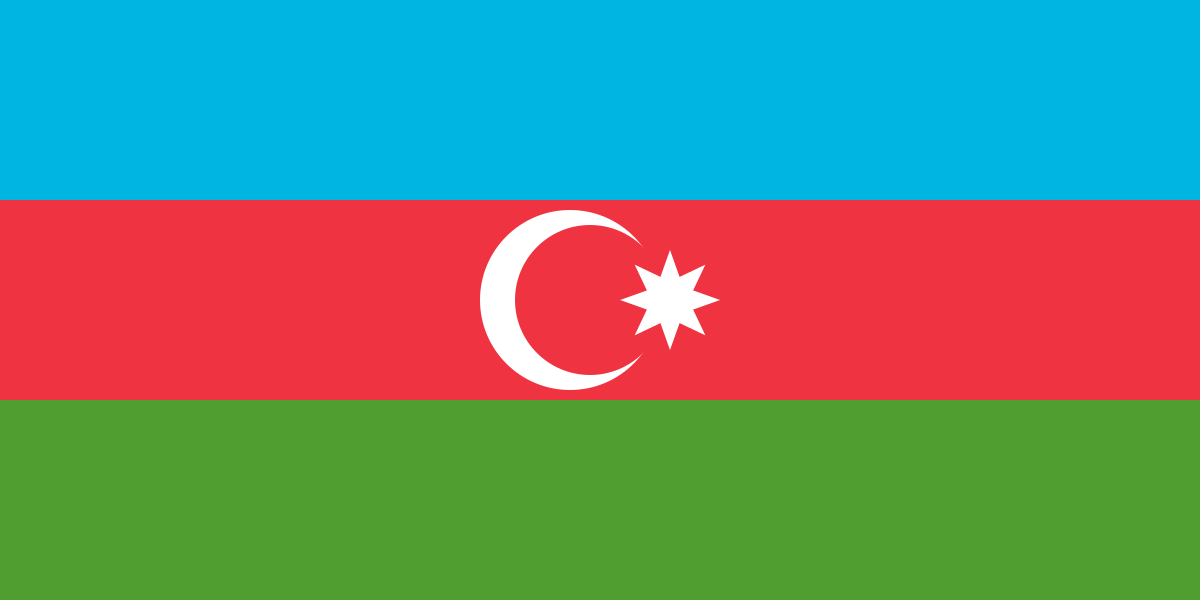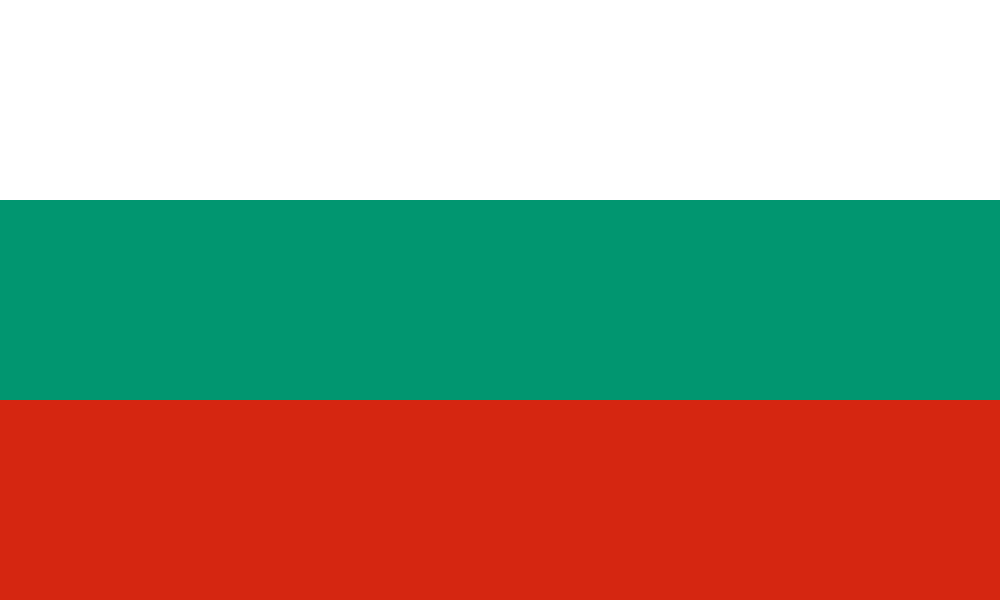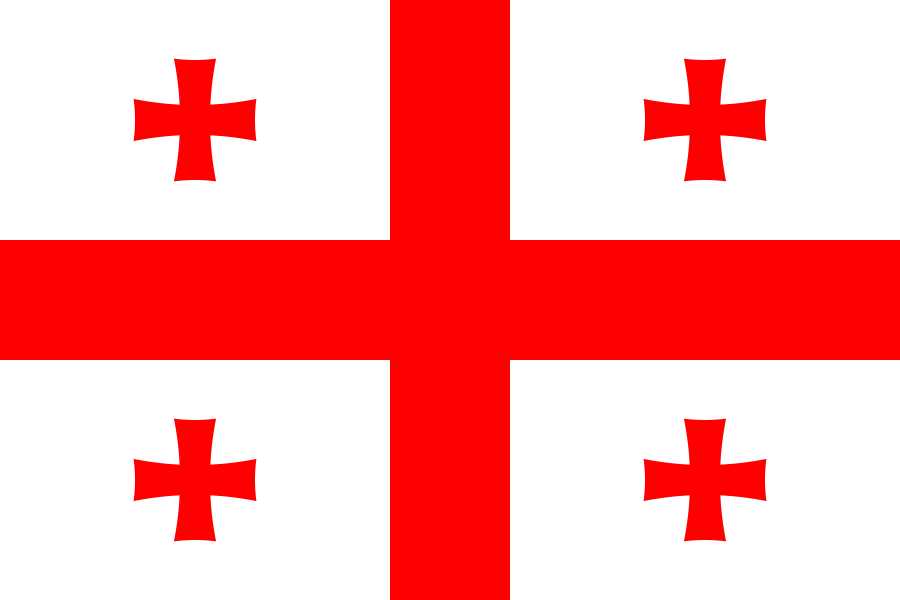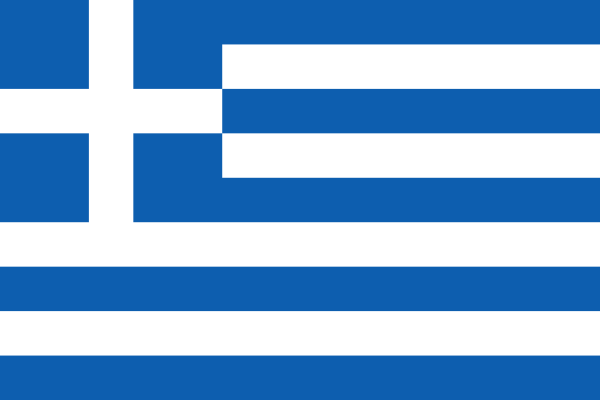
Turkey

EuropeGlobal Leader

Turkey claims the 3rd spot worldwide for university enrollment. That 127.6 figure is hard to beat. How well do you really know Turkey?

Turkey is a country in Europe with a population of 84.63M and an area of 783,562 km². Life expectancy is 77.2 years.

At a Glance

The numbers that define this country

University Enrollment Rate

127.6%
#3globally

Total university and college enrollment as a percentage of the typical college-age population.

Population

84.63M
#18globally

The total number of people living in the country.

Land Area

769.6K
#36globally

Total land area in square kilometers, excluding lakes, rivers, and territorial waters.

CO2 Per Capita

5.87
#55globally

How many tonnes of CO2 the average person produces per year.

Human Development Index

0.85
#51globally

The Human Development Index (HDI), combining life expectancy, education, and income into a single score from 0 to 1.

GDP Per Capita (PPP)

45.1K
#57globally

GDP per person, adjusted for purchasing power parity (PPP) so costs of living are comparable across countries.

Where They Stand Out

Global rankings worth knowing

🚀University Enrollment Rate

127.6%
#3globallyTop performer

Total university and college enrollment as a percentage of the typical college-age population.

🍻Air Passengers

125.94M
#5globallyTop performer

Total passengers carried by airlines registered in that country, regardless of where flights originated or ended.

💰Inflation Rate

58.5%
#8globallyTop performer

How much prices increased over the year, based on the cost of everyday goods and services.

🛡️Active Military Personnel

495.0K
#9globallyTop performer

Military and security service personnel strengths from CIA World Factbook.

🌱Irrigated Land

52.1K
#11globallyTop performer

Irrigated land area from CIA World Factbook.

Did You Know?

Facts that catch players off guard

🚀

Ranks #3 globally in university enrollment rate

University Enrollment Rate: 127.6%

Total university and college enrollment as a percentage of the typical college-age population.

World Bank 2023
💰

Only ranks #38 in employment rate (%)

Employment Rate (%): 59.2%

The percentage of adults aged 25-64 who are employed.

OECD 2024
🤝

Only ranks #35 in life satisfaction

Life Satisfaction: 5.80

How satisfied people are with their lives, rated on a scale from 0 to 10.

OECD 2024
🍻

Ranks #5 globally in air passengers

Air Passengers: 125.94M

Total passengers carried by airlines registered in that country, regardless of where flights originated or ended.

World Bank 2023
💰

Ranks #8 in inflation rate (lower is better)

Inflation Rate: 58.5%

How much prices increased over the year, based on the cost of everyday goods and services.

World Bank 2023

Surprised? See how you stack up.

Play Now

How Turkey Compares

Country vs continent vs world averages

Turkey
Europe avg
World avg

GDP per Capita

Above avg

GDP per person, adjusted for purchasing power parity (PPP) so costs of living are comparable across countries.

World Bank 2023
Turkey45.1K
Europe57.5K
World31.8K

Life Expectancy

Above avg

How many years a newborn can expect to live, based on current mortality rates.

World Bank 2023
Turkey77.2 years
Europe80.0 years
World73.7 years

Human Development Index

Above avg

The Human Development Index (HDI), combining life expectancy, education, and income into a single score from 0 to 1.

Our World in Data 2023
Turkey0.85
Europe0.89
World0.74

Internet Users

Above avg

The percentage of people who have used the internet in the last 3 months.

World Bank 2023
Turkey87.0%
Europe90.1%
World70.3%

Think you can guess which countries rank higher?

Test Your Intuition
Regional comparison for Turkey across 4 key metrics, comparing with Europe and world averages.

About Turkey

Modern Turkey was founded in 1923 from the remnants of the Ottoman Empire by reformer and national hero Mustafa KEMAL, known as Ataturk or "Father of the Turks." One-party rule ended in 1950, and periods of instability and military coups have since fractured the multiparty democracy, in 1960, 1971, 1980, 1997, and 2016.

Turkey joined the UN in 1945 and NATO in 1952. In 1963, Turkey became an associate member of the European Community; it began accession talks with the EU in 2005. Turkey intervened militarily on Cyprus in 1974 to prevent a Greek takeover of the island and has since acted as patron state to the "Turkish Republic of Northern Cyprus," which only Turkey recognizes. The Kurdistan Workers' Party (PKK), a US-designated terrorist organization, began a separatist insurgency in Turkey in 1984, and the struggle has long dominated the attention of Turkish security forces. In 2013, the Turkish Government and the PKK conducted negotiations aimed at ending the violence, but intense fighting resumed in 2015.

The Turkish Government conducted a referendum in 2017 in which voters approved constitutional amendments changing Turkey from a parliamentary to a presidential system.

🌍Geography & Climate6 facts
Location
Southeastern Europe and Southwestern Asia (that portion of Turkey west of the Bosporus is geographically part of Europe), bordering the Black Sea, between Bulgaria and Georgia, and bordering the Aegean Sea and the Mediterranean Sea, between Greece and Syria
Climate
temperate; hot, dry summers with mild, wet winters; harsher in interior
Terrain
high central plateau (Anatolia); narrow coastal plain; several mountain ranges
Natural Resources
coal, iron ore, copper, chromium, antimony, mercury, gold, barite, borate, celestite (strontium), emery, feldspar, limestone, magnesite, marble, perlite, pumice, pyrites (sulfur), clay, arable land, hydropower
Natural Hazards
severe earthquakes, especially in northern Turkey, along an arc extending from the Sea of Marmara to Lake Van; landslides; flooding volcanism: limited volcanic activity; the three historically active volcanoes (Ararat, Nemrut Dagi, and Tendurek Dagi) have not erupted since the 19th century or earlier
Size Comparison
slightly larger than Texas
👥People & Culture4 facts
Languages
Turkish (official), Kurdish, other minority languages
Religions
Muslim 99.8% (mostly Sunni), other 0.2% (mostly Christians and Jews)
Ethnic Groups
Turkish 70-75%, Kurdish 19%, other minorities 6-11% (2016 est.)
Major Cities
15.848 million Istanbul, 5.397 million ANKARA (capital), 3.088 million Izmir, 2.086 million Bursa, 1.836 million Adana, 1.805 million Gaziantep (2023)
🏛️Government & History10 facts
Government Type
presidential republic
Capital
Ankara
Capital Coordinates
39 56 N, 32 52 E
Capital Timezone
UTC+3 (8 hours ahead of Washington, DC, during Standard Time)
Official Name
Republic of Turkey
Name Origin
the name means "Land of the Turks"
Independence
29 October 1923 (republic proclaimed, succeeding the Ottoman Empire)
National Symbols
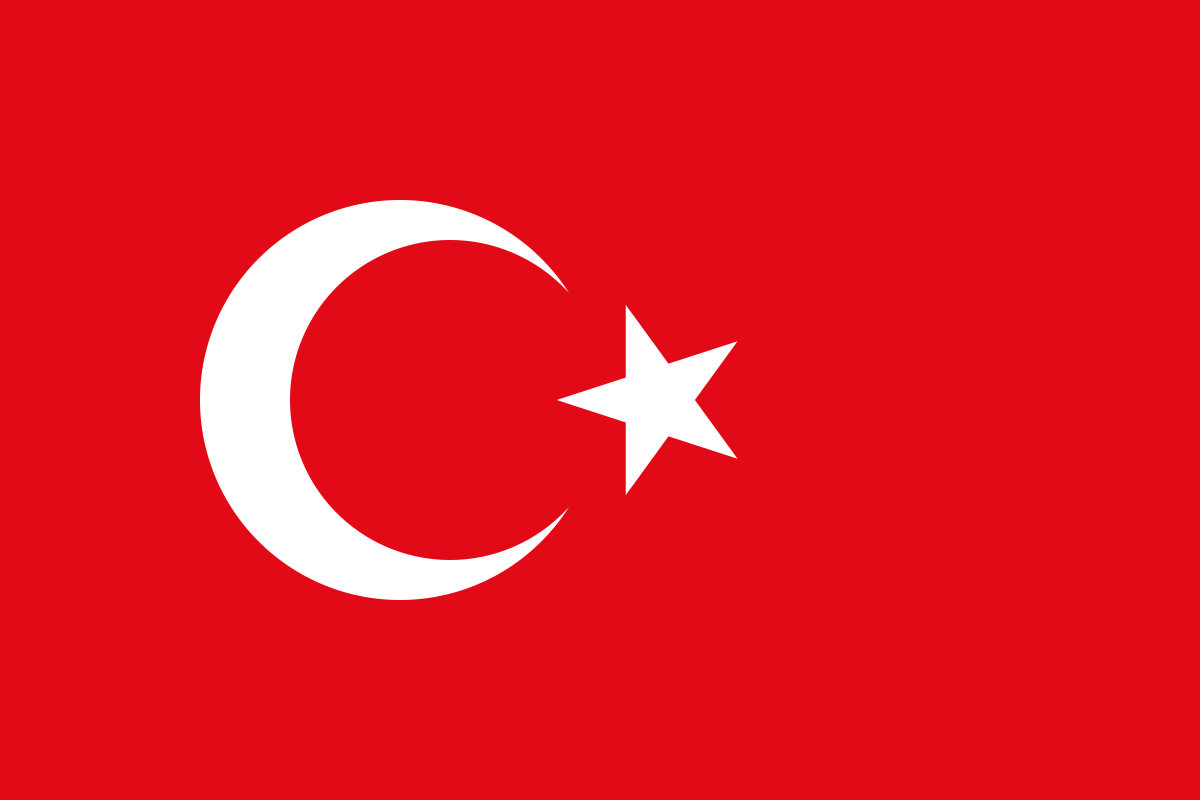
vertical crescent moon with adjacent five-pointed star
National Anthem
"Istiklal Marsi" (The March of Independence)
UNESCO Heritage
22 (20 cultural, 2 mixed)
💼Economy & Trade7 facts
Overview
upper-middle-income, diversified Middle Eastern economy; industrializing economy that maintains large agricultural base; key energy, tourism, and construction sectors; high inflation, interest rates, and foreign debt pose risk to financial stability
Industries
textiles, food processing, automobiles, electronics, mining (coal, chromate, copper, boron), steel, petroleum, construction, lumber, paper
Agricultural Products
sugar beets, wheat, milk, tomatoes, barley, maize, potatoes, apples, grapes, watermelons (2023)
Export Partners
Germany 9%, USA 6%, UK 6%, UAE 5%, Iraq 5% (2023)
Export Commodities
garments, cars, gold, refined petroleum, vehicle parts/accessories (2023)
Import Partners
China 13%, Russia 9%, Germany 9%, Switzerland 6%, USA 5% (2023)
Import Commodities
gold, refined petroleum, cars, plastics, natural gas (2023)
🔧Infrastructure & Defense5 facts
Military Forces
Turkish Armed Forces (TAF; Türk Silahlı Kuvvetleri, TSK): Turkish Land Forces (Türk Kara Kuvvetleri), Turkish Naval Forces (Türk Deniz Kuvvetleri; includes naval air and naval infantry), Turkish Air Forces (Türk Hava Kuvvetleri) Ministry of Interior: Gendarmerie General Command (aka Gendarmerie of the Turkish Republic), Turkish Coast Guard Command, General Directorate of Security (National Police) (2025)
Military Service
military service is compulsory for Turkish men 20-41 for a period of 6-12 months; men and women may volunteer (2025)
Energy Mix
fossil fuels: 57.1% of total installed capacity (2023 est.); solar: 6.7% of total installed capacity (2023 est.); wind: 10.9% of total installed capacity (2023 est.); hydroelectricity: 19.9% of total installed capacity (2023 est.); geothermal: 2.8% of total installed capacity (2023 est.); biomass and waste: 2.6% of total installed capacity (2023 est.)
Broadcast Media
Turkish Radio and Television Corporation (TRT) operates multiple TV and radio networks and stations; multiple privately owned national TV stations and 567 private regional and local TV stations; multi-channel cable TV available; 1,007 private radio stations (2019)
Space Program
has an ambitious national space program with a focus on satellites, satellite components, satellite launch capabilities, software development, ground station technologies, and building up the country's space industries; manufactures and operates remote sensing and telecommunications satellites; in recent years has initiated a satellite/space launch vehicle (SLV) program with the goal of independently placing satellites into orbit and a probe on the Moon; works with more than 25 foreign space agencies and corporations, including those of Azerbaijan, China, France, India, Japan, Kazakhstan, Pakistan, Russia, South Korea, Ukraine, and the US, as well as the ESA; has state-owned rocket and satellite development companies, including some under the Ministry of Defense; has a growing private space-industry sector, and the Turkish Government has pledged to increase the country's share of the global space market (2025)

Deep Dive

78 of 144 metrics

Every stat we track, organized by category

🚀Education & Future8 metricsBest: #3
University Enrollment Rate
127.6%#3WB
Domestic Patents
8.2K#12WB
Human Development Index
0.85#51OWID
R&D Spending (% GDP)
1.3%#33WB
Foreign Patents
242#59WB
Education Spending (% GDP)
3.1%#137WB
Leisure Time
14.609#19OECD
Life Expectancy
77.3 years#35OECD
🤝Society & Equality6 metricsBest: #3
Road Deaths
7.67#3OECD
Inequality (Gini)
44.5#11WB
Homicide Rate
1.00#15OECD
Women in Parliament (%)
19.9%#127WB
Safety at Night
59.0%#34OECD
Life Satisfaction
5.80#35OECD
🍻Lifestyle5 metricsBest: #5
Air Passengers
125.94M#5WB
Tourist Arrivals
15.97M#9WB
Beer Consumption
0.66#125OWID
Spirits Consumption
0.37#127OWID
Alcohol Consumption
1.69#144OWID
💰Wealth & Economy13 metricsBest: #8
Inflation Rate
58.5%#8WB
GDP (Nominal)
1359.12B#17WB
Long-Term Unemployment
1.7%#10OECD
Unemployment Rate
8.4%#51WB
GDP Per Capita (PPP)
45.1K#57WB
GDP Per Capita
$35.3K#63OWID
Youth Unemployment Rate
15.6%#75
GDP Growth Rate
3.3%#105WB
Gender Pay Gap (%)
10.0%#23OECD
High-Tech Exports (%)
5.1%#100WB
FDI Inflows (% GDP)
0.9%#141WB
Government Debt (% GDP)
26.6%#171WB
Employment Rate (%)
59.2%#38OECD
🌍Land & Sea5 metricsBest: #9
Border Countries Count
8.00#9
Coastline Length
7.2K#19
Highest Elevation
5.1K#24
Land Boundaries Length
2.8K#69
Lowest Elevation
0#189
🛡️Military & Defense2 metricsBest: #9
Active Military Personnel
495.0K#9
Military Spend (% GDP)
2.3%#58
🌱Environment10 metricsBest: #11
Irrigated Land
52.1K#11
Carbon Emissions (Total)
399.17M#15
Forest Area
226.9K#25WB
CO2 Per Capita
5.87#55OWID
Renewable Energy (%)
19.8%#29OWID
Air Pollution (PM2.5)
21.612#91WB
Forest Coverage (%)
29.5%#110WB
Electricity Access (%)
100.0%#117WB
Renewable Energy (%)
12.0%#135WB
Protected Land (%)
7.0%#174WB
Energy1 metricsBest: #16
Electricity Capacity
106.28M#16
👥Demographics12 metricsBest: #18
Population
84.63M#18WB
Urban Population (%)
89.3%#35WB
Land Area
769.6K#36WB
Elderly Population (%)
10.3%#92WB
Population Density
110.866#95WB
Median Age
34.4 years#106
Birth Rate
13.56#120WB
Fertility Rate
1.88#121WB
Youth Population (%)
21.4%#115WB
Death Rate
6.19#145WB
Teen Birth Rate
12.055#150WB
Dependency Ratio
46.484#170WB
🔧Infrastructure3 metricsBest: #21
Merchant Ships
1.2K#22
Railway Length
11.5K#21
Airports
116#47
❤️Health & Survival10 metricsBest: #27
Smoking Rate
30.5%#27WB
Obesity Rate
34.3%#38OWID
Life Expectancy
77.2 years#81WB
Life Expectancy
77.2 years#91OWID
Hospital Beds (per 1,000)
3.00#61WB
Doctors (per 1,000)
2.24#87WB
Child Mortality
12.8#111WB
Infant Mortality
9.10#122WB
Health Spending (% GDP)
3.7%#163WB
Suicide Rate
2.69#162WB
📡Technology3 metricsBest: #86
Internet Users (%)
87.0%#86WB
Broadband Access (%)
22#118WB
Mobile Subscriptions (%)
108#137WB

Countries with Similar GDP

Share a Fact

Share something surprising about Turkey!

Turkey
#3 in University Enrollment Rate

Total university and college enrollment as a percentage of the typical college-age population.

Top 5% globally
127.6%

Frequently Asked Questions about Turkey

What is the population of Turkey?

Turkey has a population of 84.63M, ranking #18 globally by population.

What continent is Turkey in?

Turkey is located in Europe. It has an area of 783,562 km².

What is the life expectancy in Turkey?

Life expectancy in Turkey is 77.2 years, ranking #81 globally.

What is the GDP per capita of Turkey?

Turkey's GDP per capita (PPP) is 45.1K, ranking #57 globally.

What is Turkey known for in global statistics?

Turkey ranks particularly high in University Enrollment Rate (#3), Population (#18), Land Area (#36).

What is Turkey's Human Development Index?

Turkey has an HDI of 0.853, ranking #51 globally. The HDI combines life expectancy, education, and income indicators.

How densely populated is Turkey?

Turkey has a population density of 110.9 people per km², ranking #95 globally.
Think you know Turkey?

Compare countries, guess statistics, and prove you know your stuff.