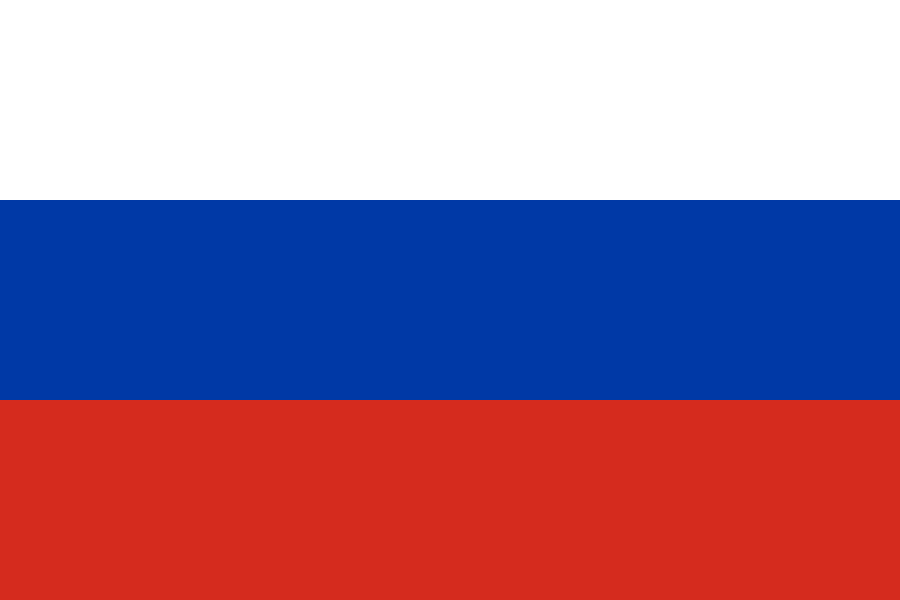
Russia

EuropeGlobal Leader

Among all countries, Russia stands 1st in land area. This achievement puts it ahead of the vast majority of countries. Can you guess its other standout statistics?

Russia is a country in Europe with a population of 140.13M and an area of 17,098,246 km². Life expectancy is 73.3 years.

At a Glance

The numbers that define this country

Land Area

16.38M
#1globally

Total land area in square kilometers, excluding lakes, rivers, and territorial waters.

Population

140.13M
#9globally

The total number of people living in the country.

CO2 Per Capita

12.295
#19globally

How many tonnes of CO2 the average person produces per year.

Internet Users (%)

94.4%
#37globally

The percentage of people who have used the internet in the last 3 months.

GDP Per Capita

$41.7K
#51globally

GDP per person, adjusted for purchasing power parity (PPP) so costs of living are comparable across countries.

GDP Per Capita (PPP)

47.4K
#55globally

GDP per person, adjusted for purchasing power parity (PPP) so costs of living are comparable across countries.

Where They Stand Out

Global rankings worth knowing

🌱Forest Area

8.15M
#1globallyTop performer

Total forest area in square kilometers, including natural and planted trees at least 5 meters tall.

👥Land Area

16.38M
#1globallyTop performer

Total land area in square kilometers, excluding lakes, rivers, and territorial waters.

🌍Land Boundaries Length

22.4K
#2globallyTop performer

Total land boundary length from CIA World Factbook.

🔧Railway Length

85.5K
#3globallyTop performer

Total railway length from CIA World Factbook.

Electricity Capacity

301.93M
#5globallyTop performer

Installed generating capacity from CIA World Factbook.

Did You Know?

Facts that catch players off guard

🌱

Ranks #1 globally in forest area

Forest Area: 8.15M

Total forest area in square kilometers, including natural and planted trees at least 5 meters tall.

World Bank 2023
👥

Ranks #1 globally in land area

Land Area: 16.38M

Total land area in square kilometers, excluding lakes, rivers, and territorial waters.

World Bank 2023
🌍

Ranks #2 globally in land boundaries length

Land Boundaries Length: 22.4K

Total land boundary length from CIA World Factbook.

🔧

Ranks #3 globally in railway length

Railway Length: 85.5K

Total railway length from CIA World Factbook.

🌍

Ranks #4 globally in coastline length

Coastline Length: 37.7K

Total coastline length from CIA World Factbook.

Surprised? See how you stack up.

Play Now

How Russia Compares

Country vs continent vs world averages

Russia
Europe avg
World avg

GDP per Capita

Above avg

GDP per person, adjusted for purchasing power parity (PPP) so costs of living are comparable across countries.

World Bank 2023
Russia47.4K
Europe57.5K
World31.8K

Life Expectancy

How many years a newborn can expect to live, based on current mortality rates.

World Bank 2023
Russia73.3 years
Europe80.0 years
World73.7 years

Human Development Index

Above avg

The Human Development Index (HDI), combining life expectancy, education, and income into a single score from 0 to 1.

Our World in Data 2023
Russia0.83
Europe0.89
World0.74

Internet Users

Above avg

The percentage of people who have used the internet in the last 3 months.

World Bank 2023
Russia94.4%
Europe90.1%
World70.3%

Think you can guess which countries rank higher?

Test Your Intuition
Regional comparison for Russia across 4 key metrics, comparing with Europe and world averages.

About Russia

Founded in the 12th century, the Principality of Muscovy emerged from over 200 years of Mongol domination (13th-15th centuries) and gradually conquered and absorbed surrounding principalities. In the early 17th century, a new ROMANOV dynasty continued this policy of expansion across Siberia to the Pacific. Under PETER I (1682-1725), hegemony was extended to the Baltic Sea and the country was renamed the Russian Empire. During the 19th century, more territorial acquisitions were made in Europe and Asia. Defeat in the Russo-Japanese War of 1904-05 contributed to the Revolution of 1905, which resulted in the formation of a parliament and other reforms. Devastating defeats and food shortages in World War I led to widespread rioting in the major cities of the Russian Empire and to the overthrow of the ROMANOV Dynasty in 1917. The communists under Vladimir LENIN seized power soon after and formed the Union of Soviet Socialist Republics (USSR).

The brutal rule of Iosif STALIN (1928-53) strengthened communist control and Russian dominance of the Soviet Union at a cost of tens of millions of lives. After defeating Germany in World War II as part of an alliance with the US (1939-1945), the USSR expanded its territory and influence in Eastern Europe and emerged as a global power. The USSR was the principal US adversary during the Cold War (1947-1991). The Soviet economy and society stagnated in the decades following Stalin's rule, until General Secretary Mikhail GORBACHEV (1985-91) introduced glasnost (openness) and perestroika (restructuring) in an attempt to modernize communism. His initiatives inadvertently released political and economic forces that by December 1991 led to the dissolution of the USSR into Russia and 14 other independent states. In response to the ensuing turmoil during President Boris YELTSIN's term (1991-99), Russia shifted toward a centralized authoritarian state under President Vladimir PUTIN (2000-2008, 2012-present) in which the regime seeks to legitimize its rule through managed elections, populist appeals, a foreign policy focused on enhancing the country's geopolitical influence, and commodity-based economic growth.

In 2014, Russia purported to annex Ukraine's Crimean Peninsula and occupied large portions of two eastern Ukrainian oblasts. In sporadic fighting over the next eight years, more than 14,000 civilians were killed or wounded as a result of the Russian invasion in eastern Ukraine. On 24 February 2022, Russia escalated its conflict with Ukraine by invading the country on several fronts in what has become the largest conventional military attack on a sovereign state in Europe since World War II. The invasion received near-universal international condemnation, and many countries imposed sanctions on Russia and supplied humanitarian and military aid to Ukraine. In September 2022, Russia unilaterally declared its annexation of four Ukrainian oblasts -- Donetsk, Kherson, Luhansk, and Zaporizhzhia -- even though none were fully under Russian control. The annexations remain unrecognized by the international community.

🌍Geography & Climate6 facts
Location
North Asia bordering the Arctic Ocean, extending from Eastern Europe (the portion west of the Urals) to the North Pacific Ocean
Climate
ranges from steppes in the south through humid continental in much of European Russia; subarctic in Siberia to tundra climate in the polar north; winters vary from cool along Black Sea coast to frigid in Siberia; summers vary from warm in the steppes to cool along Arctic coast
Terrain
broad plain with low hills west of Urals; vast coniferous forest and tundra in Siberia; uplands and mountains along southern border regions
Natural Resources
wide natural-resource base including major deposits of oil, natural gas, coal, and many strategic minerals, bauxite, reserves of rare earth elements, timber
Natural Hazards
permafrost over much of Siberia is a major impediment to development; volcanic activity in the Kuril Islands; volcanoes and earthquakes on the Kamchatka Peninsula; spring floods and summer/autumn forest fires in Siberia and parts of European Russia volcanism: Kamchatka Peninsula is home to 29 historically active volcanoes, with dozens more in the Kuril Islands; Kliuchevskoi (4,835 m) is Kamchatka's most active volcano; Avachinsky and Koryaksky volcanoes, which pose a threat to the city of Petropavlovsk-Kamchatsky, have been deemed Decade Volcanoes by the International Association of Volcanology and Chemistry of the Earth's Interior, worthy of study due to their explosive history and close proximity to human populations; other notable historically active volcanoes include Bezymianny, Chikurachki, Ebeko, Gorely, Grozny, Karymsky, Ketoi, Kronotsky, Ksudach, Medvezhia, Mutnovsky, Sarychev Peak, Shiveluch, Tiatia, Tolbachik, and Zheltovsky; see note 2 under "Geography - note"
Size Comparison
approximately 1.8 times the size of the US
👥People & Culture4 facts
Languages
Russian (official) 85.7%, Tatar 3.2%, Chechen 1%, other 10.1% (2010 est.)
Religions
Russian Orthodox 15-20%, Muslim 10-15%, other Christian 2% (2006 est.)
Ethnic Groups
Russian 77.7%, Tatar 3.7%, Ukrainian 1.4%, Bashkir 1.1%, Chuvash 1%, Chechen 1%, other 10.2%, unspecified 3.9% (2010 est.)
Major Cities
12.680 million MOSCOW (capital), 5.561 million Saint Petersburg, 1.695 million Novosibirsk, 1.528 million Yekaterinburg, 1.292 million Kazan, 1.251 million Nizhniy Novgorod (2023)
🏛️Government & History10 facts
Government Type
semi-presidential federation
Capital
Moscow
Capital Coordinates
55 45 N, 37 36 E
Capital Timezone
UTC+3 (8 hours ahead of Washington, DC, during Standard Time)
Official Name
Russian Federation
Name Origin
Russian lands were referred to as Muscovy until PETER I declared the Empire of All Russias in 1721; the new name aimed at identifying the new Russia with European political tradition; "Rus" was the Old Finnish name given to Varangians (eastern Vikings) who entered the area in the 9th century
Independence
25 December 1991 (from the Soviet Union; Russian SFSR renamed Russian Federation); notable earlier dates: 1157 (Principality of Vladimir-Suzdal created); 16 January 1547 (Tsardom of Muscovy established); 22 October 1721 (Russian Empire proclaimed); 30 December 1922 (Soviet Union established)
National Symbols
bear, double-headed eagle
National Anthem
"Gosudarstvenny Gimn Rossiyskoy Federatsii" (National Anthem of the Russian Federation)
UNESCO Heritage
33 (22 cultural, 11 natural)
💼Economy & Trade7 facts
Overview
natural resource-rich Eurasian economy; leading energy exporter to Europe and Asia; decreased oil export reliance; endemic corruption, Ukrainian invasion, and lack of green infrastructure limit investment and have led to sanctions
Industries
complete range of mining and extractive industries producing coal, oil, gas, chemicals, and metals; all forms of machine building from rolling mills to high-performance aircraft and space vehicles; defense industries (including radar, missile production, advanced electronic components), shipbuilding; road and rail transportation equipment; communications equipment; agricultural machinery, tractors, and construction equipment; electric power generating and transmitting equipment; medical and scientific instruments; consumer durables, textiles, foodstuffs, handicrafts
Agricultural Products
wheat, sugar beets, milk, barley, potatoes, sunflower seeds, maize, soybeans, chicken, pork (2023)
Export Partners
China 33%, India 17%, Turkey 8%, Kazakhstan 4%, Brazil 3% (2023)
Export Commodities
crude petroleum, refined petroleum, natural gas, coal, fertilizers (2023)
Import Partners
China 53%, Turkey 5%, Germany 5%, Kazakhstan 5%, Italy 2% (2023)
Import Commodities
cars, packaged medicine, broadcasting equipment, garments, plastic products (2023)
🔧Infrastructure & Defense5 facts
Military Forces
Armed Forces of the Russian Federation: Ground Forces (SV), Aerospace Forces (VKS), Navy (VMF); separate or independent troop branches include the Airborne Forces (VDV), Missile Troops of Strategic Purpose (RVSN; commonly to as Strategic Rocket Forces), Special Operations Forces, and Unmanned Systems Forces  Federal National Guard Troops Service of the Russian Federation (FSVNG, National Guard, Russian Guard, or Rosgvardiya) Federal Security Services (FSB): Federal Border Guard Service (includes land and maritime forces) (2025)
Military Service
18-30 years of age for compulsory service for men; 18-65 years of age for voluntary/contractual service; women and non-Russian citizens (18-30) may volunteer; minimum 12-month service obligation (2025)
Energy Mix
fossil fuels: 61.8% of total installed capacity (2023 est.); nuclear: 19.3% of total installed capacity (2023 est.); solar: 0.2% of total installed capacity (2023 est.); wind: 0.7% of total installed capacity (2023 est.); hydroelectricity: 17.6% of total installed capacity (2023 est.); biomass and waste: 0.3% of total installed capacity (2023 est.)
Broadcast Media
13 national TV stations: the federal government owns 1 and controls a second, state-owned Gazprom controls 2, state-affiliated Bank Rossiya controls 2, Moscow city administration runs 1, the Russian Orthodox Church owns 1, and the Russian military owns 1; around 3,300 national, regional, and local TV stations, with over two-thirds completely or partially state-controlled; satellite TV available; 2 state-run national radio networks, with a third majority-owned by Gazprom; around 2,400 public and commercial radio stations
Space Program
has one of the world's largest space programs and is active across all areas of the space sector; builds, launches, and operates satellite/space launch vehicles, satellites, space stations, interplanetary probes, and manned, robotic, and re-usable spacecraft; has astronaut (cosmonaut) training program and conducts human space flight; researching and developing a broad range of other space-related technologies; participates in international space programs such as the International Space Station; has had relations with dozens of foreign space agencies and commercial entities, including those of China, the ESA, India, Japan, and the US; Roscosmos and its public subsidiaries comprise the majority of the Russian space industry; Roscosmos has eight operating areas, including manned space flights, launch systems, unmanned spacecraft, rocket propulsion, military missiles, space avionics, special military space systems, and flight control systems; private companies are also involved in a range of space systems (2025)

Deep Dive

70 of 92 metrics

Every stat we track, organized by category

🌱Environment10 metricsBest: #1
Forest Area
8.15M#1WB
Carbon Emissions (Total)
1.84B#4
Irrigated Land
43.0K#13
CO2 Per Capita
12.295#19OWID
Forest Coverage (%)
49.8%#53WB
Electricity Access (%)
100.0%#101WB
Protected Land (%)
11.5%#147WB
Renewable Energy (%)
6.0%#59OWID
Air Pollution (PM2.5)
11.273#157WB
Renewable Energy (%)
3.5%#172WB
👥Demographics12 metricsBest: #1
Land Area
16.38M#1WB
Population
140.13M#9WB
Death Rate
13.93#9WB
Median Age
42.3 years#45
Elderly Population (%)
17.2%#51WB
Urban Population (%)
75.1%#79WB
Dependency Ratio
52.569#131WB
Teen Birth Rate
12.974#145WB
Youth Population (%)
17.3%#152WB
Fertility Rate
1.52#181WB
Birth Rate
8.27#201WB
Population Density
8.78#202WB
🌍Land & Sea5 metricsBest: #2
Land Boundaries Length
22.4K#2
Coastline Length
37.7K#4
Border Countries Count
15#2
Highest Elevation
5.6K#19
Lowest Elevation
-28#223
🔧Infrastructure3 metricsBest: #3
Railway Length
85.5K#3
Airports
905#8
Merchant Ships
2.9K#9
Energy2 metricsBest: #5
Electricity Capacity
301.93M#5
Nuclear Electricity Share
18.4%#19
🛡️Military & Defense2 metricsBest: #6
Military Spend (% GDP)
7.0%#6
Active Military Personnel
1.15M#6
🚀Education & Future6 metricsBest: #7
Domestic Patents
19.6K#7WB
Foreign Patents
11.4K#13WB
Human Development Index
0.83#64OWID
University Enrollment Rate
60.4%#57WB
R&D Spending (% GDP)
0.9%#44WB
Education Spending (% GDP)
4.2%#90WB
🍻Lifestyle5 metricsBest: #8
Air Passengers
98.87M#8WB
Alcohol Consumption
10.53#22OWID
Spirits Consumption
3.17#23OWID
Tourist Arrivals
6.36M#18WB
Beer Consumption
3.06#48OWID
❤️Health & Survival10 metricsBest: #9
Suicide Rate
21.37#9WB
Doctors (per 1,000)
5.11#12WB
Hospital Beds (per 1,000)
7.00#10WB
Smoking Rate
29.2%#34WB
Obesity Rate
28.0%#79OWID
Health Spending (% GDP)
6.9%#90WB
Life Expectancy
73.3 years#120WB
Life Expectancy
73.2 years#138OWID
Child Mortality
4.50#159WB
Infant Mortality
3.70#160WB
💰Wealth & Economy10 metricsBest: #11
GDP (Nominal)
2173.84B#11WB
Inflation Rate
8.4%#43WB
GDP Per Capita
$41.7K#51OWID
GDP Growth Rate
4.3%#56WB
GDP Per Capita (PPP)
47.4K#55WB
High-Tech Exports (%)
9.7%#66WB
Youth Unemployment Rate
9.3%#128
Unemployment Rate
2.5%#162WB
Government Debt (% GDP)
18.5%#184WB
FDI Inflows (% GDP)
-0.4%#180WB
📡Technology3 metricsBest: #11
Mobile Subscriptions (%)
186#11WB
Internet Users (%)
94.4%#37WB
Broadband Access (%)
25.824#108WB
🤝Society & Equality2 metricsBest: #67
Inequality (Gini)
33#67WB
Women in Parliament (%)
16.4%#143WB

Neighboring Countries

Countries with Similar GDP

Compare Russia with...

Share a Fact

Share something surprising about Russia!

Russia
#1 in Land Area

Total land area in square kilometers, excluding lakes, rivers, and territorial waters.

Top 5% globally
16.38M

Frequently Asked Questions about Russia

What is the population of Russia?

Russia has a population of 140.13M, ranking #9 globally by population.

What continent is Russia in?

Russia is located in Europe. It has an area of 17,098,246 km².

What is the life expectancy in Russia?

Life expectancy in Russia is 73.3 years, ranking #120 globally.

What is the GDP per capita of Russia?

Russia's GDP per capita (PPP) is 47.4K, ranking #55 globally.

What is Russia known for in global statistics?

Russia ranks particularly high in Land Area (#1), Population (#9), CO2 Per Capita (#19).

What is Russia's Human Development Index?

Russia has an HDI of 0.832, ranking #64 globally. The HDI combines life expectancy, education, and income indicators.

How densely populated is Russia?

Russia has a population density of 8.8 people per km², ranking #202 globally.
Think you know Russia?

Compare countries, guess statistics, and prove you know your stuff.