Geography
Size snapshot: slightly smaller than Alabama.
CIA 2026
Loading TerraBrawl
Data as of May 28, 2026
Among all countries, Greece stands 1st in university enrollment. Can you guess its other standout statistics?
Among all countries, Greece stands 1st in university enrollment. This achievement puts it ahead of the vast majority of countries. Can you guess its other standout statistics?
Area
132K km²
Pop.
10.42M
Stats
197
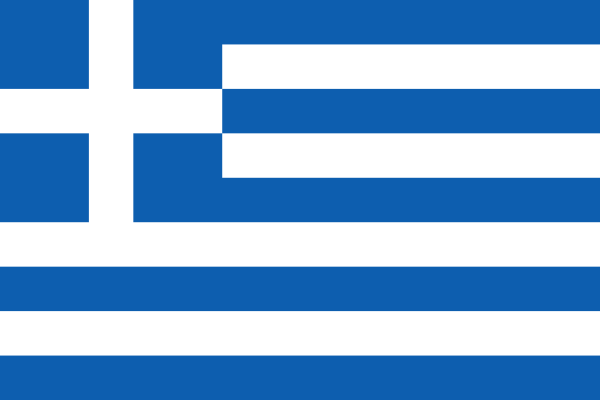
Greece is a country in Europe with a population of 10.42M and an area of 131,990 km². Life expectancy is 81.5 years.
Short factual summary generated from the same country data used in game rounds.
Core numbers
Fast scan first, deep dive later.
University Enrollment Rate
165.11%Total university and college enrollment as a percentage of the typical college-age population.
Life Expectancy
81.9 yearsAverage number of years a newborn would be expected to live if current mortality patterns stayed the same, from Our World in Data.
Human Development Index
0.91Composite 0-1 index of life expectancy, education, and income, from Our World in Data using the latest available country values in TerraBrawl.
CO2 Per Capita
5.3 t/person/yrAnnual carbon dioxide emissions in tonnes per person, from Our World in Data using the latest available country values in TerraBrawl.
GDP Per Capita
$37,752.63GDP per person adjusted for purchasing power in constant 2017 international dollars, from Our World in Data using the latest available country values in TerraBrawl.
Country briefing
A quick real-world briefing before you dive deeper into rankings, surprises, and matchups.
Geography
Size snapshot: slightly smaller than Alabama.
Culture
Major languages include Greek (official) 99%, other (includes English and French) 1%.
Identity
Formal name: Hellenic Republic.
Cities
Browse this country's cities before City Detective asks you to guess.
Thessaloníki
Central Macedonia, Greece
Athens
Attica, Greece
Irákleion
Crete, Greece
Pátra
West Greece, Greece
Kalamata
Peloponnese, Greece
Lárisa
Thessaly, Greece
Volos
Thessaly, Greece
Top stats
The strongest source-backed stats before the deeper data table.
Long-Term Unemployment
5.5% of workforceShare of the workforce unemployed for a long period, from OECD How's Life / Well-Being.
Government Debt (% GDP)
190.6% of GDPCentral government debt as a share of GDP, from World Bank Open Data.
Elderly Population (%)
23.94%Share of the population ages 65 and older, from World Bank Open Data.
Coastline Length
13.7K kmTotal coastline length from CIA World Factbook.
Reality checks
The stats that tend to surprise players in real rounds.
Ranks #12 globally in median age
The age that splits the population in half: half are younger, half are older. UN WPP estimate as of 1 July 2023.
Ranks #20 globally in merchant fleet size
Number of merchant marine ships from the frozen public-domain CIA World Factbook snapshot.
Only ranks #32 in life satisfaction
Average self-reported life satisfaction on a 0-10 scale, from OECD How's Life / Well-Being.
Ranks #16 globally in tourist arrivals
How many international tourists visit the country each year.
Ranks #20 globally in smoking rate
The percentage of people aged 15 and older who use tobacco products.
Compared with the region
Country vs continent vs world averages
GDP per person, adjusted for purchasing power parity (PPP) so costs of living are comparable across countries.
How many years a newborn can expect to live, based on current mortality rates.
Composite 0-1 index of life expectancy, education, and income, from Our World in Data using the latest available country values in TerraBrawl.
The percentage of people who have used the internet in the last 3 months.
Think you can guess which countries rank higher?
Play this countryFactbook notes
Country briefing
Greece won independence from the Ottoman Empire in 1830 and became a kingdom.
Greece won independence from the Ottoman Empire in 1830 and became a kingdom. During the second half of the 19th century and the first half of the 20th century, it gradually added neighboring islands and territories, most with Greek-speaking populations. In World War II, Greece was first invaded by Italy (1940) and subsequently occupied by Germany (1941-44); fighting endured in a protracted civil war between supporters of the king and other anti-communist and communist rebels. The communists were defeated in 1949, and Greece joined NATO in 1952. In 1967, a military coup forced the king to flee the country. The ensuing military dictatorship collapsed in 1974, and Greece abolished the monarchy to become a parliamentary republic.
In 1981, Greece joined the EC (now the EU); it became the 12th member of the European Economic and Monetary Union in 2001. From 2009 until 2019, Greece suffered a severe economic crisis due to nearly a decade of chronic overspending and structural rigidities. Beginning in 2010, Greece entered three bailout agreements -- the first two with the European Commission, the European Central Bank, and the IMF; and the third in 2015 with the European Stability Mechanism -- worth in total about $300 billion. The Greek Government formally exited the third bailout in 2018, and Greece's economy has since improved significantly. In 2022, the country finalized its early repayment to the IMF and graduated on schedule from the EU's enhanced surveillance framework.
Data vault
Every tracked stat, grouped for fast scanning.
Keep exploring
Open the head-to-head pages people naturally search after reading this profile.
Jump straight to the rankings where this country has its strongest edge.
Turn Greece's strongest number into a challenge card.
Total university and college enrollment as a percentage of the typical college-age population.
Greece has a population of 10.42M, ranking #90 globally by population.
Greece is located in Europe. It has an area of 131,990 km².
Life expectancy in Greece is 81.5 years, ranking #40 globally.
Greece's GDP per capita (PPP) is $44,005.13, ranking #58 globally.
Greece ranks particularly high in University Enrollment Rate (#1), Life Expectancy (#41), Human Development Index (#34).
Greece has an HDI of 0.908, ranking #34 globally. The HDI combines life expectancy, education, and income indicators.
Greece has a population density of 80.7 people per km², ranking #122 globally.