Geography
Natural resources include copper, mahogany forests, shrimp, hydropower.
CIA 2026
Loading TerraBrawl
Data as of May 28, 2026
Most people overlook Panama's strength in fb merchant ships. See what other surprises Panama has in store.
Most people overlook Panama's strength in fb merchant ships. Ranking #3 with 8,174, it's an overlooked achiever. See what other surprises Panama has in store.
Area
75K km²
Pop.
4.54M
Stats
125
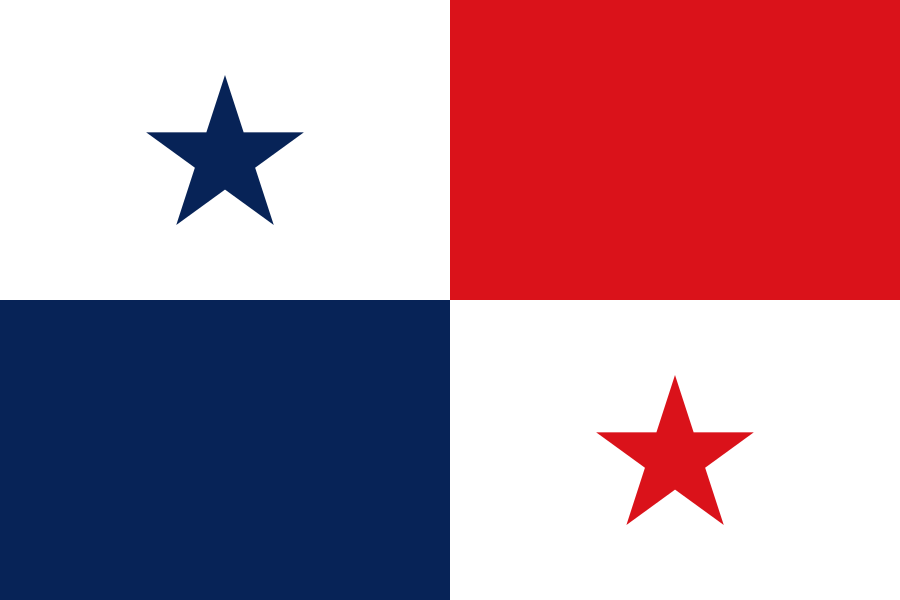
Panama is a country in North America with a population of 4.54M and an area of 75,417 km². Life expectancy is 79.6 years.
Short factual summary generated from the same country data used in game rounds.
Core numbers
Fast scan first, deep dive later.
Life Expectancy
79.6 yearsAverage number of years a newborn would be expected to live if current mortality patterns stayed the same, from Our World in Data.
GDP Per Capita
$36,426.01GDP per person adjusted for purchasing power in constant 2017 international dollars, from Our World in Data using the latest available country values in TerraBrawl.
Human Development Index
0.84Composite 0-1 index of life expectancy, education, and income, from Our World in Data using the latest available country values in TerraBrawl.
GDP Per Capita (PPP)
$41,369.42GDP per person, adjusted for purchasing power parity (PPP) so costs of living are comparable across countries.
University Enrollment Rate
53.7%Total university and college enrollment as a percentage of the typical college-age population.
Country briefing
A quick real-world briefing before you dive deeper into rankings, surprises, and matchups.
Geography
Natural resources include copper, mahogany forests, shrimp, hydropower.
Culture
Major languages include Spanish (official), Indigenous languages (including Ngabere (Guaymi), Buglere, Kuna, and more.
Identity
Formal name: Republic of Panama.
Cities
Browse this country's cities before City Detective asks you to guess.
Top stats
The strongest source-backed stats before the deeper data table.
Merchant Fleet Size
8.2KNumber of merchant marine ships from the frozen public-domain CIA World Factbook snapshot.
Inequality (Gini)
49.7A measure of income inequality where 0 means everyone earns the same and 100 means one person has everything.
Mobile Subscriptions (%)
157 per 100 peopleMobile cellular subscriptions per 100 people, from World Bank Open Data.
Protected Land (%)
31.4%The percentage of land area designated as protected natural reserves or parks.
Beer Consumption
3.5 L/person/yrLiters of beer consumed per person per year, from Our World in Data using the latest available country values in TerraBrawl.
Reality checks
The stats that tend to surprise players in real rounds.
Only ranks #162 in smoking rate
The percentage of people aged 15 and older who use tobacco products.
Only ranks #128 in railway length
Total railway length from CIA World Factbook.
Keeps inflation rate unusually low
How much prices increased over the year, based on the cost of everyday goods and services.
Ranks #34 globally in forest coverage (%)
The percentage of land covered by forests - natural or planted trees at least 5 meters tall (excludes orchards and urban parks).
Only ranks #159 in education spending (% gdp)
Government education spending as a share of GDP, from World Bank Open Data.
Compared with the region
Country vs continent vs world averages
GDP per person, adjusted for purchasing power parity (PPP) so costs of living are comparable across countries.
How many years a newborn can expect to live, based on current mortality rates.
Composite 0-1 index of life expectancy, education, and income, from Our World in Data using the latest available country values in TerraBrawl.
The percentage of people who have used the internet in the last 3 months.
Think you can guess which countries rank higher?
Play this countryFactbook notes
Country briefing
Explored and settled by the Spanish in the 16th century, Panama broke with Spain in 1821 and joined a union of Colombia, Ecuador, and Venezuela that was named the Republic of Gran Colombia.
Explored and settled by the Spanish in the 16th century, Panama broke with Spain in 1821 and joined a union of Colombia, Ecuador, and Venezuela that was named the Republic of Gran Colombia. When the union dissolved in 1830, Panama remained part of Colombia. With US backing, Panama seceded from Colombia in 1903 and promptly signed a treaty with the US allowing for the construction of a canal and US sovereignty over a strip of land known as the Panama Canal Zone on either side of the structure. The US Army Corps of Engineers built the Panama Canal between 1904 and 1914. In 1977, an agreement was signed for the complete transfer of the Canal from the US to Panama by the end of the century. Certain portions of the Zone and increasing responsibility over the Canal were turned over in the subsequent decades. With US help, Panamanian dictator Manuel NORIEGA was deposed in 1989. The entire Panama Canal, the area supporting the Canal, and remaining US military bases were transferred to Panama by the end of 1999. An ambitious expansion project to more than double the Canal's capacity by allowing for more Canal transits and larger ships was carried out between 2007 and 2016.
Data vault
Every tracked stat, grouped for fast scanning.
Keep exploring
Open the head-to-head pages people naturally search after reading this profile.
Jump straight to the rankings where this country has its strongest edge.
Turn Panama's strongest number into a challenge card.
Average number of years a newborn would be expected to live if current mortality patterns stayed the same, from Our World in Data.
Panama has a population of 4.54M, ranking #128 globally by population.
Panama is located in North America. It has an area of 75,417 km².
Life expectancy in Panama is 79.6 years, ranking #54 globally.
Panama's GDP per capita (PPP) is $41,369.42, ranking #62 globally.
Panama ranks particularly high in Life Expectancy (#61), Life Expectancy (#54), GDP Per Capita (#60).
Panama has an HDI of 0.839, ranking #59 globally. The HDI combines life expectancy, education, and income indicators.
Panama has a population density of 60.1 people per km², ranking #142 globally.