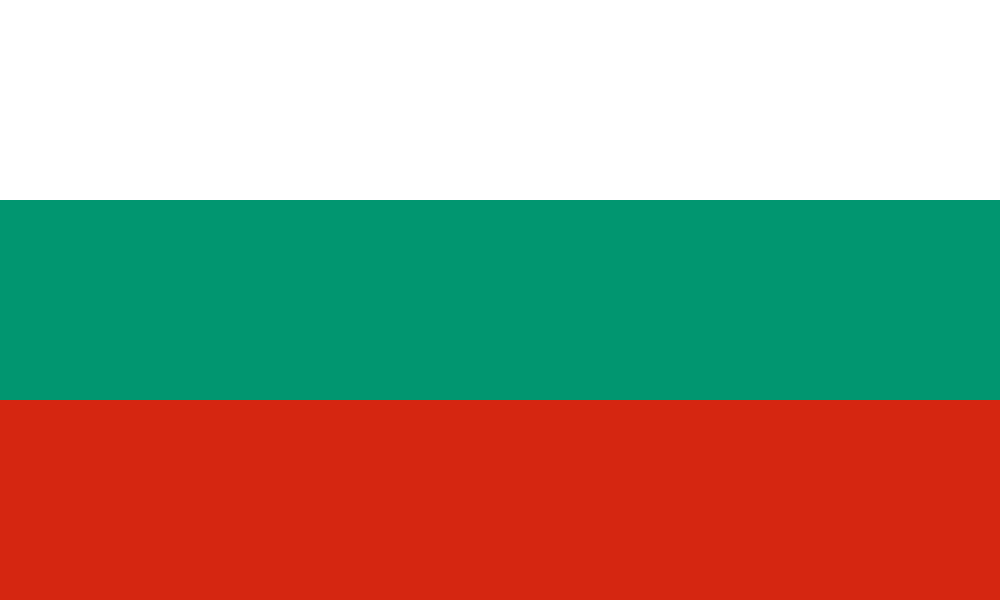
Bulgaria

EuropeGlobal Leader

Bulgaria ranks #6 globally in hospital beds. At 7.8%, it outperforms most of the world. Think you know what else Bulgaria excels at?

Bulgaria is a country in Europe with a population of 6.74M and an area of 110,879 km². Life expectancy is 75.7 years.

At a Glance

The numbers that define this country

University Enrollment Rate

79.9%
#28globally

Total university and college enrollment as a percentage of the typical college-age population.

Human Development Index

0.84
#55globally

The Human Development Index (HDI), combining life expectancy, education, and income into a single score from 0 to 1.

GDP Per Capita (PPP)

41.5K
#61globally

GDP per person, adjusted for purchasing power parity (PPP) so costs of living are comparable across countries.

GDP Per Capita

$34.1K
#64globally

GDP per person, adjusted for purchasing power parity (PPP) so costs of living are comparable across countries.

CO2 Per Capita

4.68
#75globally

How many tonnes of CO2 the average person produces per year.

Life Expectancy

75.7 years
#96globally

How many years a newborn can expect to live, based on current mortality rates.

Where They Stand Out

Global rankings worth knowing

🍻Spirits Consumption

4.75
#5globallyTop performer

How many liters of spirits the average adult (15+) drinks per year.

❤️Smoking Rate

39.5%
#5globallyTop performer

The percentage of people aged 15 and older who use tobacco products.

🌱Protected Land (%)

44.3%
#6globallyTop performer

The percentage of land area designated as protected natural reserves or parks.

👥Death Rate

14.18
#6globallyTop performer

The number of deaths per 1,000 people each year.

Nuclear Electricity Share

40.3%
#7globally

Percent of electricity generated from nuclear from CIA World Factbook.

Did You Know?

Facts that catch players off guard

🍻

Ranks #5 globally in spirits consumption

Spirits Consumption: 4.75

How many liters of spirits the average adult (15+) drinks per year.

Our World in Data 2023
❤️

Ranks #5 globally in smoking rate

Smoking Rate: 39.5%

The percentage of people aged 15 and older who use tobacco products.

World Bank 2023
🌱

Ranks #6 globally in protected land (%)

Protected Land (%): 44.3%

The percentage of land area designated as protected natural reserves or parks.

World Bank 2023
👥

Ranks #6 globally in death rate

Death Rate: 14.18

The number of deaths per 1,000 people each year.

World Bank 2023
❤️

Ranks #6 globally in hospital beds (per 1,000)

Hospital Beds (per 1,000): 7.80

The number of hospital beds available per 1,000 people.

World Bank 2023

Surprised? See how you stack up.

Play Now

How Bulgaria Compares

Country vs continent vs world averages

Bulgaria
Europe avg
World avg

GDP per Capita

Above avg

GDP per person, adjusted for purchasing power parity (PPP) so costs of living are comparable across countries.

World Bank 2023
Bulgaria41.5K
Europe57.5K
World31.8K

Life Expectancy

Above avg

How many years a newborn can expect to live, based on current mortality rates.

World Bank 2023
Bulgaria75.7 years
Europe80.0 years
World73.7 years

Human Development Index

Above avg

The Human Development Index (HDI), combining life expectancy, education, and income into a single score from 0 to 1.

Our World in Data 2023
Bulgaria0.84
Europe0.89
World0.74

Internet Users

Above avg

The percentage of people who have used the internet in the last 3 months.

World Bank 2023
Bulgaria82.4%
Europe90.1%
World70.3%

Think you can guess which countries rank higher?

Test Your Intuition
Regional comparison for Bulgaria across 4 key metrics, comparing with Europe and world averages.

About Bulgaria

The Bulgars, a Central Asian Turkic tribe, merged with the local Slavic inhabitants in the late 7th century to form the first Bulgarian state. In succeeding centuries, Bulgaria struggled with the Byzantine Empire to assert its place in the Balkans, but by the end of the 14th century, the Ottoman Turks overran the country. Northern Bulgaria attained autonomy in 1878, and all of Bulgaria became independent from the Ottoman Empire in 1908. Having fought on the losing side in both World Wars, Bulgaria fell within the Soviet sphere of influence and became a People's Republic in 1946. Communist domination ended in 1990, when Bulgaria held its first multiparty election since World War II and began the contentious process of moving toward political democracy and a market economy while combating inflation, unemployment, corruption, and crime. The country joined NATO in 2004, the EU in 2007, and the Schengen Area for air and sea travel in 2024.

🌍Geography & Climate6 facts
Location
Southeastern Europe, bordering the Black Sea, between Romania and Turkey
Climate
temperate; cold, damp winters; hot, dry summers
Terrain
mostly mountains with lowlands in north and southeast
Natural Resources
bauxite, copper, lead, zinc, coal, timber, arable land
Natural Hazards
earthquakes; landslides
Size Comparison
almost identical in size to Virginia; slightly larger than Tennessee
👥People & Culture4 facts
Languages
Bulgarian (official) 77.3%, Turkish 7.9%, Romani 3.5%, other 1%, unspecified 10.4% (2021 est.)
Religions
Christian 64.7%, Muslim 9.8%, other 0.1%, none 4.7%, unspecified 20.7% (2021 est.)
Ethnic Groups
Bulgarian 78.5%, Turkish 7.8%, Roma 4.1%, other 1.2%, unspecified 9.4% (2021 est.)
Major Cities
1.288 million SOFIA (capital) (2023)
🏛️Government & History10 facts
Government Type
parliamentary republic
Capital
Sofia
Capital Coordinates
42 41 N, 23 19 E
Capital Timezone
UTC+2 (7 hours ahead of Washington, DC, during Standard Time)
Official Name
Republic of Bulgaria
Name Origin
named after the Bulgar tribes who settled the lower Balkan region in the 7th century A.D.; the tribal name may come from the Turkic word bulga, or "mixed," referring to the blend of Turkic and Slavic ethnicities in the tribes
Independence
3 March 1878 (as an autonomous principality within the Ottoman Empire); 22 September 1908 (complete independence from the Ottoman Empire)
National Symbols
lion
National Anthem
"Mila Rodino" (Dear Homeland)
UNESCO Heritage
10 (7 cultural, 3 natural)
💼Economy & Trade7 facts
Overview
upper-middle-income EU economy; currency pegged to the euro, with eurozone accession pending; declining energy prices helping lower inflation rate; EU structural funds contributing to investment recovery; skilled labor shortage driven by emigration and aging population
Industries
electricity, gas, water; food, beverages, tobacco; machinery and equipment, automotive parts, base metals, chemical products, coke, refined petroleum, nuclear fuel; outsourcing centers
Agricultural Products
wheat, maize, sunflower seeds, barley, milk, rapeseed, grapes, potatoes, triticale, tomatoes (2023)
Export Partners
Germany 14%, Romania 11%, Italy 8%, Greece 6%, Turkey 5% (2023)
Export Commodities
refined petroleum, garments, refined copper, wheat, natural gas (2023)
Import Partners
Germany 12%, Turkey 8%, Romania 8%, Russia 7%, Italy 6% (2023)
Import Commodities
crude petroleum, copper ore, cars, packaged medicine, electricity (2023)
🔧Infrastructure & Defense5 facts
Military Forces
Bulgarian Armed Forces (aka Bulgarian Army): Land Forces, Air Force, Navy Ministry of Interior: General Directorate National Police (GDNP), General Directorate Border Police (GDBP), Special Unit for Combating Terrorism (SOBT) (2025)
Military Service
18 years of age for voluntary service for men and women (2025)
Energy Mix
fossil fuels: 35.2% of total installed capacity (2023 est.); nuclear: 40.9% of total installed capacity (2023 est.); solar: 8.2% of total installed capacity (2023 est.); wind: 4% of total installed capacity (2023 est.); hydroelectricity: 7.5% of total installed capacity (2023 est.); biomass and waste: 4.1% of total installed capacity (2023 est.)
Broadcast Media
4 national terrestrial TV stations with 1 state-owned and 3 privately owned; a vast array of TV stations are available from cable and satellite TV providers; state-owned national radio broadcasts over 3 networks; large number of private radio stations, especially in urban areas
Space Program
has a long history of space-related activities going back to the 1960s; develops, produces, and operates satellites; researches, develops, and produces other space technologies, including those related to astrophysics, remote sensing, data exploitation, optics, and electronics; has specialized in producing scientific instruments for space research; has more than 20 research institutes; Cooperating State of the ESA since 2015; works with a variety of foreign space agencies and commercial entities, including those of the ESA, EU, individual ESA and EU member states, India, Japan, Russia, and the US (2025)

Deep Dive

70 of 91 metrics

Every stat we track, organized by category

❤️Health & Survival10 metricsBest: #5
Smoking Rate
39.5%#5WB
Hospital Beds (per 1,000)
7.80#6WB
Doctors (per 1,000)
4.33#23WB
Suicide Rate
9.51#59WB
Health Spending (% GDP)
7.7%#70WB
Life Expectancy
75.7 years#96WB
Life Expectancy
75.6 years#115OWID
Obesity Rate
24.2%#100OWID
Child Mortality
6.10#145WB
Infant Mortality
5.00#146WB
🍻Lifestyle5 metricsBest: #5
Spirits Consumption
4.75#5OWID
Beer Consumption
4.42#11OWID
Alcohol Consumption
11.62#10OWID
Tourist Arrivals
4.97M#22WB
Air Passengers
723.8K#108WB
🌱Environment10 metricsBest: #6
Protected Land (%)
44.3%#6WB
Electricity Access (%)
100.0%#14WB
Carbon Emissions (Total)
33.47M#71
CO2 Per Capita
4.68#75OWID
Forest Area
39.3K#77WB
Forest Coverage (%)
36.2%#84WB
Renewable Energy (%)
16.4%#35OWID
Irrigated Land
929#95
Renewable Energy (%)
20.4%#105WB
Air Pollution (PM2.5)
17.147#119WB
👥Demographics12 metricsBest: #6
Death Rate
14.18#6WB
Elderly Population (%)
22.0%#17WB
Median Age
45.5 years#19
Urban Population (%)
73.9%#83WB
Teen Birth Rate
39.098#85WB
Dependency Ratio
57.492#89WB
Population
6.74M#108WB
Land Area
108.6K#102WB
Population Density
59.383#144WB
Fertility Rate
1.52#180WB
Youth Population (%)
14.5%#191WB
Birth Rate
7.88#206WB
Energy2 metricsBest: #7
Nuclear Electricity Share
40.3%#7
Electricity Capacity
12.94M#59
🤝Society & Equality2 metricsBest: #25
Inequality (Gini)
39.5#25WB
Women in Parliament (%)
20.8%#119WB
🚀Education & Future6 metricsBest: #28
University Enrollment Rate
79.9%#28WB
Human Development Index
0.84#55OWID
Education Spending (% GDP)
4.5%#78WB
R&D Spending (% GDP)
0.8%#48WB
Domestic Patents
165#59WB
Foreign Patents
6.00#118WB
🌍Land & Sea5 metricsBest: #40
Lowest Elevation
0#51
Border Countries Count
5.00#40
Highest Elevation
2.9K#74
Land Boundaries Length
1.8K#97
Coastline Length
354#126
🔧Infrastructure3 metricsBest: #45
Airports
107#50
Railway Length
4.0K#45
Merchant Ships
78#100
💰Wealth & Economy10 metricsBest: #53
GDP Per Capita (PPP)
41.5K#61WB
High-Tech Exports (%)
13.4%#53WB
GDP Per Capita
$34.1K#64OWID
GDP (Nominal)
113.34B#68WB
FDI Inflows (% GDP)
3.1%#77WB
GDP Growth Rate
3.4%#101WB
Youth Unemployment Rate
12.1%#100
Unemployment Rate
4.1%#122WB
Inflation Rate
2.4%#141WB
Government Debt (% GDP)
30.1%#164WB
🛡️Military & Defense2 metricsBest: #62
Military Spend (% GDP)
2.1%#62
Active Military Personnel
28.0K#76
📡Technology3 metricsBest: #71
Broadband Access (%)
36#71WB
Internet Users (%)
82.4%#103WB
Mobile Subscriptions (%)
118#104WB

Countries with Similar GDP

Share a Fact

Share something surprising about Bulgaria!

Bulgaria
#28 in University Enrollment Rate

Total university and college enrollment as a percentage of the typical college-age population.

Top 15% globally
79.9%

Frequently Asked Questions about Bulgaria

What is the population of Bulgaria?

Bulgaria has a population of 6.74M, ranking #108 globally by population.

What continent is Bulgaria in?

Bulgaria is located in Europe. It has an area of 110,879 km².

What is the life expectancy in Bulgaria?

Life expectancy in Bulgaria is 75.7 years, ranking #96 globally.

What is the GDP per capita of Bulgaria?

Bulgaria's GDP per capita (PPP) is 41.5K, ranking #61 globally.

What is Bulgaria known for in global statistics?

Bulgaria ranks particularly high in University Enrollment Rate (#28), Human Development Index (#55), GDP Per Capita (PPP) (#61).

What is Bulgaria's Human Development Index?

Bulgaria has an HDI of 0.845, ranking #55 globally. The HDI combines life expectancy, education, and income indicators.

How densely populated is Bulgaria?

Bulgaria has a population density of 59.4 people per km², ranking #144 globally.
Think you know Bulgaria?

Compare countries, guess statistics, and prove you know your stuff.