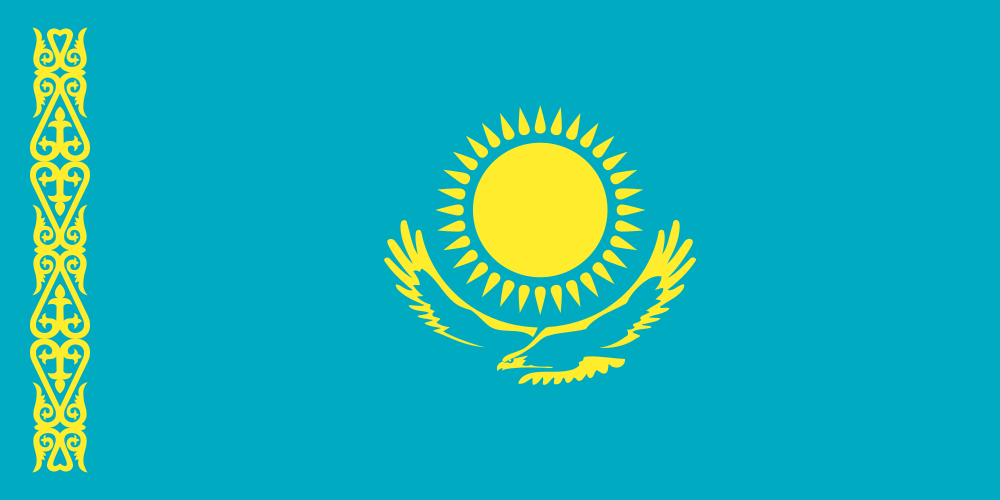
Identity
Formal name: Republic of Kazakhstan.
CIA 2026
Loading TerraBrawl
Data as of May 28, 2026
Kazakhstan claims the 9th spot worldwide for land area. How well do you really know Kazakhstan?
Kazakhstan claims the 9th spot worldwide for land area. That 2.7 million figure is hard to beat. How well do you really know Kazakhstan?
Area
2.7M km²
Pop.
20.43M
Stats
129
Kazakhstan is a country in Asia with a population of 20.43M and an area of 2,724,900 km². Life expectancy is 74.4 years.
Short factual summary generated from the same country data used in game rounds.
Core numbers
Fast scan first, deep dive later.
Land Area
2.70M km²Total land area in square kilometers, excluding lakes, rivers, and territorial waters.
CO2 Per Capita
13.94 t/person/yrAnnual carbon dioxide emissions in tonnes per person, from Our World in Data using the latest available country values in TerraBrawl.
Internet Users (%)
93.39%The percentage of people who have used the internet in the last 3 months.
GDP Per Capita
$35,905.44GDP per person adjusted for purchasing power in constant 2017 international dollars, from Our World in Data using the latest available country values in TerraBrawl.
Human Development Index
0.84Composite 0-1 index of life expectancy, education, and income, from Our World in Data using the latest available country values in TerraBrawl.
Country briefing
A quick real-world briefing before you dive deeper into rankings, surprises, and matchups.
Identity
Formal name: Republic of Kazakhstan.
Curated stat
Kazakhstan is the largest landlocked country by area.
Geography
Size snapshot: slightly less than four times the size of Texas.
Cities
Browse this country's cities before City Detective asks you to guess.
Astana
Kazakhstan
Almaty
Kazakhstan
Karagandy
Karaganda, Kazakhstan
Shymkent
Kazakhstan
Aktobe
Kazakhstan
Kyzylorda
Kazakhstan
Pavlodar
Pavlodar Region, Kazakhstan
Semey
Abai Region, Kazakhstan
Top stats
The strongest source-backed stats before the deeper data table.
Land Border Length
13.4K kmTotal length of land borders with neighboring countries from the frozen public-domain CIA World Factbook snapshot.
Highest Elevation
7.0K mHighest point elevation from CIA World Factbook.
High-Tech Exports (%)
42.2%High-tech products (like computers, pharmaceuticals, and aerospace) as a percentage of total manufactured exports.
Hospital Beds (per 1,000)
6.7 per 1kThe number of hospital beds available per 1,000 people.
Irrigated Land
17.8K km²Irrigated land area from CIA World Factbook.
Reality checks
The stats that tend to surprise players in real rounds.
Only ranks #235 in lowest elevation
Lowest point elevation from CIA World Factbook.
Only ranks #204 in population density
How many people live in each square kilometer of land.
Only ranks #150 in military spending
Military expenditure as a share of GDP, from World Bank Open Data.
Keeps youth unemployment rate unusually low
Share of the labor force ages 15-24 that is unemployed from the World Bank latest available country value.
Only ranks #192 in forest coverage (%)
The percentage of land covered by forests - natural or planted trees at least 5 meters tall (excludes orchards and urban parks).
Compared with the region
Country vs continent vs world averages
GDP per person, adjusted for purchasing power parity (PPP) so costs of living are comparable across countries.
How many years a newborn can expect to live, based on current mortality rates.
Composite 0-1 index of life expectancy, education, and income, from Our World in Data using the latest available country values in TerraBrawl.
The percentage of people who have used the internet in the last 3 months.
Think you can guess which countries rank higher?
Play this countryFactbook notes
Country briefing
Ethnic Kazakhs derive from a mix of Turkic nomadic tribes that migrated to the region in the 15th century.
Ethnic Kazakhs derive from a mix of Turkic nomadic tribes that migrated to the region in the 15th century. The Russian Empire conquered the Kazakh steppe in the 18th and 19th centuries, and Kazakhstan became a Soviet Republic in 1925. Forced agricultural collectivization led to repression and starvation, resulting in more than a million deaths in the early 1930s. During the 1950s and 1960s, the agricultural "Virgin Lands" program generated an influx of settlers -- mostly ethnic Russians, but also other nationalities -- and by the time of Kazakhstan’s independence in 1991, ethnic Kazakhs were a minority. However, non-Muslim ethnic minorities departed Kazakhstan in large numbers from the mid-1990s through the mid-2000s, and a national program has repatriated about a million ethnic Kazakhs (from Uzbekistan, Tajikistan, Mongolia, and the Xinjiang region of China) to Kazakhstan. As a result of this shift, the ethnic Kazakh share of the population now exceeds two-thirds.
Kazakhstan's economy is the largest in Central Asia, mainly due to the country's vast natural resources. Current issues include diversifying the economy, attracting foreign direct investment, enhancing Kazakhstan's economic competitiveness, and strengthening economic relations with neighboring states and foreign powers.
Data vault
Every tracked stat, grouped for fast scanning.
Keep exploring
Open the head-to-head pages people naturally search after reading this profile.
Jump straight to the rankings where this country has its strongest edge.
Turn Kazakhstan's strongest number into a challenge card.
Total land area in square kilometers, excluding lakes, rivers, and territorial waters.
Kazakhstan has a population of 20.43M, ranking #64 globally by population.
Kazakhstan is located in Asia. It has an area of 2,724,900 km².
Life expectancy in Kazakhstan is 74.4 years, ranking #110 globally.
Kazakhstan's GDP per capita (PPP) is $40,890.93, ranking #64 globally.
Kazakhstan ranks particularly high in Land Area (#9), CO2 Per Capita (#13), Internet Users (%) (#44).
Kazakhstan has an HDI of 0.837, ranking #61 globally. The HDI combines life expectancy, education, and income indicators.
Kazakhstan has a population density of 7.5 people per km², ranking #204 globally.