Culture
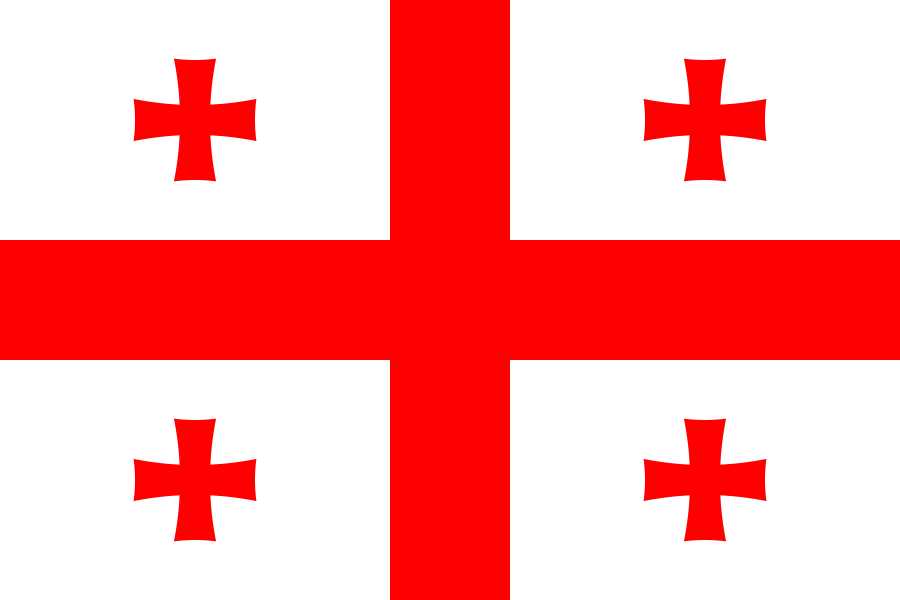
National symbols include Saint George, lion.
CIA 2026
Loading TerraBrawl
Data as of May 28, 2026
Georgia outperforms expectations at every turn. What's behind this surprising performance?
Georgia outperforms expectations at every turn. Its #80 GDP rank belies a #31 position in university enrollment. What's behind this surprising performance?
Area
70K km²
Pop.
4.90M
Stats
132
Georgia is a country in Europe with a population of 4.90M and an area of 69,700 km². Life expectancy is 74.5 years.
Short factual summary generated from the same country data used in game rounds.
Core numbers
Fast scan first, deep dive later.
University Enrollment Rate
78.27%Total university and college enrollment as a percentage of the typical college-age population.
Human Development Index
0.84Composite 0-1 index of life expectancy, education, and income, from Our World in Data using the latest available country values in TerraBrawl.
GDP Per Capita
$25,000.63GDP per person adjusted for purchasing power in constant 2017 international dollars, from Our World in Data using the latest available country values in TerraBrawl.
GDP Per Capita (PPP)
$28,285.07GDP per person, adjusted for purchasing power parity (PPP) so costs of living are comparable across countries.
Internet Users (%)
82%The percentage of people who have used the internet in the last 3 months.
Life Expectancy
74.5 yearsHow many years a newborn can expect to live, based on current mortality rates.
Country briefing
A quick real-world briefing before you dive deeper into rankings, surprises, and matchups.
Culture
National symbols include Saint George, lion.
Economy
Key industries include steel, machine tools, electrical appliances, mining (manganese, and more.
Identity
Name origin: the Western name probably derives from the name of the local people, the Gurz, whose name origin is uncertain.
Cities
Browse this country's cities before City Detective asks you to guess.
Top stats
The strongest source-backed stats before the deeper data table.
Alcohol Consumption
14.41 L/adult/yrLiters of pure alcohol the average adult aged 15+ consumes per year, from Our World in Data using the latest available country values in TerraBrawl.
Highest Elevation
5.2K mHighest point elevation from CIA World Factbook.
Reality checks
The stats that tend to surprise players in real rounds.
Has one of the highest youth unemployment rate figures
Share of the labor force ages 15-24 that is unemployed from the World Bank latest available country value.
Ranks #24 globally in obesity rate
Share of adults with obesity, from Our World in Data using the latest available country values in TerraBrawl.
Ranks #32 globally in mobile subscriptions (%)
Mobile cellular subscriptions per 100 people, from World Bank Open Data.
Compared with the region
Country vs continent vs world averages
GDP per person, adjusted for purchasing power parity (PPP) so costs of living are comparable across countries.
How many years a newborn can expect to live, based on current mortality rates.
Composite 0-1 index of life expectancy, education, and income, from Our World in Data using the latest available country values in TerraBrawl.
The percentage of people who have used the internet in the last 3 months.
Think you can guess which countries rank higher?
Play this countryFactbook notes
Country briefing
The region of present-day Georgia once contained the ancient kingdoms of Colchis (known as Egrisi locally) and Kartli-Iberia.
The region of present-day Georgia once contained the ancient kingdoms of Colchis (known as Egrisi locally) and Kartli-Iberia. The area came under Roman influence in the first centuries A.D., and Christianity became the state religion in the 330s. Persian, Arab, and Turk domination was followed by a Georgian golden age (11th-13th centuries) that was cut short when the Mongols invaded in 1236. Subsequently, the Ottoman and Persian empires competed for influence in the region. Georgia was absorbed into the Russian Empire in the 19th century. Independent for three years (1918-1921) following the Russian revolution, it was forcibly incorporated into the USSR in 1921 and regained its independence when the Soviet Union dissolved in 1991.
In 2003, mounting public discontent over rampant corruption, ineffective government services, and a government attempt to manipulate parliamentary elections touched off widespread protests that led to the resignation of Eduard SHEVARDNADZE, who had been president since 1995. In the aftermath of this "Rose Revolution," new elections in 2004 swept Mikheil SAAKASHVILI and his United National Movement (UNM) party into power. SAAKASHVILI made progress on market reforms and governance, but he faced accusations of abuse of office. Progress was further complicated when Russian support for the separatist regions of Abkhazia and South Ossetia led to a five-day conflict between Russia and Georgia in August 2008, which included Russia invading large portions of Georgian territory. Russia initially pledged to pull back from most Georgian territory but then unilaterally recognized the independence of Abkhazia and South Ossetia, and Russian military forces have remained in those regions.
Billionaire Bidzina IVANISHVILI's unexpected entry into politics in 2011 brought the divided opposition together under his Georgian Dream coalition, which won a majority of seats in the 2012 parliamentary elections and removed UNM from power. Conceding defeat, SAAKASHVILI named IVANISHVILI as prime minister and left the country after his presidential term ended in 2013. IVANISHVILI voluntarily resigned from office after the presidential succession, and in the years since, the prime minister position has seen frequent turnover. In 2021, SAAKASHVILI returned to Georgia, where he was immediately arrested to serve six years in prison on outstanding abuse-of-office convictions.
Popular support for integration with the West is high in Georgia. Joining the EU and NATO are among the country's top foreign policy goals, and Georgia applied for EU membership in 2022, becoming a candidate country in December 2023. Georgia and the EU have a Deep and Comprehensive Free Trade Agreement, and since 2017, Georgian citizens have been able to travel to the Schengen area without a visa.
Data vault
Every tracked stat, grouped for fast scanning.
Keep exploring
Open the head-to-head pages people naturally search after reading this profile.
Jump straight to the rankings where this country has its strongest edge.
Turn Georgia's strongest number into a challenge card.
Total university and college enrollment as a percentage of the typical college-age population.
Georgia has a population of 4.90M, ranking #127 globally by population.
Georgia is located in Europe. It has an area of 69,700 km².
Life expectancy in Georgia is 74.5 years, ranking #108 globally.
Georgia's GDP per capita (PPP) is $28,285.07, ranking #80 globally.
Georgia ranks particularly high in University Enrollment Rate (#31), Human Development Index (#57), GDP Per Capita (#80).
Georgia has an HDI of 0.844, ranking #57 globally. The HDI combines life expectancy, education, and income indicators.
Georgia has a population density of 65.0 people per km², ranking #139 globally.