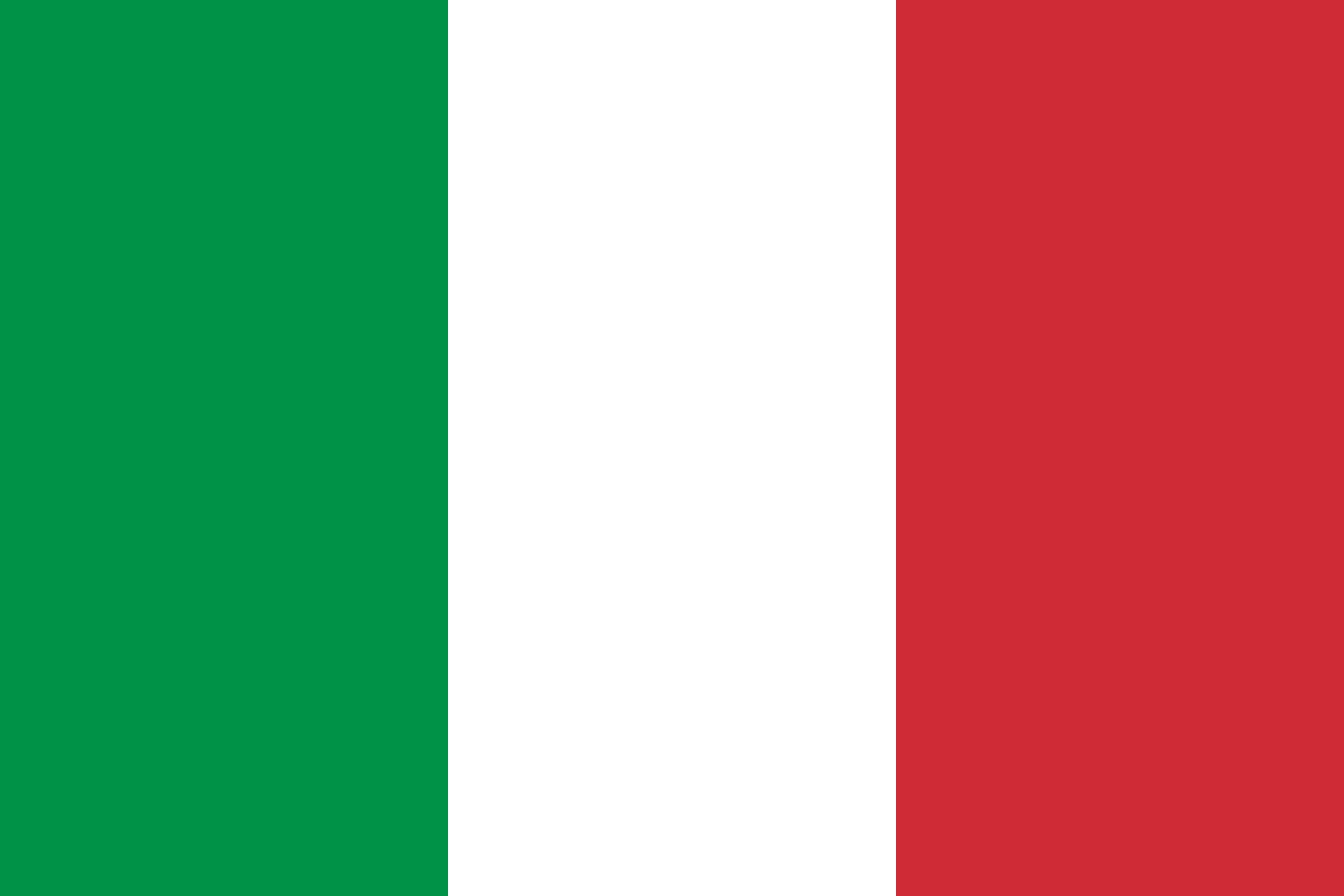
Geography
Size snapshot: almost twice the size of Georgia.
CIA 2026
Loading TerraBrawl
Data as of May 28, 2026
Globally, Italy places #4 in tourist arrivals. Ready to explore more about Italy?
Globally, Italy places #4 in tourist arrivals. This ranking reflects a standout track record. Ready to explore more about Italy?
Area
301K km²
Pop.
60.92M
Stats
199
Italy is a country in Europe with a population of 60.92M and an area of 301,336 km². Life expectancy is 83.7 years.
Short factual summary generated from the same country data used in game rounds.
Core numbers
Fast scan first, deep dive later.
Life Expectancy
83.7 yearsHow many years a newborn can expect to live, based on current mortality rates.
Human Development Index
0.92Composite 0-1 index of life expectancy, education, and income, from Our World in Data using the latest available country values in TerraBrawl.
GDP Per Capita
$53,115.14GDP per person adjusted for purchasing power in constant 2017 international dollars, from Our World in Data using the latest available country values in TerraBrawl.
GDP Per Capita (PPP)
$60,881.37GDP per person, adjusted for purchasing power parity (PPP) so costs of living are comparable across countries.
Country briefing
A quick real-world briefing before you dive deeper into rankings, surprises, and matchups.
Geography
Size snapshot: almost twice the size of Georgia.
Culture
Major languages include Italian (official), German (parts of Trentino-Alto Adige region are predominantly German-speaking), French (small French-speaking minority in Val…
Identity
Formal name: Italian Republic.
Cities
Browse this country's cities before City Detective asks you to guess.
Palermo
Sicily, Italy
Rome
Lazio, Italy
Milan
Lombardy, Italy
Naples
Campania, Italy
Florence
Tuscany, Italy
Turin
Piedmont, Italy
Catania
Sicily, Italy
Venice
Veneto, Italy
Top stats
The strongest source-backed stats before the deeper data table.
Leisure Time
16.47 hrs/dayAverage leisure and personal-care time per day, from OECD How's Life / Well-Being.
Elderly Population (%)
24.62%Share of the population ages 65 and older, from World Bank Open Data.
Tourist Arrivals
38.42MHow many international tourists visit the country each year.
GDP (Nominal)
$2,380,825,077,243.59The country's total economic output in current US dollars.
Airports
652Large, medium, and small airport records by country from the open OurAirports dataset.
Reality checks
The stats that tend to surprise players in real rounds.
Ranks #6 globally in median age
The age that splits the population in half: half are younger, half are older. UN WPP estimate as of 1 July 2023.
Has one of the highest government debt (% gdp) figures
Central government debt as a share of GDP, from World Bank Open Data.
Ranks #12 globally in electric generating capacity
Installed electricity generating capacity in kilowatts from the frozen public-domain CIA World Factbook snapshot.
Ranks #16 globally in coastline length
Total coastline length from CIA World Factbook.
Ranks #10 globally in domestic patents
How many patent applications are filed by residents each year.
Compared with the region
Country vs continent vs world averages
GDP per person, adjusted for purchasing power parity (PPP) so costs of living are comparable across countries.
How many years a newborn can expect to live, based on current mortality rates.
Composite 0-1 index of life expectancy, education, and income, from Our World in Data using the latest available country values in TerraBrawl.
The percentage of people who have used the internet in the last 3 months.
Think you can guess which countries rank higher?
Play this countryFactbook notes
Country briefing
Italy became a nation-state in 1861 when the regional states of the peninsula, along with Sardinia and Sicily, were united under King Victor EMMANUEL II.
Italy became a nation-state in 1861 when the regional states of the peninsula, along with Sardinia and Sicily, were united under King Victor EMMANUEL II. An era of parliamentary government came to a close in the early 1920s when Benito MUSSOLINI established a Fascist dictatorship. His alliance with Nazi Germany led to Italy's defeat in World War II. A democratic republic replaced the monarchy in 1946, and economic revival followed. Italy is a charter member of NATO, as well as the European Economic Community (EEC) and its successors, the EC and the EU. It has been at the forefront of European economic and political unification, joining the Economic and Monetary Union in 1999. Persistent problems include sluggish economic growth, high youth and female unemployment, organized crime, corruption, and economic disparities between southern Italy and the more prosperous north.
Data vault
Every tracked stat, grouped for fast scanning.
Keep exploring
Open the head-to-head pages people naturally search after reading this profile.
Jump straight to the rankings where this country has its strongest edge.
Turn Italy's strongest number into a challenge card.
How many years a newborn can expect to live, based on current mortality rates.
Italy has a population of 60.92M, ranking #25 globally by population.
Italy is located in Europe. It has an area of 301,336 km².
Life expectancy in Italy is 83.7 years, ranking #10 globally.
Italy's GDP per capita (PPP) is $60,881.37, ranking #34 globally.
Italy ranks particularly high in Life Expectancy (#10), Life Expectancy (#12), Population (#25).
Italy has an HDI of 0.915, ranking #30 globally. The HDI combines life expectancy, education, and income indicators.
Italy has a population density of 199.5 people per km², ranking #66 globally.