Geography
Climate: temperate, with rainfall heavier in summer than winter.
CIA 2026
Loading TerraBrawl
Data as of May 28, 2026
Among all countries, South Korea stands 1st in hospital beds. Can you guess its other standout statistics?
Among all countries, South Korea stands 1st in hospital beds. This achievement puts it ahead of the vast majority of countries. Can you guess its other standout statistics?
Area
100K km²
Pop.
51.49M
Stats
184
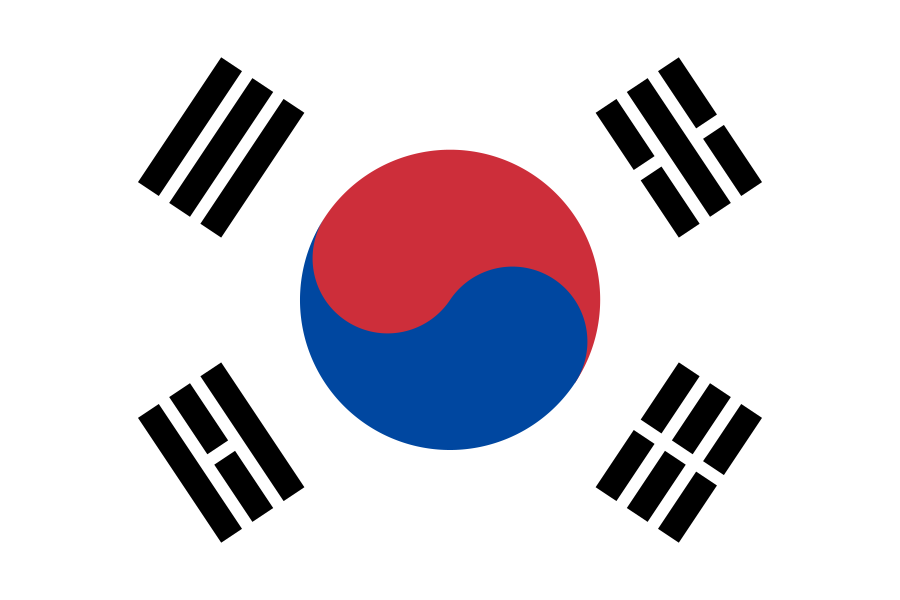
South Korea is a country in Asia with a population of 51.49M and an area of 100,210 km². Life expectancy is 83.4 years.
Short factual summary generated from the same country data used in game rounds.
Core numbers
Fast scan first, deep dive later.
Life Expectancy
84.3 yearsAverage number of years a newborn would be expected to live if current mortality patterns stayed the same, from Our World in Data.
University Enrollment Rate
106.71%Total university and college enrollment as a percentage of the typical college-age population.
Internet Users (%)
97.9%The percentage of people who have used the internet in the last 3 months.
CO2 Per Capita
11.29 t/person/yrAnnual carbon dioxide emissions in tonnes per person, from Our World in Data using the latest available country values in TerraBrawl.
Human Development Index
0.94Composite 0-1 index of life expectancy, education, and income, from Our World in Data using the latest available country values in TerraBrawl.
Country briefing
A quick real-world briefing before you dive deeper into rankings, surprises, and matchups.
Geography
Climate: temperate, with rainfall heavier in summer than winter.
Culture
Major languages include Korean, English.
Identity
Formal name: Republic of Korea.
Cities
Browse this country's cities before City Detective asks you to guess.
Busan
South Korea
Seoul
South Korea
Incheon
South Korea
Daejeon
South Korea
Gwangju
South Korea
Daegu
South Korea
Suwon
Gyeonggi-do, South Korea
Ulsan
South Korea
Top stats
The strongest source-backed stats before the deeper data table.
Gender Pay Gap (%)
28.95% of male wagesWomen's earnings shortfall compared with men in the same wage decile, from OECD How's Life / Well-Being.
Hospital Beds (per 1,000)
12.8 per 1kThe number of hospital beds available per 1,000 people.
Suicide Rate
27.53 per 100kSuicide mortality rate per 100,000 people, from World Bank Open Data.
R&D Spending (% GDP)
5.2% of GDPResearch and development spending as a share of GDP, from World Bank Open Data.
Total CO2 Emissions
588.01 Mt CO2eTotal carbon dioxide emissions excluding LULUCF from the World Bank latest available country value.
Reality checks
The stats that tend to surprise players in real rounds.
Only ranks #227 in birth rate
The number of babies born per 1,000 people each year.
Ranks #4 globally in foreign patents
How many patent applications are filed by non-residents each year.
Keeps long-term unemployment unusually low
Share of the workforce unemployed for a long period, from OECD How's Life / Well-Being.
Ranks #10 globally in electric generating capacity
Installed electricity generating capacity in kilowatts from the frozen public-domain CIA World Factbook snapshot.
Ranks #12 globally in gdp (nominal)
The country's total economic output in current US dollars.
Compared with the region
Country vs continent vs world averages
GDP per person, adjusted for purchasing power parity (PPP) so costs of living are comparable across countries.
How many years a newborn can expect to live, based on current mortality rates.
Composite 0-1 index of life expectancy, education, and income, from Our World in Data using the latest available country values in TerraBrawl.
The percentage of people who have used the internet in the last 3 months.
Think you can guess which countries rank higher?
Play this countryFactbook notes
Country briefing
The first recorded kingdom (Choson) on the Korean Peninsula dates from approximately 2300 B.C.
The first recorded kingdom (Choson) on the Korean Peninsula dates from approximately 2300 B.C. Over the subsequent centuries, three main kingdoms -- Kogoryo, Baekche, and Silla -- were established on the Peninsula. By the 5th century A.D., Kogoryo emerged as the most powerful, with control over much of the Peninsula and part of Manchuria (modern-day northeast China). However, Silla allied with the Chinese to create the first unified Korean state in 688. Following the collapse of Silla in the 9th century, Korea was unified under the Koryo (Goryeo; 918-1392) and the Chosen (Joseon; 1392-1910) dynasties.
Korea became the object of intense imperialistic rivalry among the Chinese (its traditional benefactor), Japanese, and Russian empires in the latter half of the 19th and early 20th centuries. After the Sino-Japanese War (1894-95) and the Russo-Japanese War (1904-1905), Korea was occupied by Imperial Japan. In 1910, Japan formally annexed the entire Peninsula. Korea regained its independence after Japan's surrender to the US and its allies in 1945. A US-supported democratic government (Republic of Korea, ROK) was set up in the southern half of the Korean Peninsula, while a communist-style government backed by the Soviet Union was installed in the north (North Korea; aka Democratic People's Republic of Korea, DPRK). During the Korean War (1950-53), US troops and UN forces fought alongside ROK soldiers to defend South Korea from a North Korean invasion supported by communist China and the Soviet Union. After the 1953 armistice, the two Koreas were separated by a demilitarized zone.
Syngman RHEE led the country as its first president from 1948 to 1960. PARK Chung-hee took over leadership of the country in a 1961 coup. During his controversial rule (1961-79), South Korea achieved rapid economic growth, with per capita income rising to roughly 17 times the level of North Korea by 1979. PARK was assassinated in 1979, and subsequent years were marked by political turmoil and continued military rule as the country's pro-democracy movement grew. South Korea held its first free presidential election under a revised democratic constitution in 1987, with former South Korean Army general ROH Tae-woo winning a close race. In 1993, KIM Young-sam became the first civilian president of South Korea's new democratic era. President KIM Dae-jung (1998-2003) won the Nobel Peace Prize in 2000 for his contributions to South Korean democracy and his "Sunshine Policy" of engagement with North Korea. President PARK Geun-hye, daughter of former South Korean President PARK Chung-hee, took office in 2013 as South Korea's first female leader. In 2016, the National Assembly passed an impeachment motion against PARK over her alleged involvement in a corruption and influence-peddling scandal, triggering an early presidential election in 2017 won by MOON Jae-in. In 2022, longtime prosecutor and political newcomer YOON Suk Yeol won the presidency by the slimmest margin in South Korean history.
Discord and tensions with North Korea, punctuated by North Korean military provocations, missile launches, and nuclear tests, have permeated inter-Korean relations for years. Relations remained strained, despite a period of respite in 2018-2019 ushered in by North Korea's participation in the 2018 Winter Olympic and Paralympic Games in South Korea and high-level diplomatic meetings, including historic US-North Korea summits. In 2024, Pyongyang announced it was ending all economic cooperation with South Korea, a move that followed earlier proclamations that it was scrapping a 2018 military pact to de-escalate tensions along their militarized border, abandoning the country’s decades-long pursuit of peaceful unification with South Korea, and designating the South as North Korea’s “principal enemy.”
Data vault
Every tracked stat, grouped for fast scanning.
Keep exploring
Open the head-to-head pages people naturally search after reading this profile.
Jump straight to the rankings where this country has its strongest edge.
Turn South Korea's strongest number into a challenge card.
Average number of years a newborn would be expected to live if current mortality patterns stayed the same, from Our World in Data.
South Korea has a population of 51.49M, ranking #28 globally by population.
South Korea is located in Asia. It has an area of 100,210 km².
Life expectancy in South Korea is 83.4 years, ranking #13 globally.
South Korea's GDP per capita (PPP) is $58,895, ranking #36 globally.
South Korea ranks particularly high in Life Expectancy (#5), University Enrollment Rate (#7), Life Expectancy (#13).
South Korea has an HDI of 0.937, ranking #20 globally. The HDI combines life expectancy, education, and income indicators.
South Korea has a population density of 529.8 people per km², ranking #23 globally.