Geography
Climate: temperate, with rainfall concentrated in summer.
CIA 2026
Loading TerraBrawl
Data as of May 28, 2026
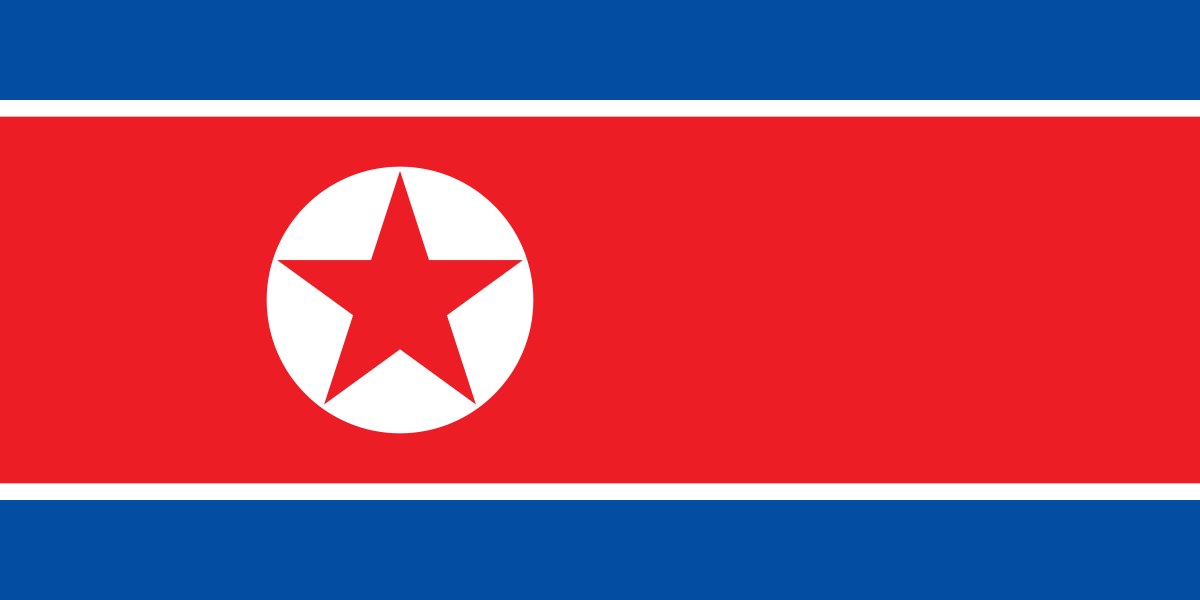
Expect the unexpected when it comes to North Korea. Discover more about this complex place.
Expect the unexpected when it comes to North Korea. A top performer in spirits consumption (#26), it falls behind in beer consumption. Discover more about this complex place.
Area
121K km²
Pop.
26.40M
Stats
84
North Korea is a country in Asia with a population of 26.40M and an area of 120,538 km². Life expectancy is 73.6 years.
Short factual summary generated from the same country data used in game rounds.
Core numbers
Fast scan first, deep dive later.
Population Density
219.4 /km²How many people live in each square kilometer of land.
Land Area
120.4K km²Total land area in square kilometers, excluding lakes, rivers, and territorial waters.
Life Expectancy
73.6 yearsHow many years a newborn can expect to live, based on current mortality rates.
CO2 Per Capita
2.4 t/person/yrAnnual carbon dioxide emissions in tonnes per person, from Our World in Data using the latest available country values in TerraBrawl.
Country briefing
A quick real-world briefing before you dive deeper into rankings, surprises, and matchups.
Geography
Climate: temperate, with rainfall concentrated in summer.
Culture
Major languages include Korean.
Identity
Formal name: Democratic People's Republic of Korea.
Cities
Browse this country's cities before City Detective asks you to guess.
Pyongyang
North Korea
Namp’o
Nampo, North Korea
Hamhŭng
South Hamgyong, North Korea
Sinŭiju
P'yongan-bukto, North Korea
Wŏnsan
Kangwon-do, North Korea
Chongjin
North Hamgyong, North Korea
Haeju
South Hwanghae, North Korea
Hyesan
Yanggang-do, North Korea
Top stats
The strongest source-backed stats before the deeper data table.
Armed Forces Personnel
1.47MTotal armed forces personnel from the World Bank latest available country value.
Domestic Patents
6.9KHow many patent applications are filed by residents each year.
Spirits Consumption
2.9 L/person/yrLiters of spirits consumed per person per year, from Our World in Data using the latest available country values in TerraBrawl.
Irrigated Land
14.6K km²Irrigated land area from CIA World Factbook.
Coastline Length
2.5K kmTotal coastline length from CIA World Factbook.
Reality checks
The stats that tend to surprise players in real rounds.
Only ranks #214 in teen birth rate
The number of births per 1,000 women aged 15-19.
Only ranks #221 in mobile subscriptions (%)
Mobile cellular subscriptions per 100 people, from World Bank Open Data.
Only ranks #153 in air passengers
Total passengers carried by airlines registered in that country, regardless of where flights originated or ended.
Only ranks #196 in protected land (%)
The percentage of land area designated as protected natural reserves or parks.
Only ranks #119 in foreign patents
How many patent applications are filed by non-residents each year.
Compared with the region
Country vs continent vs world averages
How many years a newborn can expect to live, based on current mortality rates.
Deaths before age 5 per 1,000 live births, from World Bank Open Data.
Think you can guess which countries rank higher?
Play this countryFactbook notes
Country briefing
The first recorded kingdom (Choson) on the Korean Peninsula dates from approximately 2300 B.C.
The first recorded kingdom (Choson) on the Korean Peninsula dates from approximately 2300 B.C. Over the subsequent centuries, three main kingdoms -- Kogoryo, Paekche, and Silla -- were established on the Peninsula. By the 5th century A.D., Kogoryo emerged as the most powerful, with control over much of the Peninsula and part of Manchuria (modern-day northeast China). However, Silla allied with the Chinese to create the first unified Korean state in 688. Following the collapse of Silla in the 9th century, Korea was unified under the Koryo (Goryeo; 918-1392) and the Chosen (Joseon; 1392-1910) dynasties. Korea became the object of intense imperialistic rivalry among the Chinese (its traditional benefactor), Japanese, and Russian empires in the latter half of the 19th and early 20th centuries. After the Sino-Japanese War (1894-95) and the Russo-Japanese War (1904-05), Korea was occupied by Imperial Japan. In 1910, Japan formally annexed the entire peninsula. After World War II, the northern half came under Soviet-sponsored communist control.
In 1948, North Korea (formally known as the Democratic People's Republic of Korea or DPRK) was founded under President KIM Il Sung, who consolidated power and cemented autocratic one-party rule under the Korean Worker's Party (KWP). North Korea failed to conquer UN-backed South Korea (formally the Republic of Korea or ROK) during the Korean War (1950-53), after which a demilitarized zone separated the two Koreas. KIM's authoritarian rule included tight control over North Korean citizens and the demonization of the US as the central threat to North Korea's political and social system. In addition, he molded the country's economic, military, and political policies around the core objective of unifying Korea under Pyongyang's control. North Korea also declared a central ideology of juche ("self-reliance") as a check against outside influence, while continuing to rely heavily on China and the Soviet Union for economic support. KIM Il Sung's son, KIM Jong Il, was officially designated as his father's successor in 1980, and he assumed a growing political and managerial role until the elder KIM's death in 1994. Under KIM Jong Il's reign, North Korea continued developing nuclear weapons and ballistic missiles. KIM Jong Un was publicly unveiled as his father's successor in 2010. Following KIM Jong Il's death in 2011, KIM Jong Un quickly assumed power and has since occupied the regime's highest political and military posts.
After the end of Soviet aid in 1991, North Korea faced serious economic setbacks that exacerbated decades of economic mismanagement and resource misallocation. Since the mid-1990s, North Korea has faced chronic food shortages and economic stagnation. In recent years, the North's domestic agricultural production has improved but still falls far short of producing sufficient food for its population. Starting in 2002, North Korea began to tolerate semi-private markets but has made few other efforts to meet its goal of improving the overall standard of living. New economic development plans in the 2010s failed to meet government-mandated goals for key industrial sectors, food production, or overall economic performance. At the onset of the COVID-19 pandemic in 2020, North Korea instituted a nationwide lockdown that severely restricted its economy and international engagement. Since then, KIM has repeatedly expressed concerns with the regime's economic failures and food problems, but in 2021, he vowed to continue "self-reliant" policies and has reinvigorated his pursuit of greater regime control of the economy.
As of 2024, despite slowly renewing cross-border trade with China, North Korea remained one of the world's most isolated countries and one of Asia's poorest. In 2024, Pyongyang announced it was ending all economic cooperation with South Korea. The move followed earlier proclamations that it was scrapping a 2018 military pact with South Korea to de-escalate tensions along thei
Data vault
Every tracked stat, grouped for fast scanning.
Keep exploring
Open the head-to-head pages people naturally search after reading this profile.
Jump straight to the rankings where this country has its strongest edge.
Turn North Korea's strongest number into a challenge card.
The total number of people living in the country.
North Korea has a population of 26.40M, ranking #56 globally by population.
North Korea is located in Asia. It has an area of 120,538 km².
Life expectancy in North Korea is 73.6 years, ranking #114 globally.
North Korea ranks particularly high in Population (#56), Population Density (#62), Land Area (#98).
North Korea has a population density of 219.4 people per km², ranking #62 globally.