Curated stat
Al Ain shows settled desert life going back to the Neolithic, with ancient oasis irrigation.
Loading TerraBrawl
Data as of May 28, 2026
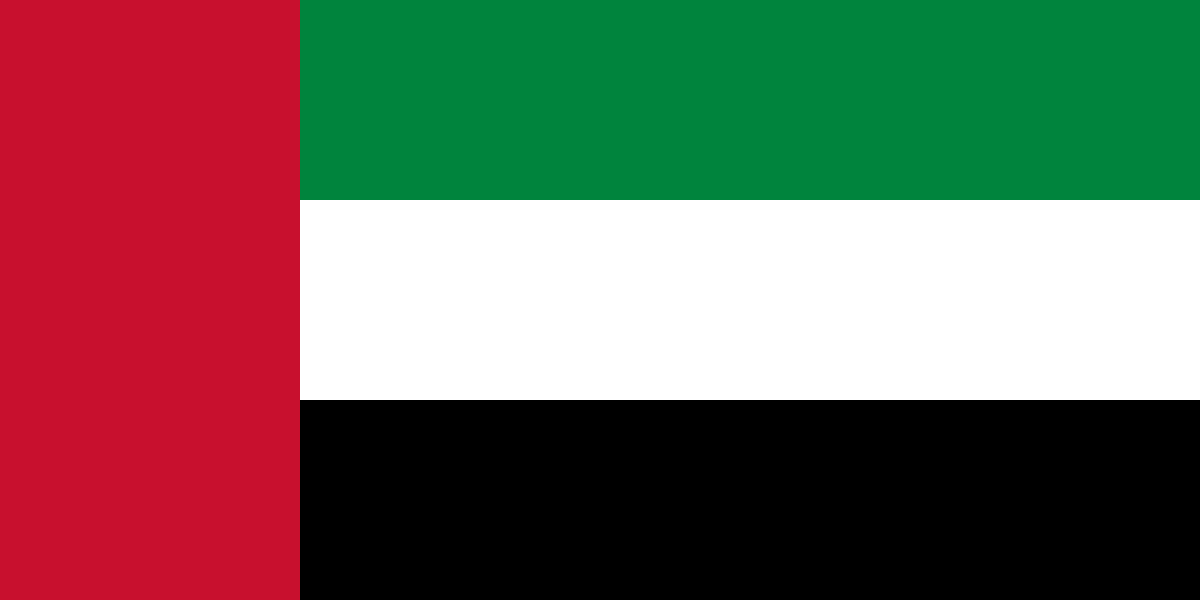
Among all countries, United Arab Emirates stands 1st in internet access. Can you guess its other standout statistics?
Among all countries, United Arab Emirates stands 1st in internet access. This achievement puts it ahead of the vast majority of countries. Can you guess its other standout statistics?
Area
84K km²
Pop.
10.09M
Stats
128
United Arab Emirates is a country in Asia with a population of 10.09M and an area of 83,600 km². Life expectancy is 82.9 years.
Short factual summary generated from the same country data used in game rounds.
Core numbers
Fast scan first, deep dive later.
Internet Users (%)
100%The percentage of people who have used the internet in the last 3 months.
CO2 Per Capita
20.13 t/person/yrAnnual carbon dioxide emissions in tonnes per person, from Our World in Data using the latest available country values in TerraBrawl.
Human Development Index
0.94Composite 0-1 index of life expectancy, education, and income, from Our World in Data using the latest available country values in TerraBrawl.
GDP Per Capita (PPP)
$79,228.74GDP per person, adjusted for purchasing power parity (PPP) so costs of living are comparable across countries.
GDP Per Capita
$68,584.66GDP per person adjusted for purchasing power in constant 2017 international dollars, from Our World in Data using the latest available country values in TerraBrawl.
Life Expectancy
82.9 yearsAverage number of years a newborn would be expected to live if current mortality patterns stayed the same, from Our World in Data.
Country briefing
A quick real-world briefing before you dive deeper into rankings, surprises, and matchups.
Curated stat
Al Ain shows settled desert life going back to the Neolithic, with ancient oasis irrigation.
Geography
Size snapshot: slightly larger than South Carolina.
Culture
Major languages include Arabic (official), English, Hindi, Malayalam, and more.
Cities
Browse this country's cities before City Detective asks you to guess.
Top stats
The strongest source-backed stats before the deeper data table.
Electricity Access (%)
100%The percentage of the population with access to electricity.
Mobile Subscriptions (%)
203 per 100 peopleMobile cellular subscriptions per 100 people, from World Bank Open Data.
Women in Parliament (%)
50%The percentage of parliament seats held by women.
Military Spending
5.6% of GDPMilitary expenditure as a share of GDP, from World Bank Open Data.
Air Passengers
91.06MTotal passengers carried by airlines registered in that country, regardless of where flights originated or ended.
Reality checks
The stats that tend to surprise players in real rounds.
Only ranks #214 in dependency ratio
Dependents as a share of the working-age population, from World Bank Open Data.
Keeps suicide rate unusually low
Suicide mortality rate per 100,000 people, from World Bank Open Data.
Keeps unemployment rate unusually low
The percentage of the workforce that is unemployed but actively looking for work.
Only ranks #191 in renewable energy (%)
The percentage of energy consumption that comes from renewable sources like solar, wind, and hydro.
Ranks #15 globally in tourist arrivals
How many international tourists visit the country each year.
Compared with the region
Country vs continent vs world averages
GDP per person, adjusted for purchasing power parity (PPP) so costs of living are comparable across countries.
How many years a newborn can expect to live, based on current mortality rates.
Composite 0-1 index of life expectancy, education, and income, from Our World in Data using the latest available country values in TerraBrawl.
The percentage of people who have used the internet in the last 3 months.
Think you can guess which countries rank higher?
Play this countryFactbook notes
Country briefing
The Trucial States of the Persian Gulf coast granted the UK control of their defense and foreign affairs in 19th-century treaties.
The Trucial States of the Persian Gulf coast granted the UK control of their defense and foreign affairs in 19th-century treaties. In 1971, six of these states -- Abu Dhabi, 'Ajman, Al Fujayrah, Ash Shariqah, Dubayy, and Umm al Qaywayn -- merged to form the United Arab Emirates (UAE). Ra's al Khaymah joined in 1972.
The UAE's per-capita GDP is on par with those of leading West European nations. For more than three decades, oil and global finance drove the UAE's economy. In 2008-09, the confluence of falling oil prices, collapsing real estate prices, and the international banking crisis hit the UAE especially hard. The UAE did not experience the "Arab Spring" unrest seen elsewhere in the Middle East in 2010-11, partly because of the government's multi-year, $1.6-billion infrastructure investment plan for the poorer northern emirates, and its aggressive pursuit of advocates for political reform.
The UAE in recent years has played a growing role in regional affairs. In addition to donating billions of dollars in economic aid to help stabilize Egypt, the UAE was one of the first countries to join the Defeat ISIS coalition, and to participate as a key partner in a Saudi-led military campaign in Yemen. In 2020, the UAE and Bahrain signed a peace agreement (the Abraham Accords) with Israel -- brokered by the US -- in Washington, D.C. The UAE and Bahrain thus became the third and fourth Middle Eastern countries, along with Egypt and Jordan, to recognize Israel.
Data vault
Every tracked stat, grouped for fast scanning.
Keep exploring
Open the head-to-head pages people naturally search after reading this profile.
Jump straight to the rankings where this country has its strongest edge.
Turn United Arab Emirates's strongest number into a challenge card.
The percentage of people who have used the internet in the last 3 months.
United Arab Emirates has a population of 10.09M, ranking #93 globally by population.
United Arab Emirates is located in Asia. It has an area of 83,600 km².
Life expectancy in United Arab Emirates is 82.9 years, ranking #24 globally.
United Arab Emirates's GDP per capita (PPP) is $79,228.74, ranking #17 globally.
United Arab Emirates ranks particularly high in Internet Users (%) (#1), CO2 Per Capita (#7), Human Development Index (#15).
United Arab Emirates has an HDI of 0.940, ranking #15 globally. The HDI combines life expectancy, education, and income indicators.
United Arab Emirates has a population density of 147.6 people per km², ranking #78 globally.