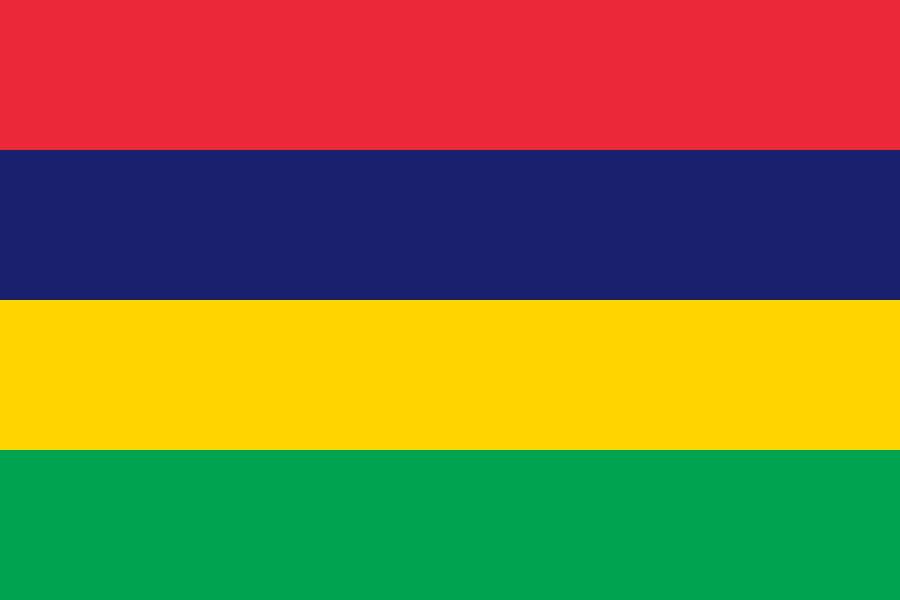
Geography
Location: Southern Africa, island in the Indian Ocean, about 800 km (500 mi) east of Madagascar.
CIA 2026
Loading TerraBrawl
Data as of May 28, 2026
Mauritius tops Africa for human development index. How does it compare to its neighbors?
Mauritius tops Africa for human development index. Neighbors look to it as a regional benchmark. How does it compare to its neighbors?
Area
2K km²
Pop.
1.31M
Stats
129
Mauritius is a country in Africa with a population of 1.31M and an area of 2,040 km². Life expectancy is 73.4 years.
Short factual summary generated from the same country data used in game rounds.
Core numbers
Fast scan first, deep dive later.
Population Density
625.26 /km²How many people live in each square kilometer of land.
Human Development Index
0.81Composite 0-1 index of life expectancy, education, and income, from Our World in Data using the latest available country values in TerraBrawl.
GDP Per Capita
$27,317.19GDP per person adjusted for purchasing power in constant 2017 international dollars, from Our World in Data using the latest available country values in TerraBrawl.
GDP Per Capita (PPP)
$31,839.76GDP per person, adjusted for purchasing power parity (PPP) so costs of living are comparable across countries.
CO2 Per Capita
3.7 t/person/yrAnnual carbon dioxide emissions in tonnes per person, from Our World in Data using the latest available country values in TerraBrawl.
Life Expectancy
74.9 yearsAverage number of years a newborn would be expected to live if current mortality patterns stayed the same, from Our World in Data.
Country briefing
A quick real-world briefing before you dive deeper into rankings, surprises, and matchups.
Geography
Location: Southern Africa, island in the Indian Ocean, about 800 km (500 mi) east of Madagascar.
Culture
Major languages include Creole 86.5%, Bhojpuri 5.3%, French 4.1%, two languages 1.4%, and more.
Identity
Formal name: Republic of Mauritius.
Cities
Browse this country's cities before City Detective asks you to guess.
Top stats
The strongest source-backed stats before the deeper data table.
Spirits Consumption
4.2 L/person/yrLiters of spirits consumed per person per year, from Our World in Data using the latest available country values in TerraBrawl.
Mobile Subscriptions (%)
173 per 100 peopleMobile cellular subscriptions per 100 people, from World Bank Open Data.
Suicide Rate
10.52 per 100kSuicide mortality rate per 100,000 people, from World Bank Open Data.
Reality checks
The stats that tend to surprise players in real rounds.
Only ranks #157 in military spending
Military expenditure as a share of GDP, from World Bank Open Data.
Only ranks #198 in dependency ratio
Dependents as a share of the working-age population, from World Bank Open Data.
Keeps air pollution (pm2.5) unusually low
The average level of fine particle air pollution (PM2.5) that people are exposed to.
Only ranks #145 in high-tech exports (%)
High-tech products (like computers, pharmaceuticals, and aerospace) as a percentage of total manufactured exports.
Only ranks #209 in land border length
Total length of land borders with neighboring countries from the frozen public-domain CIA World Factbook snapshot.
Compared with the region
Country vs continent vs world averages
GDP per person, adjusted for purchasing power parity (PPP) so costs of living are comparable across countries.
How many years a newborn can expect to live, based on current mortality rates.
Composite 0-1 index of life expectancy, education, and income, from Our World in Data using the latest available country values in TerraBrawl.
The percentage of people who have used the internet in the last 3 months.
Think you can guess which countries rank higher?
Play this countryFactbook notes
Country briefing
Although known to Arab and European sailors since at least the early 1500s, the island of Mauritius was uninhabited until 1638 when the Dutch established a settlement named in honor of Prince Maurits van NASSAU.
Although known to Arab and European sailors since at least the early 1500s, the island of Mauritius was uninhabited until 1638 when the Dutch established a settlement named in honor of Prince Maurits van NASSAU. Their presence led to the rapid disappearance of the flightless dodo bird that has since become one of the most well-known examples of extinction in modern times. The Dutch abandoned their financially distressed settlement in 1710, although a number of formerly enslaved people remained. In 1722, the French established what would become a highly profitable settlement focused on sugar cane plantations that were reliant on the labor of enslaved people brought to Mauritius from other parts of Africa. In the 1790s, the island had a brief period of autonomous rule when plantation owners rejected French control because of laws ending slavery that were temporarily in effect during the French Revolution. Britain captured the island in 1810 as part of the Napoleonic Wars but kept most of the French administrative structure, which remains to this day in the form of the country’s legal codes and widespread use of the French Creole language. The abolition of slavery in 1835 -- later than most other British colonies -- led to increased reliance on contracted laborers from the Indian subcontinent to work on plantations. Today their descendants form the majority of the population. Mauritius remained a strategically important British naval base and later an air station, and it played a role during World War II in anti-submarine and convoy operations, as well as in the collection of signals intelligence.
Mauritius gained independence from the UK in 1968 as a Parliamentary Republic and has remained a stable democracy with regular free elections and a positive human rights record. The country also attracted considerable foreign investment and now has one of Africa's highest per capita incomes. Mauritius’ often-fractious coalition politics has been dominated by two prominent families, each of which has had father-son pairs who have been prime minister over multiple, often nonconsecutive, terms. Seewoosagur RAMGOOLAM (1968-76) was Mauritius’ first prime minister, and he was succeeded by Anerood JUGNAUTH (1982-95, 2000-03, 2014-17); his son Navin RAMGOOLAM (1995-2000, 2005-14); and Paul Raymond BERENGER (2003-05), the only non-Hindu prime minister of post-independence Mauritius. In 2017, Pravind JUGNAUTH became prime minister after his father stepped down short of completing his term, and he was elected in his own right in 2019.
Mauritius claims the French island of Tromelin and the British Chagos Archipelago (British Indian Ocean Territory). Since 2017, Mauritius has secured favorable UN General Assembly resolutions and an International Court of Justice advisory opinion relating to its sovereignty dispute with the UK.
Data vault
Every tracked stat, grouped for fast scanning.
Keep exploring
Open the head-to-head pages people naturally search after reading this profile.
Jump straight to the rankings where this country has its strongest edge.
Turn Mauritius's strongest number into a challenge card.
How many people live in each square kilometer of land.
Mauritius has a population of 1.31M, ranking #158 globally by population.
Mauritius is located in Africa. It has an area of 2,040 km².
Life expectancy in Mauritius is 73.4 years, ranking #119 globally.
Mauritius's GDP per capita (PPP) is $31,839.76, ranking #77 globally.
Mauritius ranks particularly high in Population Density (#14), Human Development Index (#73), GDP Per Capita (#76).
Mauritius has an HDI of 0.806, ranking #73 globally. The HDI combines life expectancy, education, and income indicators.
Mauritius has a population density of 625.3 people per km², ranking #14 globally.