Argentina

South AmericaGlobal Leader

Argentina ranks #6 globally in university enrollment. At 107.8, it outperforms most of the world. Think you know what else Argentina excels at?

Argentina is a country in South America with a population of 45.42M and an area of 2,780,400 km². Life expectancy is 77.4 years.

At a Glance

The numbers that define this country

University Enrollment Rate

107.8%
#6globally

Total university and college enrollment as a percentage of the typical college-age population.

Land Area

2.74M
#8globally

Total land area in square kilometers, excluding lakes, rivers, and territorial waters.

Population

45.42M
#35globally

The total number of people living in the country.

Human Development Index

0.86
#47globally

The Human Development Index (HDI), combining life expectancy, education, and income into a single score from 0 to 1.

Internet Users (%)

89.7%
#61globally

The percentage of people who have used the internet in the last 3 months.

Life Expectancy

77.4 years
#77globally

How many years a newborn can expect to live, based on current mortality rates.

Where They Stand Out

Global rankings worth knowing

💰Inflation Rate

219.9%
#1globallyTop performer

How much prices increased over the year, based on the cost of everyday goods and services.

🌱Electricity Access (%)

100.0%
#6globallyTop performer

The percentage of the population with access to electricity.

🌍Land Boundaries Length

12.0K
#7globallyTop performer

Total land boundary length from CIA World Factbook.

🚀University Enrollment Rate

107.8%
#6globallyTop performer

Total university and college enrollment as a percentage of the typical college-age population.

👥Land Area

2.74M
#8globallyTop performer

Total land area in square kilometers, excluding lakes, rivers, and territorial waters.

Did You Know?

Facts that catch players off guard

💰

Ranks #1 in inflation rate (lower is better)

Inflation Rate: 219.9%

How much prices increased over the year, based on the cost of everyday goods and services.

World Bank 2023
🌱

Ranks #6 globally in electricity access (%)

Electricity Access (%): 100.0%

The percentage of the population with access to electricity.

World Bank 2023
🌍

Ranks #7 globally in land boundaries length

Land Boundaries Length: 12.0K

Total land boundary length from CIA World Factbook.

🚀

Ranks #6 globally in university enrollment rate

University Enrollment Rate: 107.8%

Total university and college enrollment as a percentage of the typical college-age population.

World Bank 2023
👥

Ranks #8 globally in land area

Land Area: 2.74M

Total land area in square kilometers, excluding lakes, rivers, and territorial waters.

World Bank 2023

Surprised? See how you stack up.

Play Now

How Argentina Compares

Country vs continent vs world averages

Argentina
South America avg
World avg

GDP per Capita

GDP per person, adjusted for purchasing power parity (PPP) so costs of living are comparable across countries.

World Bank 2023
Argentina30.4K
South America23.6K
World31.8K

Life Expectancy

Above avg

How many years a newborn can expect to live, based on current mortality rates.

World Bank 2023
Argentina77.4 years
South America76.3 years
World73.7 years

Human Development Index

Above avg

The Human Development Index (HDI), combining life expectancy, education, and income into a single score from 0 to 1.

Our World in Data 2023
Argentina0.86
South America0.81
World0.74

Internet Users

Above avg

The percentage of people who have used the internet in the last 3 months.

World Bank 2023
Argentina89.7%
South America85.6%
World70.3%

Think you can guess which countries rank higher?

Test Your Intuition
Regional comparison for Argentina across 4 key metrics, comparing with South America and world averages.

About Argentina

In 1816, the United Provinces of the Río de la Plata declared their independence from Spain. After Bolivia, Paraguay, and Uruguay went their separate ways, the area that remained became Argentina. European immigrants heavily shaped the country's population and culture, with Italy and Spain providing the largest percentage of newcomers from 1860 to 1930. Until about the mid-20th century, much of Argentina's history was dominated by periods of internal political unrest and conflict between civilian and military factions.

After World War II, former President Juan Domingo PERÓN -- the founder of the Peronist political movement -- introduced an era of populism, serving three non-consecutive terms in office until his death in 1974. Direct and indirect military interference in government throughout the PERÓN years led to a military junta taking power in 1976. In 1982, the junta failed in its bid to seize the Falkland Islands (Islas Malvinas) by force from the United Kingdom. Democracy was reinstated in 1983 and has persisted despite numerous challenges, the most formidable of which was a severe economic crisis in 2001-02 that led to violent public protests and the successive resignations of several presidents. The years 2003-15 saw Peronist rule by Néstor KIRCHNER (2003-07) and his spouse Cristina FERNÁNDEZ DE KIRCHNER (2007-15), who oversaw several years of strong economic growth (2003-11) followed by a gradual deterioration in the government’s fiscal situation and eventual economic stagnation and isolation. Argentina underwent a brief period of economic reform and international reintegration under Mauricio MACRI (2015-19), but a recession in 2018-19 and frustration with MACRI’s economic policies ushered in a new Peronist government in 2019 led by President Alberto FERNÁNDEZ and Vice President Cristina FERNÁNDEZ DE KIRCHNER. Argentina's high public debts, its pandemic-related inflationary pressures, and systemic monetary woes served as the catalyst for the 2023 elections, culminating with President Javier MILEI's electoral success. Argentina has since eliminated half of its government agencies and is seeking shock therapy to amend taxation and monetary policies.

🌍Geography & Climate6 facts
Location
Southern South America, bordering the South Atlantic Ocean, between Chile and Uruguay
Climate
mostly temperate; arid in southeast; subantarctic in southwest
Terrain
rich plains of the Pampas in northern half, flat to rolling plateau of Patagonia in south, rugged Andes along western border
Natural Resources
fertile plains of the pampas, lead, zinc, tin, copper, iron ore, manganese, petroleum, uranium, arable land
Natural Hazards
San Miguel de Tucumán and Mendoza areas in the Andes subject to earthquakes; pamperos are violent windstorms that can strike the pampas and northeast; heavy flooding in some areas volcanism: volcanic activity in the Andes Mountains along the Chilean border; Copahue (2,997 m) last erupted in 2000; other historically active volcanoes include Llullaillaco, Maipo, Planchón-Peteroa, San José, Tromen, Tupungatito, and Viedma
Size Comparison
slightly less than three-tenths the size of the US
👥People & Culture4 facts
Languages
Spanish (official), Italian, English, German, French, indigenous (Quechua, Guarani, Mapudungun)
Religions
Roman Catholic 62.9%, Evangelical 15.3% (Pentecostal 13%, other Evangelical 2.3%), Jehovah's Witness and Church of Jesus Christ 1.4%, other 1.2% (includes Muslim, Jewish), none 18.9% (includes agnostic and atheist), unspecified 0.3% (2019 est.)
Ethnic Groups
European (mostly Spanish and Italian descent) and Mestizo (mixed European and Indigenous ancestry) 97.2%, Indigenous 2.4%, African descent 0.4% (2010 est.)
Major Cities
15.490 million BUENOS AIRES (capital), 1.612 million Córdoba, 1.594 million Rosario, 1.226 million Mendoza, 1.027 million San Miguel de Tucumán, 914,000 La Plata (2023)
🏛️Government & History10 facts
Government Type
presidential republic
Capital
Buenos Aires
Capital Coordinates
34 36 S, 58 22 W
Capital Timezone
UTC-3 (2 hours ahead of Washington, DC, during Standard Time)
Official Name
Argentine Republic
Name Origin
the name is derived from one of the Spanish words for "silver," but the origin is unclear; it may have described the land next to the Rio de la Plata ("Silver River"), a major river that forms the boundary between Argentina and Uruguay; another possible source is the Spanish explorers in the 16th century mistakenly believing that the silver ornaments they bought from inhabitants came from a local source of silver
Independence
9 July 1816 (from Spain)
National Symbols
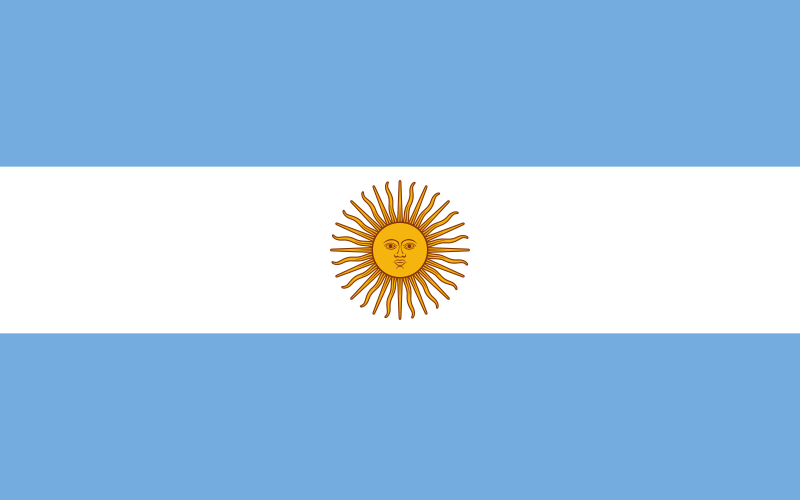
Sun of May (a sun-with-face symbol)
National Anthem
"Himno Nacional Argentino" (Argentine National Anthem)
UNESCO Heritage
12 (7 cultural, 5 natural)
💼Economy & Trade7 facts
Overview
large diversified economy; financial risks from debt obligations, rapid inflation, and reduced investor appetites; resource-rich, export-led growth model; increasing trade relations with China; G20 and OAS leader; tendency to nationalize businesses and under-report inflation
Industries
food processing, motor vehicles, consumer durables, textiles, chemicals and petrochemicals, printing, metallurgy, steel
Agricultural Products
maize, soybeans, sugarcane, wheat, milk, sunflower seeds, barley, beef, potatoes, chicken (2023)
Export Partners
Brazil 18%, USA 9%, Chile 8%, China 8%, India 4% (2023)
Export Commodities
soybean meal, corn, trucks, soybean oil, crude petroleum (2023)
Import Partners
Brazil 23%, China 20%, USA 12%, Paraguay 5%, Germany 4% (2023)
Import Commodities
soybeans, vehicle parts/accessories, refined petroleum, natural gas, cars (2023)
🔧Infrastructure & Defense5 facts
Military Forces
Armed Forces of the Argentine Republic (Fuerzas Armadas de la República Argentina): Argentine Army (Ejercito Argentino, EA), Navy of the Argentine Republic (Armada Republica, ARA; includes naval aviation and naval infantry), Argentine Air Force (Fuerza Aerea Argentina, FAA) Ministry of Security: Gendarmería Nacional Argentina (National Gendarmerie), Coast Guard (Prefectura Naval) (2025)
Military Service
18-24 years of age for voluntary military service for men and women; conscription suspended in 1995; citizens can still be drafted in times of crisis, national emergency, or war, or if the Defense Ministry is unable to fill all vacancies to keep the military functional (2025)
Energy Mix
fossil fuels: 61.5% of total installed capacity (2023 est.); nuclear: 6.9% of total installed capacity (2023 est.); solar: 2.5% of total installed capacity (2023 est.); wind: 11% of total installed capacity (2023 est.); hydroelectricity: 16.5% of total installed capacity (2023 est.); biomass and waste: 1.7% of total installed capacity (2023 est.)
Broadcast Media
one of South America's biggest media markets; dozens of TV networks, hundreds of radio stations, and more than 150 daily newspapers (2023)
Space Program
has a national space program and a history in the development of space-related capabilities, including rockets and satellites; develops, builds, and operates communications, remote sensing (RS), and scientific satellites, often in partnership with other countries; developing additional satellites with more advanced payloads; contracts with commercial and other government space agencies for launches, but has a domestic rocket program and is developing space launch vehicle (SLV) capabilities; cooperates with a broad range of space agencies and industries, including those of Brazil, China, the European Space Agency and its member states (particularly France, Italy), and the US; also has a commercial space industry (2025)

Deep Dive

69 of 88 metrics

Every stat we track, organized by category

💰Wealth & Economy10 metricsBest: #1
Inflation Rate
219.9%#1WB
GDP (Nominal)
638.37B#23WB
Youth Unemployment Rate
21.2%#50
Unemployment Rate
7.9%#54WB
GDP Per Capita
$26.5K#79OWID
GDP Per Capita (PPP)
30.4K#78WB
Government Debt (% GDP)
55.0%#86WB
FDI Inflows (% GDP)
1.8%#116WB
High-Tech Exports (%)
3.9%#106WB
GDP Growth Rate
-1.3%#198WB
🚀Education & Future6 metricsBest: #6
University Enrollment Rate
107.8%#6WB
Education Spending (% GDP)
5.9%#30WB
Foreign Patents
3.3K#23WB
Human Development Index
0.86#47OWID
Domestic Patents
406#49WB
R&D Spending (% GDP)
0.5%#59WB
🌱Environment10 metricsBest: #6
Electricity Access (%)
100.0%#6WB
Forest Area
282.5K#20WB
Carbon Emissions (Total)
198.14M#31
Irrigated Land
13.9K#33
CO2 Per Capita
3.74#91OWID
Renewable Energy (%)
14.8%#37OWID
Air Pollution (PM2.5)
14.908#129WB
Renewable Energy (%)
9.2%#149WB
Protected Land (%)
8.8%#159WB
Forest Coverage (%)
10.3%#165WB
🌍Land & Sea5 metricsBest: #7
Land Boundaries Length
12.0K#7
Highest Elevation
7.0K#9
Coastline Length
5.0K#26
Border Countries Count
5.00#38
Lowest Elevation
-105#232
👥Demographics12 metricsBest: #8
Land Area
2.74M#8WB
Urban Population (%)
92.3%#27WB
Population
45.42M#35WB
Elderly Population (%)
12.4%#76WB
Death Rate
7.94#88WB
Median Age
34.6 years#103
Teen Birth Rate
26.414#112WB
Youth Population (%)
21.6%#114WB
Dependency Ratio
51.561#140WB
Birth Rate
10.47#167WB
Fertility Rate
1.43#194WB
Population Density
16.64#193WB
🔧Infrastructure3 metricsBest: #10
Airports
764#10
Railway Length
17.9K#16
Merchant Ships
201#66
❤️Health & Survival10 metricsBest: #11
Doctors (per 1,000)
5.11#11WB
Health Spending (% GDP)
9.9%#31WB
Obesity Rate
36.0%#33OWID
Smoking Rate
23.8%#55WB
Hospital Beds (per 1,000)
3.30#54WB
Life Expectancy
77.4 years#77WB
Life Expectancy
77.4 years#86OWID
Suicide Rate
7.94#83WB
Child Mortality
9.60#126WB
Infant Mortality
8.20#127WB
🤝Society & Equality2 metricsBest: #16
Women in Parliament (%)
42.4%#19WB
Inequality (Gini)
42.4#16WB
Energy2 metricsBest: #24
Electricity Capacity
47.63M#29
Nuclear Electricity Share
6.3%#24
🍻Lifestyle4 metricsBest: #33
Beer Consumption
3.35#37OWID
Air Passengers
21.06M#33WB
Alcohol Consumption
8.05#48OWID
Spirits Consumption
0.61#104OWID
📡Technology3 metricsBest: #44
Mobile Subscriptions (%)
140#44WB
Internet Users (%)
89.7%#61WB
Broadband Access (%)
25#109WB
🛡️Military & Defense2 metricsBest: #50
Active Military Personnel
75.0K#50
Military Spend (% GDP)
0.6%#151

Neighboring Countries

Compare Argentina with...

Share a Fact

Share something surprising about Argentina!

Argentina
#6 in University Enrollment Rate

Total university and college enrollment as a percentage of the typical college-age population.

Top 5% globally
107.8%

Frequently Asked Questions about Argentina

What is the population of Argentina?

Argentina has a population of 45.42M, ranking #35 globally by population.

What continent is Argentina in?

Argentina is located in South America. It has an area of 2,780,400 km².

What is the life expectancy in Argentina?

Life expectancy in Argentina is 77.4 years, ranking #77 globally.

What is the GDP per capita of Argentina?

Argentina's GDP per capita (PPP) is 30.4K, ranking #78 globally.

What is Argentina known for in global statistics?

Argentina ranks particularly high in University Enrollment Rate (#6), Land Area (#8), Population (#35).

What is Argentina's Human Development Index?

Argentina has an HDI of 0.865, ranking #47 globally. The HDI combines life expectancy, education, and income indicators.

How densely populated is Argentina?

Argentina has a population density of 16.6 people per km², ranking #193 globally.
Think you know Argentina?

Compare countries, guess statistics, and prove you know your stuff.