Geography
Natural resources include tin, rubber, natural gas, tungsten, and more.
CIA 2026
Loading TerraBrawl
Data as of May 28, 2026
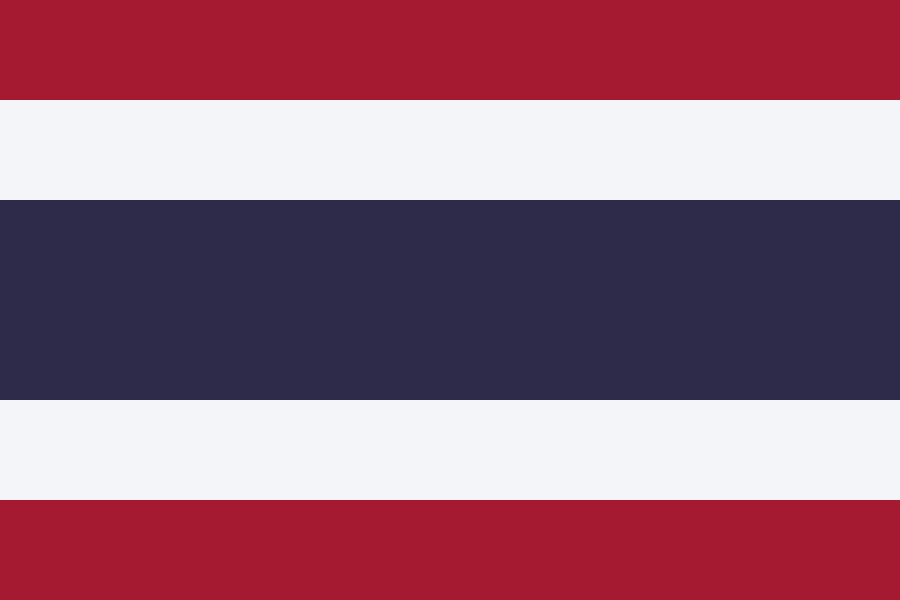
Thailand defies simple categorization. Test your assumptions about Thailand.
Thailand defies simple categorization. Strong at #4 for spirits consumption, it stumbles on fertility rate. Test your assumptions about Thailand.
Area
513K km²
Pop.
70.03M
Stats
129
Thailand is a country in Asia with a population of 70.03M and an area of 513,120 km². Life expectancy is 76.4 years.
Short factual summary generated from the same country data used in game rounds.
Core numbers
Fast scan first, deep dive later.
Land Area
510.9K km²Total land area in square kilometers, excluding lakes, rivers, and territorial waters.
Internet Users (%)
90.87%The percentage of people who have used the internet in the last 3 months.
Population Density
140.35 /km²How many people live in each square kilometer of land.
Human Development Index
0.80Composite 0-1 index of life expectancy, education, and income, from Our World in Data using the latest available country values in TerraBrawl.
Life Expectancy
76.4 yearsHow many years a newborn can expect to live, based on current mortality rates.
Country briefing
A quick real-world briefing before you dive deeper into rankings, surprises, and matchups.
Geography
Natural resources include tin, rubber, natural gas, tungsten, and more.
Culture
Major languages include Thai (official) only 90.7%, Thai and other languages 6.4%, only other languages 2.9% (includes Malay, Burmese);.
Identity
Formal name: Kingdom of Thailand.
Cities
Browse this country's cities before City Detective asks you to guess.
Bangkok
Thailand
Chiang Mai
Thailand
Nakhon Ratchasima
Thailand
Surat Thani
Thailand
Hat Yai
Songkhla, Thailand
Khon Kaen
Thailand
Nakhon Si Thammarat
Thailand
Ubon Ratchathani
Thailand
Top stats
The strongest source-backed stats before the deeper data table.
Spirits Consumption
4.9 L/person/yrLiters of spirits consumed per person per year, from Our World in Data using the latest available country values in TerraBrawl.
Irrigated Land
64.2K km²Irrigated land area from CIA World Factbook.
Armed Forces Personnel
455.0KTotal armed forces personnel from the World Bank latest available country value.
Suicide Rate
16.59 per 100kSuicide mortality rate per 100,000 people, from World Bank Open Data.
Mobile Subscriptions (%)
161 per 100 peopleMobile cellular subscriptions per 100 people, from World Bank Open Data.
Reality checks
The stats that tend to surprise players in real rounds.
Keeps unemployment rate unusually low
The percentage of the workforce that is unemployed but actively looking for work.
Has one of the highest total co2 emissions figures
Total carbon dioxide emissions excluding LULUCF from the World Bank latest available country value.
Ranks #29 globally in land border length
Total length of land borders with neighboring countries from the frozen public-domain CIA World Factbook snapshot.
Ranks #27 globally in electric generating capacity
Installed electricity generating capacity in kilowatts from the frozen public-domain CIA World Factbook snapshot.
Ranks #18 globally in foreign patents
How many patent applications are filed by non-residents each year.
Compared with the region
Country vs continent vs world averages
GDP per person, adjusted for purchasing power parity (PPP) so costs of living are comparable across countries.
How many years a newborn can expect to live, based on current mortality rates.
Composite 0-1 index of life expectancy, education, and income, from Our World in Data using the latest available country values in TerraBrawl.
The percentage of people who have used the internet in the last 3 months.
Think you can guess which countries rank higher?
Play this countryFactbook notes
Country briefing
Two unified Thai kingdoms emerged in the mid-13th century.
Two unified Thai kingdoms emerged in the mid-13th century. The Sukhothai Kingdom, located in the south-central plains, gained its independence from the Khmer Empire to the east. By the late 13th century, Sukhothai’s territory extended into present-day Burma and Laos. Sukhothai lasted until the mid-15th century. The Thai Lan Na Kingdom was established in the north with its capital at Chang Mai; the Burmese conquered Lan Na in the 16th century. The Ayutthaya Kingdom (14th-18th centuries) succeeded the Sukhothai and would become known as the Siamese Kingdom. During the Ayutthaya period, the Thai/Siamese peoples consolidated their hold on what is present-day central and north-central Thailand. Following a military defeat at the hands of the Burmese in 1767, the Siamese Kingdom rose to new heights under the military ruler TAKSIN, who defeated the Burmese occupiers and expanded the kingdom’s territory into modern-day northern Thailand (formerly the Lan Na Kingdom), Cambodia, Laos, and the Malay Peninsula. In the mid-1800s, Western pressure led to Siam signing trade treaties that reduced the country’s sovereignty and independence. In the 1890s and 1900s, the British and French forced the kingdom to cede Cambodian, Laotian, and Malay territories that had been under Siamese control.
Following a bloodless revolution in 1932 that led to the establishment of a constitutional monarchy, Thailand's political history was marked by a series of mostly bloodless coups with power concentrated among military and bureaucratic elites. Periods of civilian rule were unstable. The Cold War era saw a communist insurgency and the rise of strongman leaders. Thailand became a US treaty ally in 1954 after sending troops to Korea and later fighting alongside the US in Vietnam. In the 21st century, Thailand has experienced additional turmoil, including a military coup in 2006 that ousted then Prime Minister THAKSIN Chinnawat and large-scale street protests led by competing political factions in 2008-2010. In 2011, THAKSIN's youngest sister, YINGLAK Chinnawat, led the Puea Thai Party to an electoral win and assumed control of the government.
In 2014, after months of major anti-government protests in Bangkok, the Constitutional Court removed YINGLAK from office, and the Army, led by Gen. PRAYUT Chan-ocha, then staged a coup against the caretaker government. The military-affiliated National Council for Peace and Order (NCPO) ruled the country under PRAYUT for more than four years, drafting a new constitution that allowed the military to appoint the entire 250-member Senate and required a joint meeting of the House and Senate to select the prime minister -- which effectively gave the military a veto on the selection. King PHUMIPHON Adunyadet passed away in 2016 after 70 years on the throne; his only son, WACHIRALONGKON (aka King RAMA X), formally ascended the throne in 2019. The same year, a long-delayed election allowed PRAYUT to continue his premiership, although the results were disputed and widely viewed as skewed in favor of the party aligned with the military. The country again experienced major anti-government protests in 2020. The reformist Move Forward Party won the most seats in the 2023 election but was unable to form a government, and Srettha THRAVISIN from the Pheu Thai Party replaced PRAYUT as prime minister after forming a coalition of moderate and conservative parties.
Data vault
Every tracked stat, grouped for fast scanning.
Keep exploring
Open the head-to-head pages people naturally search after reading this profile.
Jump straight to the rankings where this country has its strongest edge.
Turn Thailand's strongest number into a challenge card.
The total number of people living in the country.
Thailand has a population of 70.03M, ranking #20 globally by population.
Thailand is located in Asia. It has an area of 513,120 km².
Life expectancy in Thailand is 76.4 years, ranking #88 globally.
Thailand's GDP per capita (PPP) is $24,712.07, ranking #90 globally.
Thailand ranks particularly high in Population (#20), Land Area (#50), Internet Users (%) (#57).
Thailand has an HDI of 0.798, ranking #76 globally. The HDI combines life expectancy, education, and income indicators.
Thailand has a population density of 140.3 people per km², ranking #82 globally.