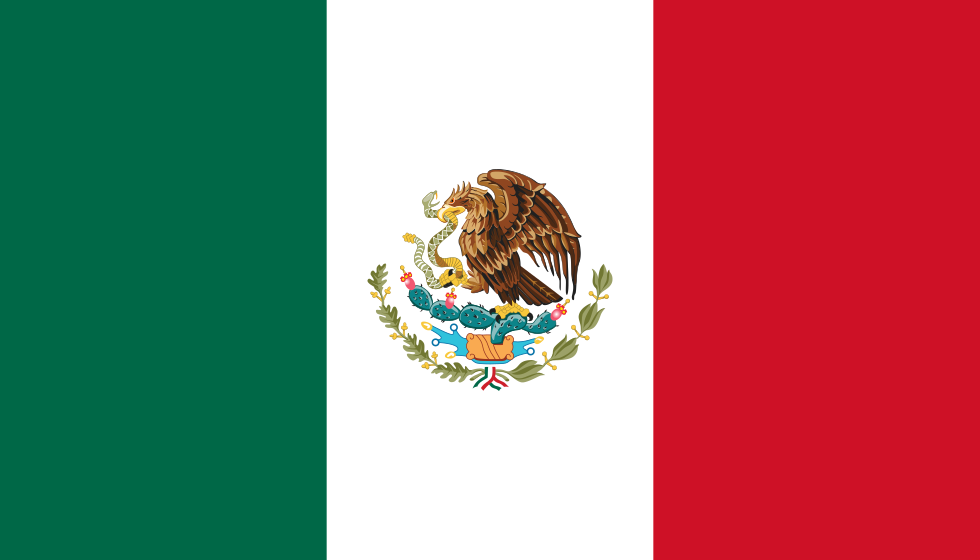
Mexico

North AmericaGlobal Leader

With a global ranking of #2, Mexico leads in tourist arrivals. Few places match this level of performance. Test your knowledge of this global leader.

Mexico is a country in North America with a population of 130.74M and an area of 1,964,375 km². Life expectancy is 75.1 years.

At a Glance

The numbers that define this country

Life Satisfaction

8.45
#1globally

How satisfied people are with their lives, rated on a scale from 0 to 10.

Population

130.74M
#10globally

The total number of people living in the country.

Land Area

1.94M
#13globally

Total land area in square kilometers, excluding lakes, rivers, and territorial waters.

Human Development Index

0.79
#82globally

The Human Development Index (HDI), combining life expectancy, education, and income into a single score from 0 to 1.

GDP Per Capita

$22.0K
#87globally

GDP per person, adjusted for purchasing power parity (PPP) so costs of living are comparable across countries.

GDP Per Capita (PPP)

25.7K
#87globally

GDP per person, adjusted for purchasing power parity (PPP) so costs of living are comparable across countries.

Where They Stand Out

Global rankings worth knowing

🤝Homicide Rate

27.4
#1globallyTop performer

Homicides per 100,000 people.

🤝Life Satisfaction

8.45
#1globallyTop performer

How satisfied people are with their lives, rated on a scale from 0 to 10.

🔧Airports

1.6K
#4globallyTop performer

Total airports from CIA World Factbook.

🍻Tourist Arrivals

51.13M
#2globallyTop performer

How many international tourists visit the country each year.

👥Population

130.74M
#10globallyTop performer

The total number of people living in the country.

Did You Know?

Facts that catch players off guard

🤝

Ranks #1 in homicide rate (lower is better)

Homicide Rate: 27.4

Homicides per 100,000 people.

OECD 2024
🔧

Ranks #4 globally in airports

Airports: 1.6K

Total airports from CIA World Factbook.

🍻

Ranks #2 globally in tourist arrivals

Tourist Arrivals: 51.13M

How many international tourists visit the country each year.

World Bank 2023
🤝

Ranks #4 globally in women in parliament (%)

Women in Parliament (%): 50.2%

The percentage of parliament seats held by women.

World Bank 2023
🚀

Only ranks #38 in life expectancy

Life Expectancy: 75.5 years

How many years a newborn can expect to live, based on current mortality rates.

OECD 2024

Surprised? See how you stack up.

Play Now

How Mexico Compares

Country vs continent vs world averages

Mexico
North America avg
World avg

GDP per Capita

GDP per person, adjusted for purchasing power parity (PPP) so costs of living are comparable across countries.

World Bank 2023
Mexico25.7K
North America38.3K
World31.8K

Life Expectancy

Above avg

How many years a newborn can expect to live, based on current mortality rates.

World Bank 2023
Mexico75.1 years
North America75.5 years
World73.7 years

Human Development Index

Above avg

The Human Development Index (HDI), combining life expectancy, education, and income into a single score from 0 to 1.

Our World in Data 2023
Mexico0.79
North America0.77
World0.74

Internet Users

Above avg

The percentage of people who have used the internet in the last 3 months.

World Bank 2023
Mexico81.0%
North America76.6%
World70.3%

Think you can guess which countries rank higher?

Test Your Intuition
Regional comparison for Mexico across 4 key metrics, comparing with North America and world averages.

About Mexico

Mexico was the site of several advanced Amerindian civilizations -- including the Olmec, Toltec, Teotihuacan, Zapotec, Maya, and Aztec -- until Spain conquered and colonized the area in the early 16th century. Administered as the Viceroyalty of New Spain for three centuries, it achieved independence early in the 19th century. Elections held in 2000 marked the first time since Mexican Revolution in 1910 that an opposition candidate -- Vicente FOX of the National Action Party (PAN) -- defeated the party in government, the Institutional Revolutionary Party (PRI). He was succeeded in 2006 by another PAN candidate Felipe CALDERON, but Enrique PEÑA NIETO regained the presidency for the PRI in 2012. Left-leaning anti-establishment politician and former mayor of Mexico City (2000-05) Andrés Manuel LÓPEZ OBRADOR, from the National Regeneration Movement (MORENA), became president in 2018.

The US-Mexico-Canada Agreement (USMCA, or T-MEC by its Spanish acronym) entered into force in 2020 and replaced its predecessor, the North American Free Trade Agreement (NAFTA). Mexico amended its constitution in 2019 to facilitate the implementation of the labor components of USMCA.

Mexico is currently the US's second-largest goods trading partner, after Canada. Ongoing economic and social concerns include low real wages, high underemployment, inequitable income distribution, and few advancement opportunities, particularly for the largely indigenous population in the impoverished southern states. Since 2007, Mexico's powerful transnational criminal organizations have engaged in a struggle to control criminal markets, resulting in tens of thousands of drug-related homicides and forced disappearances.

🌍Geography & Climate6 facts
Location
North America, bordering the Caribbean Sea and the Gulf of America, between Belize and the United States and bordering the North Pacific Ocean, between Guatemala and the United States
Climate
varies from tropical to desert
Terrain
high, rugged mountains; low coastal plains; high plateaus; desert
Natural Resources
petroleum, silver, antimony, copper, gold, lead, zinc, natural gas, timber
Natural Hazards
tsunamis along the Pacific coast; volcanoes and destructive earthquakes in the center and south; hurricanes on the Pacific, Gulf of America, and Caribbean coasts volcanism: volcanic activity in the central-southern part of the country; the volcanoes in Baja California are mostly dormant; Colima (3,850 m) is Mexico's most active volcano and is responsible for periodic evacuations of nearby villagers; it has been deemed a Decade Volcano by the International Association of Volcanology and Chemistry of the Earth's Interior, worthy of study due to its explosive history and close proximity to human populations; Popocatepetl (5,426 m) poses a threat to Mexico City; other historically active volcanoes include Barcena, Ceboruco, El Chichon, Michoacan-Guanajuato, Pico de Orizaba, San Martin, Socorro, and Tacana; see note 2 under "Geography - note"
Size Comparison
slightly less than three times the size of Texas
👥People & Culture4 facts
Languages
Spanish only 93.8%, Spanish and indigenous languages (including Mayan, Nahuatl, and others) 5.4%, indigenous only 0.6%, unspecified 0.2% (2020 est.)
Religions
Catholic 77.7%, no religion 10.6%, other Evangelical Churches 7.5%, Jehovah Witness 1.2%; less than 1 percent: Pentecostal, Seventh Day Adventist, Historics, not specified, Latter Day Saints, other religions (2020 est.)
Ethnic Groups
Mestizo (Indigenous-Spanish) 62%, predominantly Indigenous 21%, Indigenous 7%, other 10% (mostly European) (2012 est.)
Major Cities
22.281 million MEXICO CITY (capital), 5.420 million Guadalajara, 5.117 million Monterrey, 3.345 million Puebla, 2.626 million Toluca de Lerdo, 2.260 million Tijuana (2023)
🏛️Government & History10 facts
Government Type
federal presidential republic
Capital
Mexico City (Ciudad de Mexico)
Capital Coordinates
19 26 N, 99 08 W
Capital Timezone
UTC-6 (1 hour behind Washington, DC, during Standard Time)
Official Name
United Mexican States
Name Origin
name may derive from one of the Nahuatl (Aztec) names for the capital city, Metztlixihtlico, which probably meant "the center of the moon;" alternatively, it may come from Mexica, the original name of the Aztec people
Independence
16 September 1810 (declared independence from Spain); 27 September 1821 (recognized by Spain)
National Symbols
golden eagle, dahlia
National Anthem
"Himno Nacional Mexicano" (National Anthem of Mexico)
UNESCO Heritage
36 (28 cultural, 6 natural, 2 mixed)
💼Economy & Trade7 facts
Overview
upper-middle-income economy; highly integrated with US via trade and nearshore manufacturing; weak domestic demand, fiscal consolidation, and trade uncertainty contributing to sluggish growth; low unemployment; challenges from income inequality, corruption, and cartel-based violence
Industries
food and beverages, tobacco, chemicals, iron and steel, petroleum, mining, textiles, clothing, motor vehicles, consumer durables, tourism
Agricultural Products
sugarcane, maize, milk, oranges, sorghum, tomatoes, chicken, chillies/peppers, wheat, lemons/limes (2023)
Export Partners
USA 76%, Canada 5%, China 2%, Germany 2%, Spain 1% (2023)
Export Commodities
cars, vehicle parts/accessories, crude petroleum, trucks, computers (2023)
Import Partners
USA 46%, China 20%, Germany 4%, Japan 3%, S. Korea 3% (2023)
Import Commodities
vehicle parts/accessories, refined petroleum, integrated circuits, broadcasting equipment, cars (2023)
🔧Infrastructure & Defense5 facts
Military Forces
the Mexican Armed Forces (Fuerzas Armadas de México) are divided between the Secretariat of National Defense and the Secretariat of the Navy: Secretariat of National Defense (Secretaria de Defensa Nacional, SEDENA): Army (Ejercito), Mexican Air Force (Fuerza Aerea Mexicana, FAM), National Guard (Guardia Nacional); Secretariat of the Navy (Secretaria de Marina, SEMAR): Mexican Navy (Armada de Mexico (ARM), includes Naval Air Force (FAN), Mexican Naval Infantry Corps (Cuerpo de Infanteria de Marina, Mexmar or CIM)) Secretariat of Security and Civilian Protection/SEDENA: National Guard (2025)
Military Service
18 years of age (16 with parental consent) for voluntary service for men and women; men at age 18 subject to lottery-based 12-month compulsory military service (2025)
Energy Mix
fossil fuels: 79.6% of total installed capacity (2023 est.); nuclear: 3.2% of total installed capacity (2023 est.); solar: 4.2% of total installed capacity (2023 est.); wind: 5.7% of total installed capacity (2023 est.); hydroelectricity: 5.2% of total installed capacity (2023 est.); geothermal: 1.1% of total installed capacity (2023 est.); biomass and waste: 1% of total installed capacity (2023 est.)
Broadcast Media
telecom reform in 2013 ended a quasi-monopoly; now 885 TV stations and 1,841 radio stations, most privately owned; foreign satellite and cable operators are available; completed transition to digital in 2016 (2022)
Space Program
has a national space policy with a focus on expanding Mexico's commercial space sector, including acquiring satellites and developing specialists, technologies, and infrastructure; manufactures and operates communications and scientific satellites; conducts research on a range of space-related capabilities and technologies, including astronomy, astrophysics, Earth and weather sciences, remote sensing, robotics, satellite payloads, and telecommunications; works with a variety of foreign space agencies and commercial space industries, including those of Argentina, Brazil, Chile, the ESA, individual ESA member states (particularly France, Germany, and the UK), India, Japan, Peru, Russia, Ukraine, and the US; led effort to establish the Latin American and Caribbean Space Agency and hosts its headquarters (2025)

Deep Dive

78 of 146 metrics

Every stat we track, organized by category

🤝Society & Equality6 metricsBest: #1
Life Satisfaction
8.45#1OECD
Homicide Rate
27.4#1OECD
Women in Parliament (%)
50.2%#4WB
Inequality (Gini)
43.5#13WB
Safety at Night
48.0%#36OECD
Road Deaths
1.45#36OECD
🍻Lifestyle5 metricsBest: #2
Tourist Arrivals
51.13M#2WB
Air Passengers
78.76M#15WB
Beer Consumption
3.83#23OWID
Alcohol Consumption
4.79#88OWID
Spirits Consumption
0.50#111OWID
🔧Infrastructure3 metricsBest: #4
Airports
1.6K#4
Railway Length
23.4K#12
Merchant Ships
674#34
🌱Environment10 metricsBest: #10
Irrigated Land
59.9K#10
Forest Area
653.1K#11WB
Carbon Emissions (Total)
441.05M#13
Forest Coverage (%)
33.6%#97WB
CO2 Per Capita
3.52#101OWID
Protected Land (%)
15.3%#124WB
Renewable Energy (%)
13.0%#127WB
Electricity Access (%)
99.7%#132WB
Air Pollution (PM2.5)
14.992#128WB
Renewable Energy (%)
8.3%#56OWID
👥Demographics12 metricsBest: #10
Population
130.74M#10WB
Land Area
1.94M#13WB
Teen Birth Rate
60.099#53WB
Urban Population (%)
79.8%#63WB
Youth Population (%)
24.5%#102WB
Birth Rate
14.73#111WB
Elderly Population (%)
8.2%#108WB
Fertility Rate
1.85#126WB
Median Age
31.0 years#131
Population Density
66.74#136WB
Death Rate
6.04#151WB
Dependency Ratio
48.717#160WB
🚀Education & Future7 metricsBest: #11
Foreign Patents
15.0K#11WB
Domestic Patents
1.1K#30WB
Human Development Index
0.79#82OWID
University Enrollment Rate
47.5%#80WB
Education Spending (% GDP)
4.1%#98WB
R&D Spending (% GDP)
0.3%#72WB
Life Expectancy
75.5 years#38OECD
💰Wealth & Economy13 metricsBest: #13
GDP (Nominal)
1856.37B#13WB
High-Tech Exports (%)
19.3%#34WB
Inflation Rate
4.7%#69WB
GDP Per Capita
$22.0K#87OWID
GDP Per Capita (PPP)
25.7K#87WB
Gender Pay Gap (%)
11.4%#18OECD
FDI Inflows (% GDP)
2.4%#98WB
Government Debt (% GDP)
45.1%#118WB
GDP Growth Rate
1.4%#157WB
Unemployment Rate
2.7%#156WB
Youth Unemployment Rate
5.5%#157
Employment Rate (%)
70.9%#35OECD
Long-Term Unemployment
0.1%#36OECD
🌍Land & Sea5 metricsBest: #15
Coastline Length
9.3K#15
Highest Elevation
5.6K#20
Land Boundaries Length
4.4K#44
Border Countries Count
3.00#104
Lowest Elevation
-10#217
🛡️Military & Defense2 metricsBest: #16
Active Military Personnel
260.0K#16
Military Spend (% GDP)
0.9%#132
Energy2 metricsBest: #17
Electricity Capacity
105.59M#17
Nuclear Electricity Share
4.9%#27
❤️Health & Survival10 metricsBest: #31
Obesity Rate
36.1%#31OWID
Doctors (per 1,000)
2.59#78WB
Life Expectancy
75.1 years#102WB
Life Expectancy
75.1 years#121OWID
Suicide Rate
6.95#100WB
Infant Mortality
10.8#112WB
Child Mortality
12.5#115WB
Health Spending (% GDP)
5.7%#115WB
Smoking Rate
14.9%#102WB
Hospital Beds (per 1,000)
1.00#129WB
📡Technology3 metricsBest: #116
Internet Users (%)
81.0%#116WB
Mobile Subscriptions (%)
111.562#124WB
Broadband Access (%)
21#121WB

Neighboring Countries

Share a Fact

Share something surprising about Mexico!

Mexico
#1 in Life Satisfaction

How satisfied people are with their lives, rated on a scale from 0 to 10.

Top 5% globally
8.45

Frequently Asked Questions about Mexico

What is the population of Mexico?

Mexico has a population of 130.74M, ranking #10 globally by population.

What continent is Mexico in?

Mexico is located in North America. It has an area of 1,964,375 km².

What is the life expectancy in Mexico?

Life expectancy in Mexico is 75.1 years, ranking #102 globally.

What is the GDP per capita of Mexico?

Mexico's GDP per capita (PPP) is 25.7K, ranking #87 globally.

What is Mexico known for in global statistics?

Mexico ranks particularly high in Life Satisfaction (#1), Population (#10), Land Area (#13).

What is Mexico's Human Development Index?

Mexico has an HDI of 0.789, ranking #82 globally. The HDI combines life expectancy, education, and income indicators.

How densely populated is Mexico?

Mexico has a population density of 66.7 people per km², ranking #136 globally.
Think you know Mexico?

Compare countries, guess statistics, and prove you know your stuff.