Uruguay

South AmericaRegional Champion

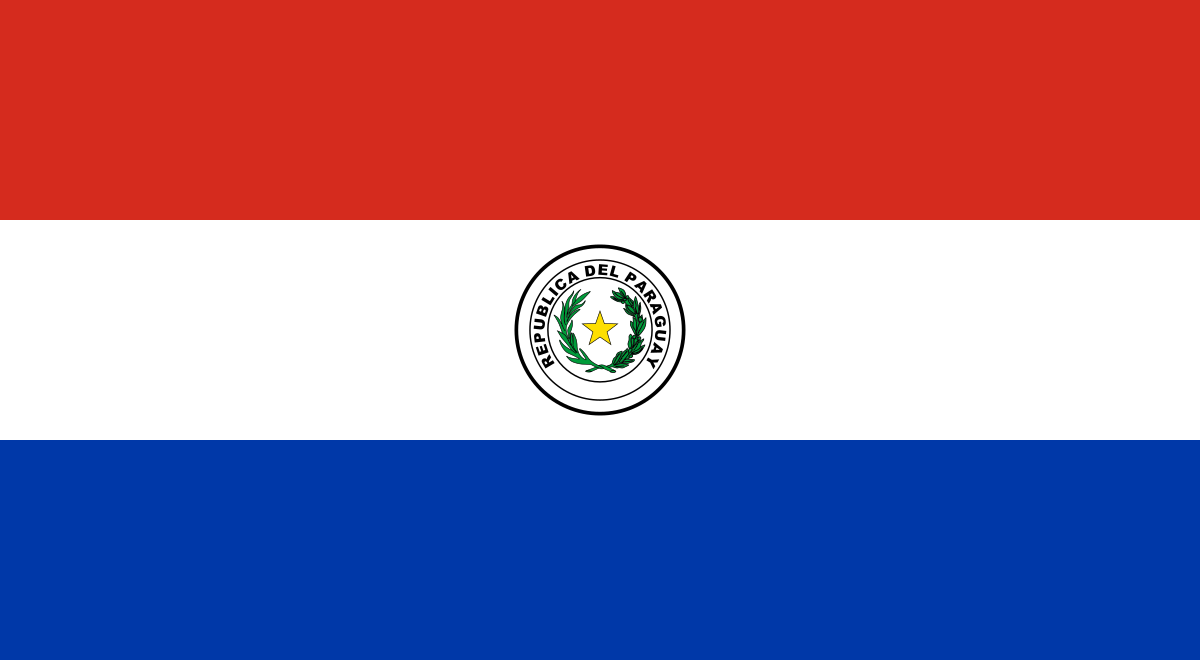
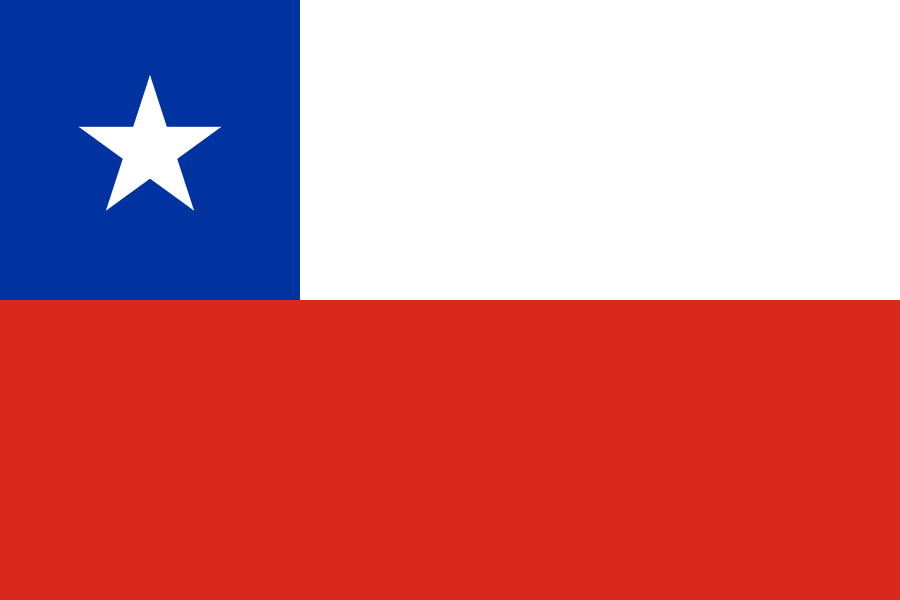
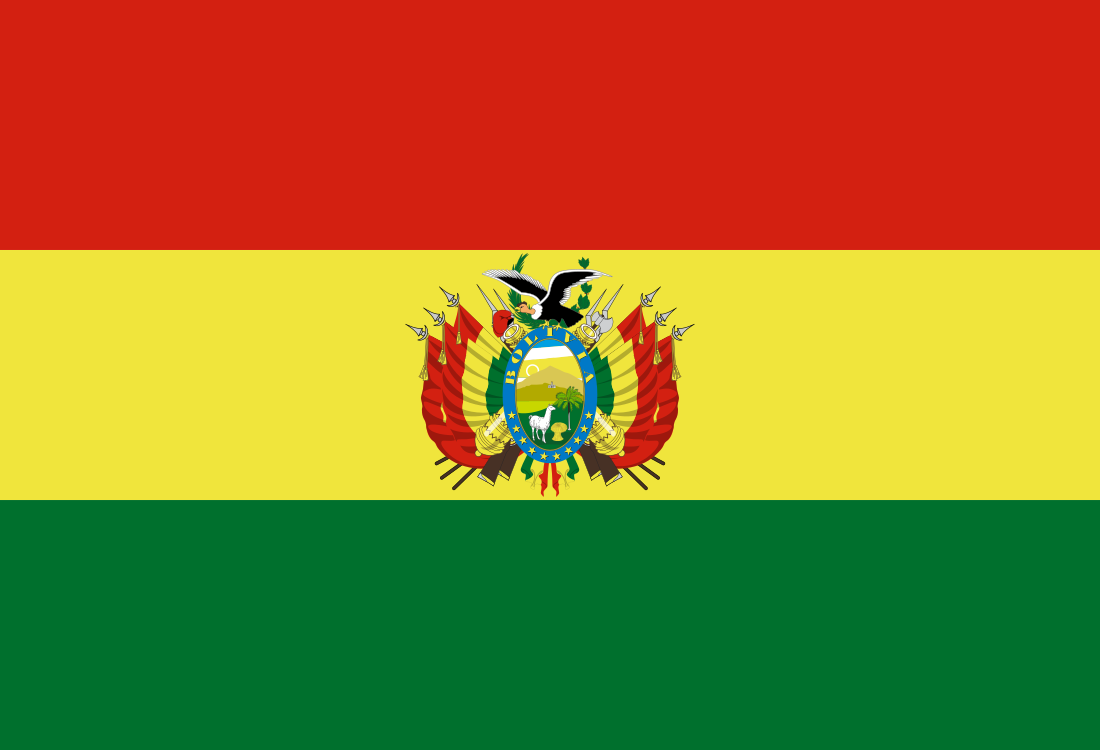
Uruguay tops South America for life expectancy. Neighbors look to it as a regional benchmark. How does it compare to its neighbors?

Uruguay is a country in South America with a population of 3.45M and an area of 181,034 km². Life expectancy is 78.1 years.

At a Glance

The numbers that define this country

University Enrollment Rate

80.0%
#27globally

Total university and college enrollment as a percentage of the typical college-age population.

Human Development Index

0.86
#49globally

The Human Development Index (HDI), combining life expectancy, education, and income into a single score from 0 to 1.

Internet Users (%)

92.0%
#52globally

The percentage of people who have used the internet in the last 3 months.

Life Expectancy

78.1 years
#62globally

How many years a newborn can expect to live, based on current mortality rates.

Life Expectancy

78.1 years
#73globally

How many years a newborn can expect to live, based on current mortality rates.

GDP Per Capita

$32.0K
#67globally

GDP per person, adjusted for purchasing power parity (PPP) so costs of living are comparable across countries.

Where They Stand Out

Global rankings worth knowing

❤️Suicide Rate

24.75
#5globallyTop performer

The number of suicide deaths per 100,000 people each year.

❤️Doctors (per 1,000)

4.67
#16globallyTop performer

The number of doctors per 1,000 people.

👥Urban Population (%)

95.6%
#19globallyTop performer

The percentage of people living in cities and urban areas.

💰Youth Unemployment Rate

26.4%
#29globallyTop performer

Youth unemployment rate (ages 15-24) from CIA World Factbook.

📡Mobile Subscriptions (%)

146
#37globally

The number of mobile phone subscriptions per 100 people.

Did You Know?

Facts that catch players off guard

❤️

Ranks #5 in suicide rate (lower is better)

Suicide Rate: 24.75

The number of suicide deaths per 100,000 people each year.

World Bank 2023
💰

Only ranks #192 in fdi inflows (% gdp)

FDI Inflows (% GDP): -4.9%

Foreign investment flowing into the country as a percentage of GDP.

World Bank 2023
👥

Only ranks #211 in fertility rate

Fertility Rate: 1.27

The average number of children a woman would have over her lifetime based on current birth rates.

World Bank 2023
👥

Ranks #19 globally in urban population (%)

Urban Population (%): 95.6%

The percentage of people living in cities and urban areas.

World Bank 2023
🌱

Only ranks #192 in protected land (%)

Protected Land (%): 3.1%

The percentage of land area designated as protected natural reserves or parks.

World Bank 2023

Surprised? See how you stack up.

Play Now

How Uruguay Compares

Country vs continent vs world averages

Uruguay
South America avg
World avg

GDP per Capita

Above avg

GDP per person, adjusted for purchasing power parity (PPP) so costs of living are comparable across countries.

World Bank 2023
Uruguay36.4K
South America23.6K
World31.8K

Life Expectancy

Above avg

How many years a newborn can expect to live, based on current mortality rates.

World Bank 2023
Uruguay78.1 years
South America76.3 years
World73.7 years

Human Development Index

Above avg

The Human Development Index (HDI), combining life expectancy, education, and income into a single score from 0 to 1.

Our World in Data 2023
Uruguay0.86
South America0.81
World0.74

Internet Users

Above avg

The percentage of people who have used the internet in the last 3 months.

World Bank 2023
Uruguay92.0%
South America85.6%
World70.3%

Think you can guess which countries rank higher?

Test Your Intuition
Regional comparison for Uruguay across 4 key metrics, comparing with South America and world averages.

About Uruguay

The Spanish founded the city of Montevideo in modern-day Uruguay in 1726 as a military stronghold, and it soon became an important commercial center due to its natural harbor. Argentina initially claimed Uruguay, but Brazil annexed the country in 1821. Uruguay declared its independence in 1825 and secured its freedom in 1828 after a three-year struggle. The administrations of President Jose BATLLE in the early 20th century launched widespread political, social, and economic reforms that established a statist tradition. A violent Marxist urban guerrilla movement named the Tupamaros (or Movimiento de Liberación Nacional-Tupamaros) launched in the late 1960s and pushed Uruguay's president to cede control of the government to the military in 1973. By year-end, the rebels had been crushed, but the military continued to expand its hold over the government. Civilian rule was restored in 1985. In 2004, the left-of-center Frente Amplio (FA) Coalition won national elections that effectively ended 170 years of political control by the Colorado and National (Blanco) parties. The left-of-center coalition retained the presidency and control of both chambers of congress until 2019. Uruguay's political and labor conditions are among the freest on the South American continent.

🌍Geography & Climate6 facts
Location
Southern South America, bordering the South Atlantic Ocean, between Argentina and Brazil
Climate
warm temperate; freezing temperatures almost unknown
Terrain
mostly rolling plains and low hills; fertile coastal lowland
Natural Resources
arable land, hydropower, minor minerals, fish
Natural Hazards
seasonally high winds (the pampero is a chilly and occasional violent wind that blows north from the Argentine pampas), droughts, floods; because of the absence of mountains, which act as weather barriers, all locations are particularly vulnerable to rapid changes from weather fronts
Size Comparison
about the size of Virginia and West Virginia combined; slightly smaller than the state of Washington
👥People & Culture4 facts
Languages
Spanish (official, Rioplatense is the most widely spoken dialect)
Religions
Roman Catholic 36.5%, Protestant 5% (Evangelical (non-specific) 4.6%, Adventist 0.2%, Protestant (non-specific) 0.3%), African American Cults/Umbanda 2.8%, Jehovah's Witness 0.6%, Church of Jesus Christ 0.2%, other 1%, Believer (not belonging to the church) 1.8%, agnostic 0.3%, atheist 1.3%, none 47.3%, unspecified 3.4% Roman Catholic 42%, Protestant 15%, other 6%, agnostic 3%, atheist 10%, unspecified 24% (2023 est.)
Ethnic Groups
White 87.7%, Black 4.6%, Indigenous 2.4%, other 0.3%, none or unspecified 5% (2011 est.)
Major Cities
1.774 million MONTEVIDEO (capital) (2023)
🏛️Government & History10 facts
Government Type
presidential republic
Capital
Montevideo
Capital Coordinates
34 51 S, 56 10 W
Capital Timezone
UTC-3 (2 hours ahead of Washington, DC, during Standard Time)
Official Name
Oriental Republic of Uruguay
Name Origin
name derives from the Uruguay River, which makes up the western border of the country; the river's name comes from the Guarani words uru (bird) and guay (tail)
Independence
25 August 1825 (from Brazil)
National Symbols
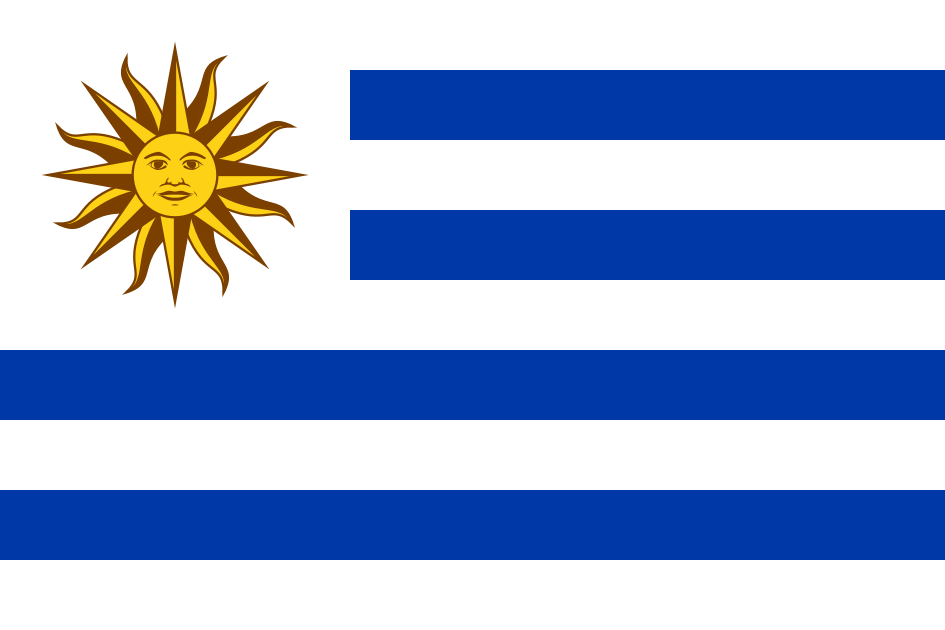
Sun of May (a sun-with-face symbol)
National Anthem
"Himno Nacional" (National Anthem of Uruguay)
UNESCO Heritage
3 (all cultural)
💼Economy & Trade7 facts
Overview
high-income, export-oriented South American economy; South America's largest middle class; low socioeconomic inequality; growing homicide rates; growing Chinese and EU relations; 2019 Argentine recession hurt; key milk, beef, rice, and wool exporter
Industries
food processing, electrical machinery, transportation equipment, petroleum products, textiles, chemicals, beverages
Agricultural Products
milk, rice, wheat, barley, soybeans, beef, rapeseed, sugarcane, maize, beef offal (2023)
Export Partners
China 21%, Brazil 17%, USA 8%, Argentina 5%, Netherlands 5% (2023)
Export Commodities
wood pulp, beef, milk, rice, wood (2023)
Import Partners
Brazil 22%, China 18%, Argentina 11%, USA 9%, Nigeria 4% (2023)
Import Commodities
crude petroleum, refined petroleum, cars, trucks, fertilizers (2023)
🔧Infrastructure & Defense4 facts
Military Forces
Armed Forces of Uruguay (Fuerzas Armadas del Uruguay or FF.AA. del Uruguay): National Army, National Navy (includes Coast Guard (Prefectura Nacional Naval or PRENA)), Uruguayan Air Force Ministry of Interior: National Police (2025)
Military Service
generally 18-30 years of age (up to 22 for the Navy and up to 40 for some specialist positions) for voluntary military service for men and women; initial 24-month service obligation (2025)
Energy Mix
fossil fuels: 8% of total installed capacity (2023 est.); solar: 3.8% of total installed capacity (2023 est.); wind: 37% of total installed capacity (2023 est.); hydroelectricity: 27.3% of total installed capacity (2023 est.); biomass and waste: 23.9% of total installed capacity (2023 est.)
Broadcast Media
mix of privately owned and state-run broadcast media; over 100 commercial radio stations and about 20 TV channels; cable TV is available; many community radio and TV stations; adopted the hybrid Japanese/Brazilian HDTV standard (ISDB-T) in 2010 (2019)

Deep Dive

64 of 85 metrics

Every stat we track, organized by category

❤️Health & Survival10 metricsBest: #5
Suicide Rate
24.75#5WB
Doctors (per 1,000)
4.67#16WB
Obesity Rate
34.7%#36OWID
Health Spending (% GDP)
8.9%#45WB
Life Expectancy
78.1 years#62WB
Life Expectancy
78.1 years#73OWID
Smoking Rate
20.5%#75WB
Hospital Beds (per 1,000)
2.50#81WB
Child Mortality
6.70#140WB
Infant Mortality
5.50#141WB
👥Demographics12 metricsBest: #19
Urban Population (%)
95.6%#19WB
Death Rate
9.88#39WB
Elderly Population (%)
16.0%#58WB
Median Age
37.4 years#87
Land Area
175.0K#90WB
Teen Birth Rate
26.188#115WB
Population
3.45M#133WB
Dependency Ratio
52.296#133WB
Youth Population (%)
18.3%#137WB
Birth Rate
9.05#188WB
Population Density
19.358#187WB
Fertility Rate
1.27#211WB
🤝Society & Equality2 metricsBest: #22
Inequality (Gini)
40#22WB
Women in Parliament (%)
28.3%#78WB
🚀Education & Future4 metricsBest: #27
University Enrollment Rate
80.0%#27WB
Human Development Index
0.86#49OWID
Education Spending (% GDP)
4.8%#68WB
R&D Spending (% GDP)
0.6%#54WB
💰Wealth & Economy10 metricsBest: #29
Youth Unemployment Rate
26.4%#29
Unemployment Rate
8.4%#52WB
Government Debt (% GDP)
66.4%#61WB
Inflation Rate
4.8%#67WB
GDP Per Capita
$32.0K#67OWID
GDP Per Capita (PPP)
36.4K#67WB
High-Tech Exports (%)
9.8%#65WB
GDP (Nominal)
80.96B#82WB
GDP Growth Rate
3.1%#109WB
FDI Inflows (% GDP)
-4.9%#192WB
📡Technology3 metricsBest: #37
Mobile Subscriptions (%)
146#37WB
Internet Users (%)
92.0%#52WB
Broadband Access (%)
32#87WB
🌱Environment9 metricsBest: #41
Renewable Energy (%)
57.8%#41WB
Irrigated Land
2.2K#69
Forest Area
20.9K#107WB
Electricity Access (%)
100.0%#121WB
CO2 Per Capita
2.35#124OWID
Carbon Emissions (Total)
6.90M#123
Forest Coverage (%)
12.0%#152WB
Air Pollution (PM2.5)
10.572#164WB
Protected Land (%)
3.1%#192WB
🛡️Military & Defense2 metricsBest: #66
Military Spend (% GDP)
2.1%#66
Active Military Personnel
23.0K#89
🔧Infrastructure3 metricsBest: #75
Airports
65#75
Railway Length
1.7K#79
Merchant Ships
58#115
🍻Lifestyle3 metricsBest: #82
Alcohol Consumption
5.61#82OWID
Beer Consumption
1.72#88OWID
Spirits Consumption
0.70#101OWID
Energy1 metricsBest: #85
Electricity Capacity
5.68M#85
🌍Land & Sea5 metricsBest: #96
Coastline Length
660#96
Land Boundaries Length
1.6K#104
Highest Elevation
514#192
Lowest Elevation
0#196
Border Countries Count
2.00#141

Neighboring Countries

Compare Uruguay with...

Share a Fact

Share something surprising about Uruguay!

Uruguay
#27 in University Enrollment Rate

Total university and college enrollment as a percentage of the typical college-age population.

Top 15% globally
80.0%

Frequently Asked Questions about Uruguay

What is the population of Uruguay?

Uruguay has a population of 3.45M, ranking #133 globally by population.

What continent is Uruguay in?

Uruguay is located in South America. It has an area of 181,034 km².

What is the life expectancy in Uruguay?

Life expectancy in Uruguay is 78.1 years, ranking #62 globally.

What is the GDP per capita of Uruguay?

Uruguay's GDP per capita (PPP) is 36.4K, ranking #67 globally.

What is Uruguay known for in global statistics?

Uruguay ranks particularly high in University Enrollment Rate (#27), Human Development Index (#49), Internet Users (%) (#52).

What is Uruguay's Human Development Index?

Uruguay has an HDI of 0.862, ranking #49 globally. The HDI combines life expectancy, education, and income indicators.

How densely populated is Uruguay?

Uruguay has a population density of 19.4 people per km², ranking #187 globally.
Think you know Uruguay?

Compare countries, guess statistics, and prove you know your stuff.