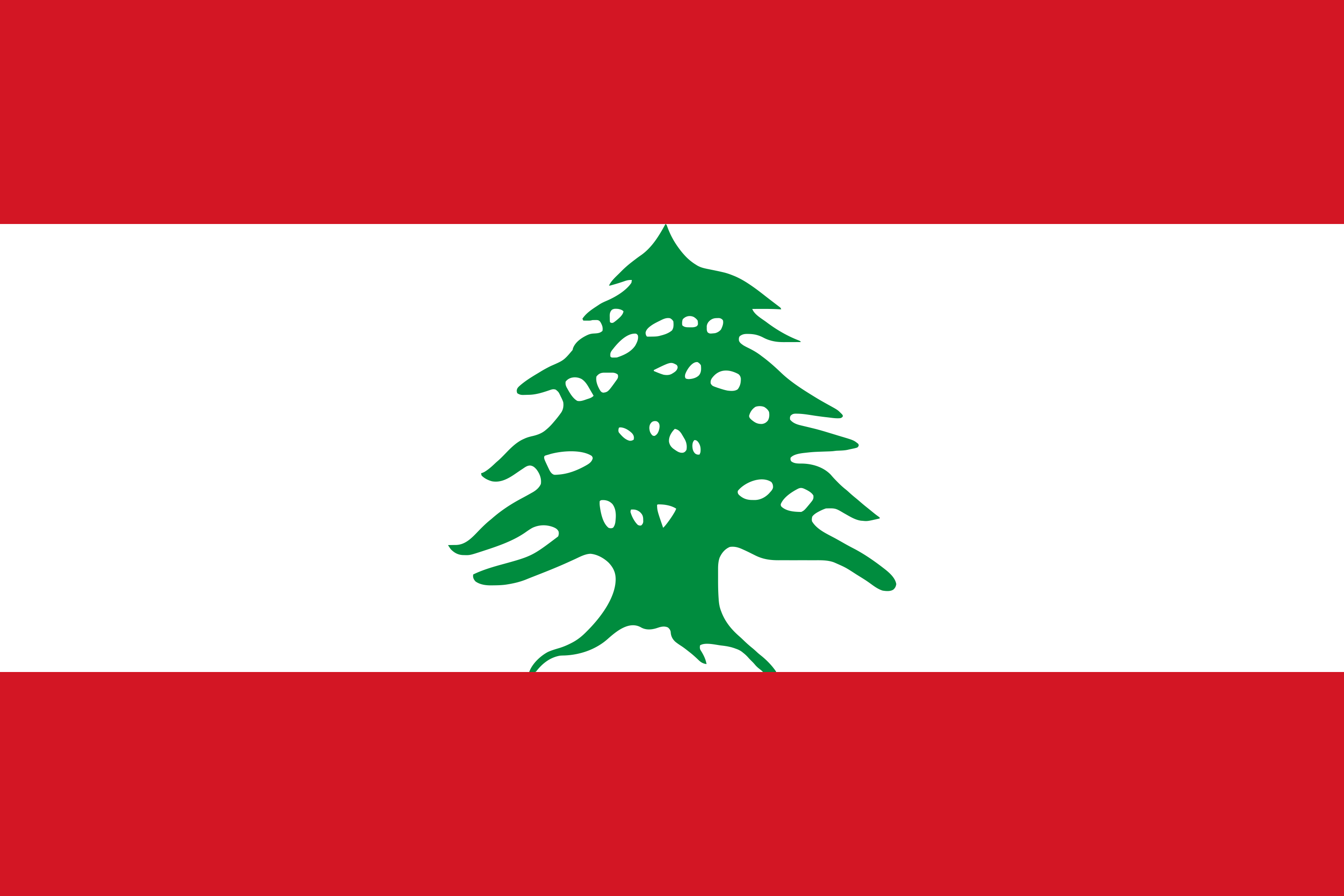
Culture
Major languages include Arabic (official), French, English, Armenian.
CIA 2026
Loading TerraBrawl
Data as of May 28, 2026
Lebanon defies simple categorization. Test your assumptions about Lebanon.
Lebanon defies simple categorization. It ranks #18 in population density, yet surprisingly lags in education spending. Test your assumptions about Lebanon.
Area
10K km²
Pop.
5.36M
Stats
125
Lebanon is a country in Asia with a population of 5.36M and an area of 10,452 km². Life expectancy is 77.8 years.
Short factual summary generated from the same country data used in game rounds.
Core numbers
Fast scan first, deep dive later.
Population Density
564.37 /km²How many people live in each square kilometer of land.
Life Expectancy
77.8 yearsHow many years a newborn can expect to live, based on current mortality rates.
Internet Users (%)
84%The percentage of people who have used the internet in the last 3 months.
University Enrollment Rate
54.4%Total university and college enrollment as a percentage of the typical college-age population.
Country briefing
A quick real-world briefing before you dive deeper into rankings, surprises, and matchups.
Culture
Major languages include Arabic (official), French, English, Armenian.
Identity
Formal name: Lebanese Republic.
Curated stat
Lebanon's Byblos has been inhabited since Neolithic times and is tied to the Phoenician alphabet.
Cities
Browse this country's cities before City Detective asks you to guess.
Top stats
The strongest source-backed stats before the deeper data table.
Government Debt (% GDP)
146.8% of GDPCentral government debt as a share of GDP, from World Bank Open Data.
Inflation Rate
45.2%How much prices increased over the year, based on the cost of everyday goods and services.
Smoking Rate
34.3%The percentage of people aged 15 and older who use tobacco products.
Urban Population (%)
90.7%The percentage of people living in cities and urban areas.
Military Spending
2.6% of GDPMilitary expenditure as a share of GDP, from World Bank Open Data.
Reality checks
The stats that tend to surprise players in real rounds.
Keeps suicide rate unusually low
Suicide mortality rate per 100,000 people, from World Bank Open Data.
Only ranks #179 in education spending (% gdp)
Government education spending as a share of GDP, from World Bank Open Data.
Only ranks #177 in women in parliament (%)
The percentage of parliament seats held by women.
Only ranks #192 in gdp growth rate
The annual percentage change in the country's GDP.
Only ranks #120 in railway length
Total railway length from CIA World Factbook.
Compared with the region
Country vs continent vs world averages
GDP per person, adjusted for purchasing power parity (PPP) so costs of living are comparable across countries.
How many years a newborn can expect to live, based on current mortality rates.
Composite 0-1 index of life expectancy, education, and income, from Our World in Data using the latest available country values in TerraBrawl.
The percentage of people who have used the internet in the last 3 months.
Think you can guess which countries rank higher?
Play this countryFactbook notes
Country briefing
As a result of its location at the crossroads of three continents, the area that is modern-day Lebanon is rich in cultural and religious diversity.
As a result of its location at the crossroads of three continents, the area that is modern-day Lebanon is rich in cultural and religious diversity. This region was subject to various foreign conquerors for much of its history, including the Romans, Arabs, and Ottomans. Following World War I, France acquired a mandate over the northern portion of the former Ottoman Empire province of Syria. From it the French demarcated the region of Lebanon in 1920, and it gained independence in 1943. Lebanon subsequently experienced periods of political turmoil interspersed with prosperity built on its position as a regional center for finance and trade.
The country's 1975-90 civil war, which resulted in an estimated 120,000 fatalities, was followed by years of social and political instability, and sectarianism remains a key element of Lebanese political life. The Israeli defense forces, which occupied parts of Lebanon during the civil war, did not completely withdraw until 2000. Neighboring Syria influenced Lebanon's foreign and domestic policies while its military occupied Lebanon from 1976 until 2005, but its influence diminished significantly after 2005. Over 1.5 million Syrian refugees fled to Lebanon after the start of the Syrian conflict in 2011. Hizballah -- a major Lebanese political party, militia, and US-designated foreign terrorist organization -- and Israel continued attacks and counterattacks against each other after Syria's withdrawal and fought a brief war in 2006. After HAMAS attacked Israel on 7 October 2023, the intensity and frequency of these cross-border attacks increased substantially into a cycle of hostilities, mostly limited to the border areas as of January 2024. Lebanon's borders with Syria and Israel remain unresolved.
Lebanon's prosperity has significantly diminished since the beginning of the country's economic crisis in 2019, which has crippled its economy, shut down its previously lucrative banking sector, reduced the value of its currency, and caused many Lebanese to emigrate in search of better prospects.
Data vault
Every tracked stat, grouped for fast scanning.
Keep exploring
Open the head-to-head pages people naturally search after reading this profile.
Jump straight to the rankings where this country has its strongest edge.
Turn Lebanon's strongest number into a challenge card.
How many people live in each square kilometer of land.
Lebanon has a population of 5.36M, ranking #122 globally by population.
Lebanon is located in Asia. It has an area of 10,452 km².
Life expectancy in Lebanon is 77.8 years, ranking #68 globally.
Lebanon's GDP per capita (PPP) is $12,574.83, ranking #128 globally.
Lebanon ranks particularly high in Population Density (#18), Life Expectancy (#68), Life Expectancy (#78).
Lebanon has an HDI of 0.752, ranking #102 globally. The HDI combines life expectancy, education, and income indicators.
Lebanon has a population density of 564.4 people per km², ranking #18 globally.