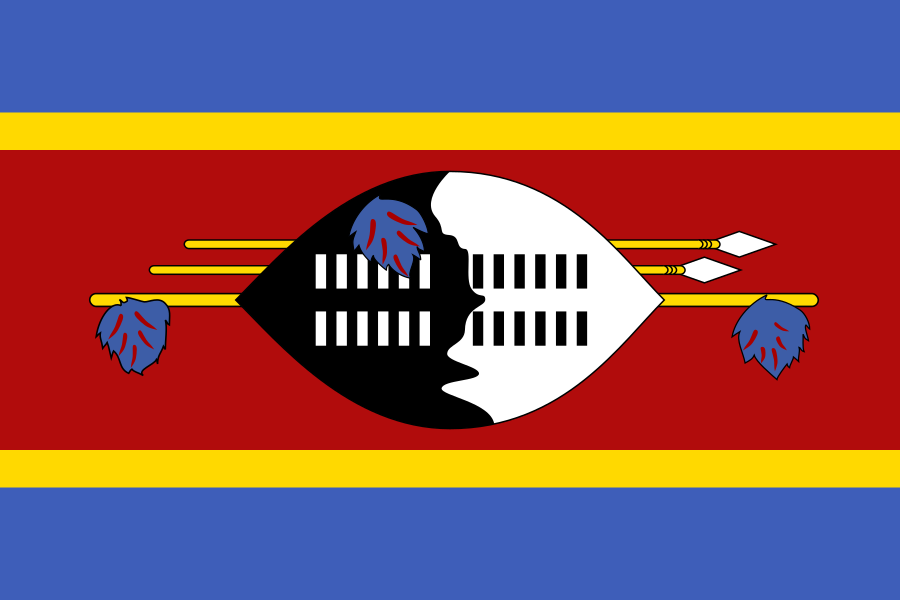
Geography
Climate: varies from tropical to near temperate.
CIA 2026
Loading TerraBrawl
Data as of May 28, 2026
Strong in one area, surprising in another — that's Eswatini. How well do you know Eswatini's stats?
Strong in one area, surprising in another — that's Eswatini. It ranks #24 in education spending, yet surprisingly lags in life expectancy. How well do you know Eswatini's stats?
Area
17K km²
Pop.
1.14M
Stats
118
Eswatini is a country in Africa with a population of 1.14M and an area of 17,364 km². Life expectancy is 64.1 years.
Short factual summary generated from the same country data used in game rounds.
Core numbers
Fast scan first, deep dive later.
Population Density
71.54 /km²How many people live in each square kilometer of land.
GDP Per Capita
$10,367.27GDP per person adjusted for purchasing power in constant 2017 international dollars, from Our World in Data using the latest available country values in TerraBrawl.
Human Development Index
0.69Composite 0-1 index of life expectancy, education, and income, from Our World in Data using the latest available country values in TerraBrawl.
GDP Per Capita (PPP)
$11,799.2GDP per person, adjusted for purchasing power parity (PPP) so costs of living are comparable across countries.
Internet Users (%)
58%The percentage of people who have used the internet in the last 3 months.
Country briefing
A quick real-world briefing before you dive deeper into rankings, surprises, and matchups.
Geography
Climate: varies from tropical to near temperate.
Culture
Major languages include English (official, used for government business), siSwati (official).
Identity
Formal name: Kingdom of Eswatini.
Cities
Browse this country's cities before City Detective asks you to guess.
Top stats
The strongest source-backed stats before the deeper data table.
Unemployment Rate
34.4%The percentage of the workforce that is unemployed but actively looking for work.
Suicide Rate
27.23 per 100kSuicide mortality rate per 100,000 people, from World Bank Open Data.
Youth Unemployment Rate
54.33% of youth labor forceShare of the labor force ages 15-24 that is unemployed from the World Bank latest available country value.
Education Spending (% GDP)
6.0% of GDPGovernment education spending as a share of GDP, from World Bank Open Data.
Renewable Energy (%)
64.7%The percentage of energy consumption that comes from renewable sources like solar, wind, and hydro.
Reality checks
The stats that tend to surprise players in real rounds.
Only ranks #231 in coastline length
Total coastline length from CIA World Factbook.
Only ranks #147 in air passengers
Total passengers carried by airlines registered in that country, regardless of where flights originated or ended.
Only ranks #157 in high-tech exports (%)
High-tech products (like computers, pharmaceuticals, and aerospace) as a percentage of total manufactured exports.
Only ranks #211 in urban population (%)
The percentage of people living in cities and urban areas.
Only ranks #122 in railway length
Total railway length from CIA World Factbook.
Compared with the region
Country vs continent vs world averages
GDP per person, adjusted for purchasing power parity (PPP) so costs of living are comparable across countries.
How many years a newborn can expect to live, based on current mortality rates.
Composite 0-1 index of life expectancy, education, and income, from Our World in Data using the latest available country values in TerraBrawl.
The percentage of people who have used the internet in the last 3 months.
Think you can guess which countries rank higher?
Play this countryFactbook notes
Country briefing
A Swazi kingdom was founded in the mid-18th century and ruled by a series of kings, including MSWATI II, a 19th century ruler whose name was adopted for the country and its predominant ethnic group.
A Swazi kingdom was founded in the mid-18th century and ruled by a series of kings, including MSWATI II, a 19th century ruler whose name was adopted for the country and its predominant ethnic group. European countries defined the kingdom’s modern borders during the late-19th century, and Swaziland (as it became known) was administered as a UK high commission territory from 1903 until its independence in 1968. A new constitution that came into effect in 2005 included provisions for a more independent parliament and judiciary, but the legal status of political parties remains unclear, and the kingdom is still considered an absolute monarchy. King MSWATI III renamed the country from Swaziland to Eswatini in 2018 to reflect the name most commonly used by its citizens.
In 2021, MSWATI III used security forces to suppress prodemocracy protests. A national dialogue and reconciliation process agreed to in the wake of violence has not materialized. In November 2023, King MSWATI III appointed a new prime minister following peaceful national elections. Despite its classification as a lower-middle income country, Eswatini suffers from severe poverty, corruption, and high unemployment. Eswatini has the world's highest HIV/AIDS prevalence rate, although recent years have shown marked declines in new infections. Eswatini is the only country in Africa that recognizes Taiwan.
Data vault
Every tracked stat, grouped for fast scanning.
Keep exploring
Open the head-to-head pages people naturally search after reading this profile.
Jump straight to the rankings where this country has its strongest edge.
Turn Eswatini's strongest number into a challenge card.
How many people live in each square kilometer of land.
Eswatini has a population of 1.14M, ranking #159 globally by population.
Eswatini is located in Africa. It has an area of 17,364 km².
Life expectancy in Eswatini is 64.1 years, ranking #190 globally.
Eswatini's GDP per capita (PPP) is $11,799.2, ranking #130 globally.
Eswatini ranks particularly high in Population Density (#134), GDP Per Capita (#129), Human Development Index (#127).
Eswatini has an HDI of 0.695, ranking #127 globally. The HDI combines life expectancy, education, and income indicators.
Eswatini has a population density of 71.5 people per km², ranking #134 globally.