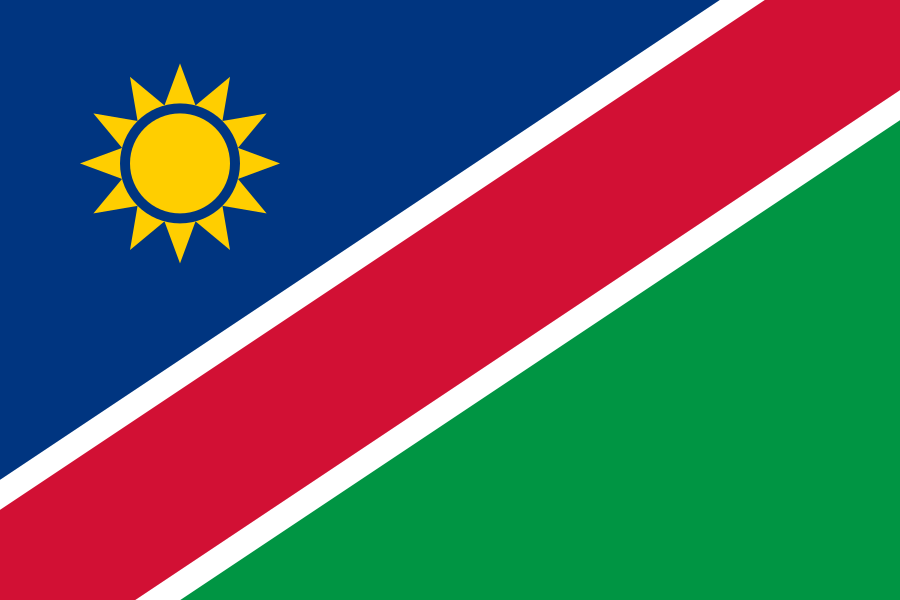
Curated stat
Namibia's Namib Desert is considered the oldest desert on Earth.
Loading TerraBrawl
Data as of May 28, 2026
Namibia defies simple categorization. Test your assumptions about Namibia.
Namibia defies simple categorization. Strong at #4 for education spending, it stumbles on population density. Test your assumptions about Namibia.
Area
826K km²
Pop.
2.85M
Stats
125
Namibia is a country in Africa with a population of 2.85M and an area of 825,615 km². Life expectancy is 67.4 years.
Short factual summary generated from the same country data used in game rounds.
Core numbers
Fast scan first, deep dive later.
Land Area
823.3K km²Total land area in square kilometers, excluding lakes, rivers, and territorial waters.
GDP Per Capita
$10,281.34GDP per person adjusted for purchasing power in constant 2017 international dollars, from Our World in Data using the latest available country values in TerraBrawl.
GDP Per Capita (PPP)
$11,686.6GDP per person, adjusted for purchasing power parity (PPP) so costs of living are comparable across countries.
Internet Users (%)
64%The percentage of people who have used the internet in the last 3 months.
Human Development Index
0.67Composite 0-1 index of life expectancy, education, and income, from Our World in Data using the latest available country values in TerraBrawl.
Country briefing
A quick real-world briefing before you dive deeper into rankings, surprises, and matchups.
Curated stat
Namibia's Namib Desert is considered the oldest desert on Earth.
Identity
Name origin: named for the coastal Namib Desert.
Geography
Size snapshot: almost seven times the size of Pennsylvania.
Cities
Browse this country's cities before City Detective asks you to guess.
Top stats
The strongest source-backed stats before the deeper data table.
Education Spending (% GDP)
9.1% of GDPGovernment education spending as a share of GDP, from World Bank Open Data.
Unemployment Rate
19.15%The percentage of the workforce that is unemployed but actively looking for work.
Youth Unemployment Rate
38.05% of youth labor forceShare of the labor force ages 15-24 that is unemployed from the World Bank latest available country value.
Protected Land (%)
39.9%The percentage of land area designated as protected natural reserves or parks.
Airports
294Large, medium, and small airport records by country from the open OurAirports dataset.
Reality checks
The stats that tend to surprise players in real rounds.
Only ranks #212 in population density
How many people live in each square kilometer of land.
Keeps government debt (% gdp) unusually low
Central government debt as a share of GDP, from World Bank Open Data.
Only ranks #140 in air passengers
Total passengers carried by airlines registered in that country, regardless of where flights originated or ended.
Ranks #24 globally in women in parliament (%)
The percentage of parliament seats held by women.
Only ranks #188 in electricity access (%)
The percentage of the population with access to electricity.
Compared with the region
Country vs continent vs world averages
GDP per person, adjusted for purchasing power parity (PPP) so costs of living are comparable across countries.
How many years a newborn can expect to live, based on current mortality rates.
Composite 0-1 index of life expectancy, education, and income, from Our World in Data using the latest available country values in TerraBrawl.
The percentage of people who have used the internet in the last 3 months.
Think you can guess which countries rank higher?
Play this countryFactbook notes
Country briefing
Various ethnic groups occupied southwestern Africa prior to Germany establishing a colony over most of the territory in 1884.
Various ethnic groups occupied southwestern Africa prior to Germany establishing a colony over most of the territory in 1884. South Africa occupied the colony, then known as German South West Africa, in 1915 during World War I and administered it as a mandate until after World War II, when it annexed the territory. In 1966, the Marxist South-West Africa People's Organization (SWAPO) guerrilla group launched a war of independence for the area that became Namibia, but it was not until 1988 that South Africa agreed to end its administration in accordance with a UN peace plan for the entire region. Namibia gained independence in 1990, and SWAPO has governed it since, although the party has dropped much of its Marxist ideology. President Hage GEINGOB was elected in 2014 in a landslide victory, replacing Hifikepunye POHAMBA, who stepped down after serving two terms. SWAPO retained its parliamentary super majority in the 2014 elections. In 2019 elections, GEINGOB was reelected but by a substantially reduced majority, and SWAPO narrowly lost its super majority in parliament.
Data vault
Every tracked stat, grouped for fast scanning.
Keep exploring
Open the head-to-head pages people naturally search after reading this profile.
Jump straight to the rankings where this country has its strongest edge.
Turn Namibia's strongest number into a challenge card.
Total land area in square kilometers, excluding lakes, rivers, and territorial waters.
Namibia has a population of 2.85M, ranking #140 globally by population.
Namibia is located in Africa. It has an area of 825,615 km².
Life expectancy in Namibia is 67.4 years, ranking #167 globally.
Namibia's GDP per capita (PPP) is $11,686.6, ranking #132 globally.
Namibia ranks particularly high in Land Area (#33), Population (#140), GDP Per Capita (#130).
Namibia has an HDI of 0.665, ranking #136 globally. The HDI combines life expectancy, education, and income indicators.
Namibia has a population density of 3.6 people per km², ranking #212 globally.