Curated stat
Egypt's population map hugs the Nile Valley and Delta: FAO says 98% of people live on only 3% of the land.
Loading TerraBrawl
Data as of May 28, 2026
Across Africa, Egypt stands first in economic output. Explore what drives its regional success.
Across Africa, Egypt stands first in economic output. Few in the region come close to matching it. Explore what drives its regional success.
Area
1.0M km²
Pop.
112.87M
Stats
129
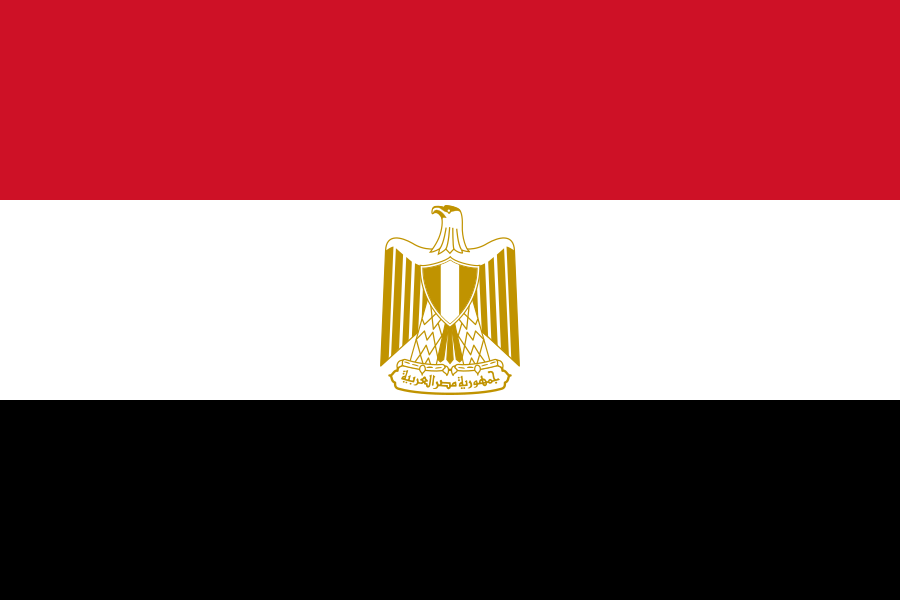
Egypt is a country in Africa with a population of 112.87M and an area of 1,002,450 km². Life expectancy is 71.6 years.
Short factual summary generated from the same country data used in game rounds.
Core numbers
Fast scan first, deep dive later.
Land Area
995.5K km²Total land area in square kilometers, excluding lakes, rivers, and territorial waters.
Population Density
115.06 /km²How many people live in each square kilometer of land.
Human Development Index
0.75Composite 0-1 index of life expectancy, education, and income, from Our World in Data using the latest available country values in TerraBrawl.
GDP Per Capita
$16,798.15GDP per person adjusted for purchasing power in constant 2017 international dollars, from Our World in Data using the latest available country values in TerraBrawl.
GDP Per Capita (PPP)
$19,094.14GDP per person, adjusted for purchasing power parity (PPP) so costs of living are comparable across countries.
Country briefing
A quick real-world briefing before you dive deeper into rankings, surprises, and matchups.
Curated stat
Egypt's population map hugs the Nile Valley and Delta: FAO says 98% of people live on only 3% of the land.
Identity
Name origin: the English name Egypt derives from the ancient Greek name for the country, "Aguptos," and the ancient Roman name, "Aegyptus," with the Greek form coming fr…
Geography
Size snapshot: more than eight times the size of Ohio.
Cities
Browse this country's cities before City Detective asks you to guess.
Cairo
Egypt
Alexandria
Egypt
Luxor
Egypt
Port Said
Egypt
Suez
Egypt
Al Fayyum
Faiyum, Egypt
Assiut
Asyut, Egypt
Aswān
Aswan, Egypt
Top stats
The strongest source-backed stats before the deeper data table.
Armed Forces Personnel
836.0KTotal armed forces personnel from the World Bank latest available country value.
Air Pollution (PM2.5)
54.86 µg/m³The average level of fine particle air pollution (PM2.5) that people are exposed to.
Irrigated Land
36.5K km²Irrigated land area from CIA World Factbook.
FDI Inflows (% GDP)
11.97% of GDPForeign direct investment net inflows as a share of GDP, from World Bank Open Data.
Obesity Rate
42.99%Share of adults with obesity, from Our World in Data using the latest available country values in TerraBrawl.
Reality checks
The stats that tend to surprise players in real rounds.
Keeps suicide rate unusually low
Suicide mortality rate per 100,000 people, from World Bank Open Data.
Only ranks #207 in forest coverage (%)
The percentage of land covered by forests - natural or planted trees at least 5 meters tall (excludes orchards and urban parks).
Only ranks #236 in lowest elevation
Lowest point elevation from CIA World Factbook.
Only ranks #176 in alcohol consumption
Liters of pure alcohol the average adult aged 15+ consumes per year, from Our World in Data using the latest available country values in TerraBrawl.
Has one of the highest inflation rate figures
How much prices increased over the year, based on the cost of everyday goods and services.
Compared with the region
Country vs continent vs world averages
GDP per person, adjusted for purchasing power parity (PPP) so costs of living are comparable across countries.
How many years a newborn can expect to live, based on current mortality rates.
Composite 0-1 index of life expectancy, education, and income, from Our World in Data using the latest available country values in TerraBrawl.
The percentage of people who have used the internet in the last 3 months.
Think you can guess which countries rank higher?
Play this countryFactbook notes
Country briefing
The regularity and richness of the annual Nile River flood, coupled with semi-isolation provided by deserts to the east and west, allowed for the development of one of the world's great civilizations in Egypt.
The regularity and richness of the annual Nile River flood, coupled with semi-isolation provided by deserts to the east and west, allowed for the development of one of the world's great civilizations in Egypt. A unified kingdom arose circa 3200 B.C., and a series of dynasties ruled in Egypt for the next three millennia. The last native dynasty fell to the Persians in 341 B.C., who in turn were replaced by the Greeks, Romans, and Byzantines. Arab conquerors introduced Islam and the Arabic language in the 7th century and ruled for the next six centuries. The Mamluks, a local military caste, took control around 1250 and continued to govern after the Ottoman Turks conquered Egypt in 1517.
Completion of the Suez Canal in 1869 elevated Egypt as an important world transportation hub. Ostensibly to protect its investments, Britain seized control of Egypt's government in 1882, but the country's nominal allegiance to the Ottoman Empire continued until 1914. Egypt gained partial independence from the UK in 1922 and full sovereignty in 1952. British forces evacuated the Suez Canal Zone in 1956. The completion of the Aswan High Dam in 1971 and the resultant Lake Nasser have reaffirmed the time-honored place of the Nile River in the agriculture and ecology of Egypt. A rapidly growing population (the largest in the Arab world), limited arable land, and dependence on the Nile all continue to overtax resources and stress society. The government has struggled to meet the demands of Egypt's fast-growing population as it implements large-scale infrastructure projects, energy cooperation, and foreign direct investment appeals.
Inspired by the 2010 Tunisian revolution, Egyptian opposition groups led demonstrations and labor strikes countrywide, culminating in President Hosni MUBARAK's ouster in 2011. Egypt's military assumed national leadership until a new legislature was in place in early 2012; later that same year, Muslim Brotherhood candidate Mohamed MORSI won the presidential election. Following protests throughout the spring of 2013 against MORSI's government and the Muslim Brotherhood, the Egyptian Armed Forces intervened and removed MORSI from power in July 2013 and replaced him with interim president Adly MANSOUR. Simultaneously, the government began enacting laws to limit freedoms of assembly and expression. In 2014, voters approved a new constitution by referendum and then elected former defense minister Abdel Fattah EL-SISI president. EL-SISI was reelected to a second four-year term in 2018 and a third term in December 2023.
Data vault
Every tracked stat, grouped for fast scanning.
Keep exploring
Open the head-to-head pages people naturally search after reading this profile.
Jump straight to the rankings where this country has its strongest edge.
Turn Egypt's strongest number into a challenge card.
The total number of people living in the country.
Egypt has a population of 112.87M, ranking #15 globally by population.
Egypt is located in Africa. It has an area of 1,002,450 km².
Life expectancy in Egypt is 71.6 years, ranking #138 globally.
Egypt's GDP per capita (PPP) is $19,094.14, ranking #104 globally.
Egypt ranks particularly high in Population (#15), Land Area (#29), Population Density (#92).
Egypt has an HDI of 0.754, ranking #100 globally. The HDI combines life expectancy, education, and income indicators.
Egypt has a population density of 115.1 people per km², ranking #92 globally.