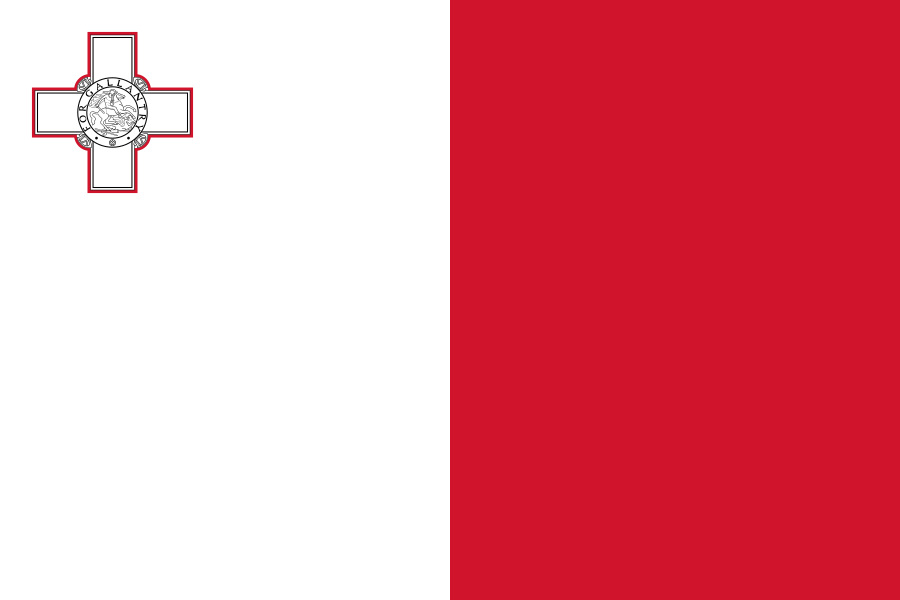
Malta

EuropeLand of Contrasts

The numbers tell two very different stories about Malta. A top performer in population density (#8), it falls behind in fertility rate. Think you can explain the gap?

Malta is a country in Europe with a population of 521.8K and an area of 316 km². Life expectancy is 83.5 years.

At a Glance

The numbers that define this country

Population Density

1.7K
#8globally

How many people live in each square kilometer of land.

Life Expectancy

83.5 years
#12globally

How many years a newborn can expect to live, based on current mortality rates.

Life Expectancy

83.3 years
#19globally

How many years a newborn can expect to live, based on current mortality rates.

Human Development Index

0.92
#24globally

The Human Development Index (HDI), combining life expectancy, education, and income into a single score from 0 to 1.

University Enrollment Rate

80.5%
#24globally

Total university and college enrollment as a percentage of the typical college-age population.

GDP Per Capita

$60.5K
#27globally

GDP per person, adjusted for purchasing power parity (PPP) so costs of living are comparable across countries.

Where They Stand Out

Global rankings worth knowing

💰FDI Inflows (% GDP)

170.5%
#1globallyTop performer

Foreign investment flowing into the country as a percentage of GDP.

❤️Doctors (per 1,000)

7.86
#3globallyTop performer

The number of doctors per 1,000 people.

👥Population Density

1.7K
#8globallyTop performer

How many people live in each square kilometer of land.

🔧Merchant Ships

2.0K
#14globallyTop performer

Merchant marine fleet size from CIA World Factbook.

🚀Human Development Index

0.92
#24globallyTop performer

The Human Development Index (HDI), combining life expectancy, education, and income into a single score from 0 to 1.

Did You Know?

Facts that catch players off guard

💰

Ranks #1 globally in fdi inflows (% gdp)

FDI Inflows (% GDP): 170.5%

Foreign investment flowing into the country as a percentage of GDP.

World Bank 2023
❤️

Ranks #3 globally in doctors (per 1,000)

Doctors (per 1,000): 7.86

The number of doctors per 1,000 people.

World Bank 2023
🔧

Only ranks #225 in airports

Airports: 1.00

Total airports from CIA World Factbook.

👥

Ranks #8 globally in population density

Population Density: 1.7K

How many people live in each square kilometer of land.

World Bank 2023
👥

Only ranks #221 in fertility rate

Fertility Rate: 1.18

The average number of children a woman would have over her lifetime based on current birth rates.

World Bank 2023

Surprised? See how you stack up.

Play Now

How Malta Compares

Country vs continent vs world averages

Malta
Europe avg
World avg

GDP per Capita

Above avg

GDP per person, adjusted for purchasing power parity (PPP) so costs of living are comparable across countries.

World Bank 2023
Malta69.8K
Europe57.5K
World31.8K

Life Expectancy

Above avg

How many years a newborn can expect to live, based on current mortality rates.

World Bank 2023
Malta83.5 years
Europe80.0 years
World73.7 years

Human Development Index

Above avg

The Human Development Index (HDI), combining life expectancy, education, and income into a single score from 0 to 1.

Our World in Data 2023
Malta0.92
Europe0.89
World0.74

Internet Users

Above avg

The percentage of people who have used the internet in the last 3 months.

World Bank 2023
Malta92.0%
Europe90.1%
World70.3%

Think you can guess which countries rank higher?

Test Your Intuition
Regional comparison for Malta across 4 key metrics, comparing with Europe and world averages.

About Malta

With a civilization that dates back thousands of years, Malta boasts some of the oldest megalithic sites in the world. Situated in the center of the Mediterranean, Malta's islands have long served as a strategic military asset, with the islands at various times falling under the control of the Phoenicians, Carthaginians, Greeks, Romans, Byzantines, Moors, Normans, Sicilians, Spanish, Knights of St. John, and French. Most recently a British colony (since 1814), Malta gained its independence in 1964 and declared itself a republic 10 years later. While under British rule, the island staunchly supported the UK through both world wars. Since the mid-1980s, the island has transformed itself into a freight transshipment point, a financial center, and a tourist destination, as its key industries moved toward more service-oriented activities. Malta became an EU member in 2004 and joined the eurozone in 2008.

🌍Geography & Climate6 facts
Location
Southern Europe, islands in the Mediterranean Sea, south of Sicily (Italy)
Climate
Mediterranean; mild, rainy winters; hot, dry summers
Terrain
mostly low, rocky, flat to dissected plains; many coastal cliffs
Natural Resources
limestone, salt, arable land
Natural Hazards
occasional droughts
Size Comparison
slightly less than twice the size of Washington, D.C.
👥People & Culture4 facts
Languages
Maltese (official) 90.1%, English (official) 6%, multilingual 3%, other 0.9% (2005 est.)
Religions
Roman Catholic (official) more than 90% (2006 est.)
Ethnic Groups
Maltese (descendants of ancient Carthaginians and Phoenicians with strong elements of Italian and other Mediterranean stock)
Major Cities
213,000 VALLETTA (capital) (2018)
🏛️Government & History10 facts
Government Type
parliamentary republic
Capital
Valletta
Capital Coordinates
35 53 N, 14 30 E
Capital Timezone
UTC+1 (6 hours ahead of Washington, DC, during Standard Time)
Official Name
Republic of Malta
Name Origin
the origin is unclear; the name may come from the ancient term mel, meaning "high" and probably referring to the island's rocks; the ancient Greeks called the island "Melite," possibly from the Greek word meli, meaning "honey" and referring to the island's honey production
Independence
21 September 1964 (from the UK)
National Symbols
Maltese eight-pointed cross
National Anthem
"L-Innu Malti" (The Hymn of Malta)
UNESCO Heritage
3 (all cultural)
💼Economy & Trade7 facts
Overview
high-income, EU-member European economy; diversified portfolio; euro user; dependent on food and energy imports; strong tourism, trade, and manufacturing sectors; high North African immigration; large welfare system; educated workforce
Industries
tourism, electronics, ship building and repair, construction, food and beverages, pharmaceuticals, footwear, clothing, tobacco, aviation services, financial services, information technology services
Agricultural Products
milk, tomatoes, onions, potatoes, chicken, cauliflower/broccoli, cabbages, pork, pumpkins/squash, watermelons (2023)
Export Partners
Nigeria 28%, Germany 10%, China 6%, Singapore 5%, Hong Kong 4% (2023)
Export Commodities
refined petroleum, integrated circuits, packaged medicine, ships, postage stamps/documents (2023)
Import Partners
Italy 18%, China 10%, Germany 8%, France 7%, Turkey 7% (2023)
Import Commodities
ships, refined petroleum, integrated circuits, aircraft, packaged medicine (2023)
🔧Infrastructure & Defense4 facts
Military Forces
the Armed Forces of Malta (AFM): Land Component (combat, combat support, and combat service support divided into three regiments), Maritime Squadron, Air Wing; Volunteer Reserve Force (2025)
Military Service
18-30 years of age for men and women for voluntary military service; no conscription (2026)
Energy Mix
fossil fuels: 86.4% of total installed capacity (2023 est.); solar: 13.2% of total installed capacity (2023 est.); biomass and waste: 0.4% of total installed capacity (2023 est.)
Broadcast Media
2 publicly owned TV stations, Television Malta and an educational channel; several privately owned national television stations, 2 of which are owned by political parties; Italian and British broadcast programs are available; multi-channel cable and satellite TV services are available; publicly owned radio broadcaster operates 3 stations; roughly 20 commercial radio stations (2019)

Deep Dive

66 of 85 metrics

Every stat we track, organized by category

💰Wealth & Economy10 metricsBest: #1
FDI Inflows (% GDP)
170.5%#1WB
High-Tech Exports (%)
45.2%#9WB
GDP Growth Rate
6.8%#16WB
GDP Per Capita
$60.5K#27OWID
GDP Per Capita (PPP)
69.8K#28WB
Government Debt (% GDP)
50.7%#97WB
GDP (Nominal)
24.97B#120WB
Youth Unemployment Rate
7.8%#139
Inflation Rate
1.7%#170WB
Unemployment Rate
2.7%#157WB
❤️Health & Survival10 metricsBest: #3
Doctors (per 1,000)
7.86#3WB
Life Expectancy
83.5 years#12WB
Life Expectancy
83.3 years#19OWID
Obesity Rate
34.6%#37OWID
Health Spending (% GDP)
9.5%#38WB
Hospital Beds (per 1,000)
4.40#34WB
Smoking Rate
24.7%#51WB
Suicide Rate
6.47#105WB
Infant Mortality
4.80#150WB
Child Mortality
5.50#152WB
👥Demographics12 metricsBest: #8
Population Density
1.7K#8WB
Urban Population (%)
95.7%#17WB
Elderly Population (%)
20.2%#31WB
Median Age
42.1 years#49
Death Rate
8.65#69WB
Dependency Ratio
49.797#152WB
Teen Birth Rate
10.398#156WB
Population
521.8K#171WB
Land Area
320#198WB
Birth Rate
7.67#211WB
Youth Population (%)
13.0%#205WB
Fertility Rate
1.18#221WB
🔧Infrastructure2 metricsBest: #14
Merchant Ships
2.0K#14
Airports
1.00#225
🚀Education & Future6 metricsBest: #24
Human Development Index
0.92#24OWID
University Enrollment Rate
80.5%#24WB
Education Spending (% GDP)
4.7%#70WB
R&D Spending (% GDP)
0.6%#56WB
Domestic Patents
5.00#111WB
Foreign Patents
5.00#121WB
📡Technology3 metricsBest: #39
Mobile Subscriptions (%)
142#39WB
Broadband Access (%)
44#48WB
Internet Users (%)
92.0%#51WB
🌱Environment9 metricsBest: #42
Protected Land (%)
28.9%#42WB
Electricity Access (%)
100.0%#82WB
CO2 Per Capita
3.20#107OWID
Carbon Emissions (Total)
8.96M#111
Irrigated Land
39#154
Renewable Energy (%)
8.6%#155WB
Air Pollution (PM2.5)
11.723#154WB
Forest Coverage (%)
1.4%#191WB
Forest Area
4.60#204WB
🤝Society & Equality2 metricsBest: #50
Women in Parliament (%)
27.8%#81WB
Inequality (Gini)
34.6#50WB
🍻Lifestyle5 metricsBest: #53
Beer Consumption
2.94#53OWID
Spirits Consumption
1.85#57OWID
Alcohol Consumption
7.11#62OWID
Air Passengers
2.39M#76WB
Tourist Arrivals
718.0K#69WB
Energy1 metricsBest: #137
Electricity Capacity
829.0K#137
🌍Land & Sea4 metricsBest: #139
Lowest Elevation
0#140
Coastline Length
196.8#139
Highest Elevation
253#210
Land Boundaries Length
0#208
🛡️Military & Defense2 metricsBest: #158
Active Military Personnel
2.0K#159
Military Spend (% GDP)
0.5%#158

Neighboring Countries

Compare Malta with...

Share a Fact

Share something surprising about Malta!

Malta
#8 in Population Density

How many people live in each square kilometer of land.

Top 5% globally
1.7K

Frequently Asked Questions about Malta

What is the population of Malta?

Malta has a population of 521.8K, ranking #171 globally by population.

What continent is Malta in?

Malta is located in Europe. It has an area of 316 km².

What is the life expectancy in Malta?

Life expectancy in Malta is 83.5 years, ranking #12 globally.

What is the GDP per capita of Malta?

Malta's GDP per capita (PPP) is 69.8K, ranking #28 globally.

What is Malta known for in global statistics?

Malta ranks particularly high in Population Density (#8), Life Expectancy (#12), Life Expectancy (#19).

What is Malta's Human Development Index?

Malta has an HDI of 0.924, ranking #24 globally. The HDI combines life expectancy, education, and income indicators.

How densely populated is Malta?

Malta has a population density of 1727.3 people per km², ranking #8 globally.
Think you know Malta?

Compare countries, guess statistics, and prove you know your stuff.