Curated stat
Vatican City has only hundreds of residents, fewer than many apartment buildings.
CIA
Loading TerraBrawl
Data as of May 28, 2026
At only 0 km², Holy See is remarkably compact. There's more here than meets the eye.
At only 0 km², Holy See is remarkably compact. Smaller than many cities, yet a fully recognized country. There's more here than meets the eye.
Area
0 km²
Pop.
1.0K
Stats
14
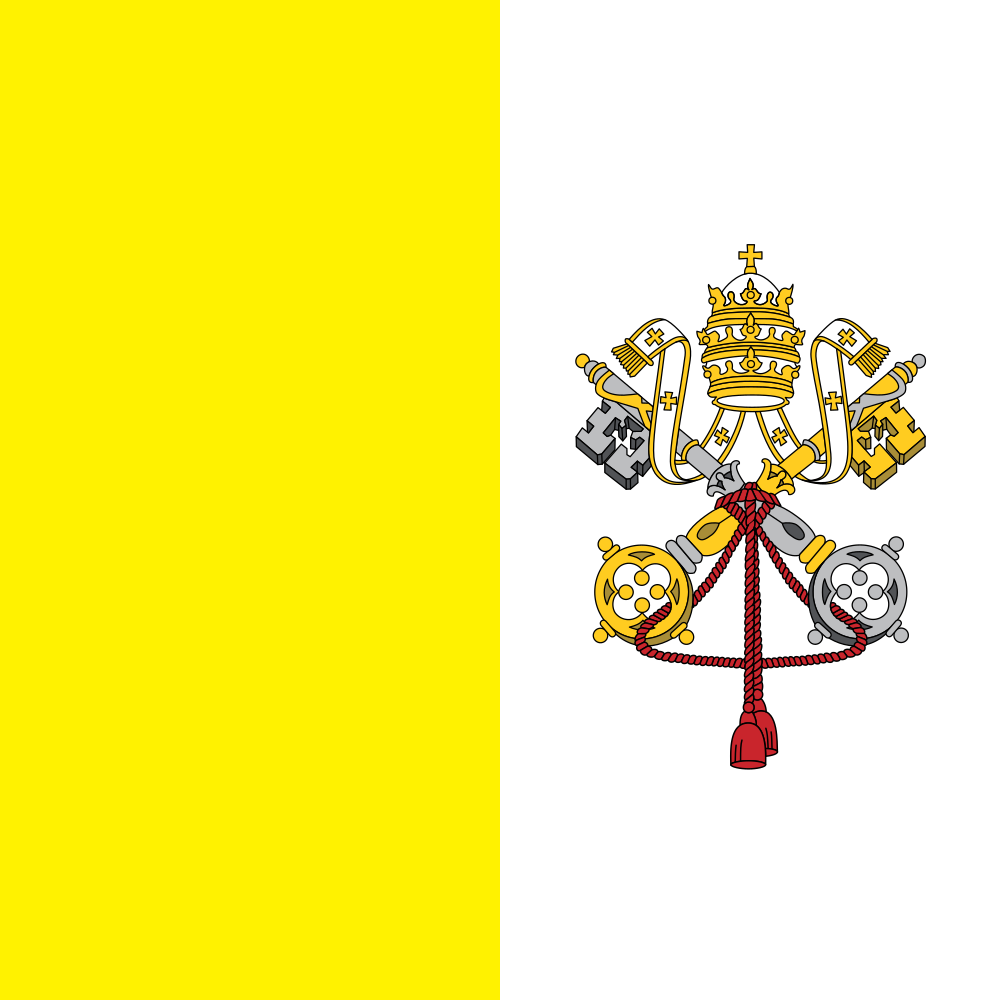
Holy See is a country in Europe with a population of 1.0K.
Short factual summary generated from the same country data used in game rounds.
Core numbers
Fast scan first, deep dive later.
Life Expectancy
83.0 yearsAverage number of years a newborn would be expected to live if current mortality patterns stayed the same, from Our World in Data.
Internet Users (%)
87%The percentage of people who have used the internet in the last 3 months.
Median Age
59.6 yearsThe age that splits the population in half: half are younger, half are older. UN WPP estimate as of 1 July 2023.
Urban Population (%)
100%The percentage of people living in cities and urban areas.
Lowest Elevation
19 mLowest point elevation from CIA World Factbook.
Country briefing
A quick real-world briefing before you dive deeper into rankings, surprises, and matchups.
Curated stat
Vatican City has only hundreds of residents, fewer than many apartment buildings.
Identity
Name origin: "holy" comes from the Greek word hera, meaning "sacred".
Geography
Size snapshot: about 0.7 times the size of the National Mall in Washington, D.C.
Top stats
The strongest source-backed stats before the deeper data table.
Land Border Length
3.4 kmTotal length of land borders with neighboring countries from the frozen public-domain CIA World Factbook snapshot.
Highest Elevation
78 mHighest point elevation from CIA World Factbook.
Coastline Length
0 kmTotal coastline length from CIA World Factbook.
Compared with the region
Country vs continent vs world averages
The percentage of people who have used the internet in the last 3 months.
Think you can guess which countries rank higher?
Play this countryFactbook notes
Country briefing
Popes in their secular role ruled portions of the Italian peninsula for more than a thousand years until the mid-19th century, when the newly established Kingdom of Italy seized many of the Papal States.
Popes in their secular role ruled portions of the Italian peninsula for more than a thousand years until the mid-19th century, when the newly established Kingdom of Italy seized many of the Papal States. In 1870, the pope's holdings were further circumscribed when Rome itself was annexed. Disputes between Italy and a series of "prisoner" popes were resolved in 1929 by three Lateran Treaties, which established the independent state of Vatican City and granted Roman Catholicism special status in Italy. In 1984, a concordat between the Holy See and Italy modified some of the earlier treaty provisions, including the primacy of Roman Catholicism as the Italian state religion.
Present concerns of the Holy See include religious freedom, threats against minority Christian communities in Africa and the Middle East, the plight of refugees and migrants, climate change and the environment, conflict and war, nuclear weapons, artificial intelligence, sexual misconduct by clergy, humanitarian issues, interreligious dialogue and reconciliation, and the application of church doctrine in an era of rapid change and globalization. About 1.3 billion people worldwide profess Catholicism, the world's largest Christian faith.
Data vault
Every tracked stat, grouped for fast scanning.
Keep exploring
Open the head-to-head pages people naturally search after reading this profile.
Jump straight to the rankings where this country has its strongest edge.
Turn Holy See's strongest number into a challenge card.
Average number of years a newborn would be expected to live if current mortality patterns stayed the same, from Our World in Data.
Holy See has a population of 1.0K, ranking #232 globally by population.
Holy See is located in Europe. It has an area of 0 km².
Holy See ranks particularly high in Life Expectancy (#23), Internet Users (%) (#87), Population (#232).