Geography
Climate: tropical marine, mild.
CIA 2026
Loading TerraBrawl
Data as of May 28, 2026
Across North America, Puerto Rico stands first in life expectancy. Explore what drives its regional success.
Across North America, Puerto Rico stands first in life expectancy. Few in the region come close to matching it. Explore what drives its regional success.
Area
9K km²
Pop.
2.98M
Stats
79
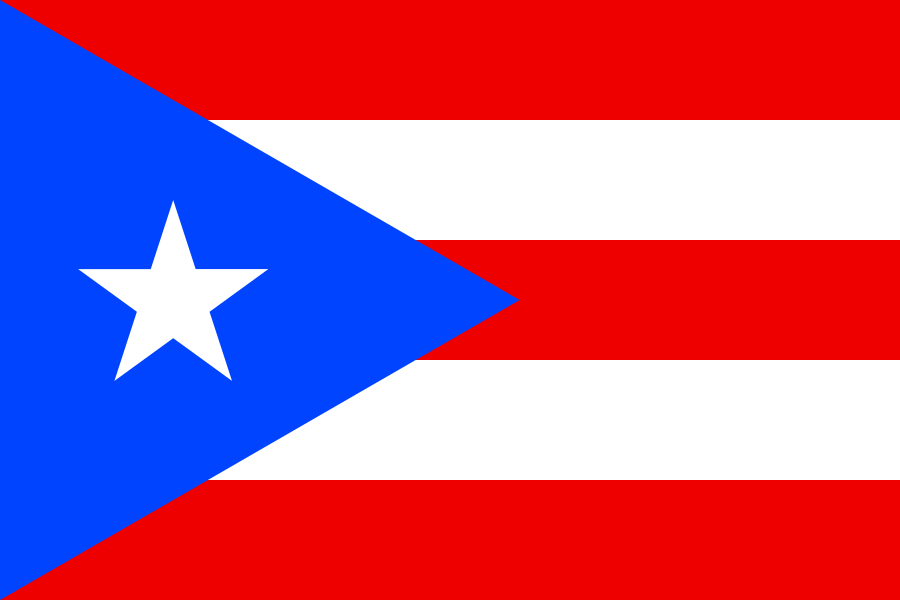
Puerto Rico is a country in North America with a population of 2.98M and an area of 8,870 km². Life expectancy is 81.7 years.
Short factual summary generated from the same country data used in game rounds.
Core numbers
Fast scan first, deep dive later.
Population Density
361.19 /km²How many people live in each square kilometer of land.
Life Expectancy
81.7 yearsHow many years a newborn can expect to live, based on current mortality rates.
University Enrollment Rate
77.93%Total university and college enrollment as a percentage of the typical college-age population.
GDP Per Capita
$44,124.54GDP per person adjusted for purchasing power in constant 2017 international dollars, from Our World in Data using the latest available country values in TerraBrawl.
GDP Per Capita (PPP)
$50,247.85GDP per person, adjusted for purchasing power parity (PPP) so costs of living are comparable across countries.
Country briefing
A quick real-world briefing before you dive deeper into rankings, surprises, and matchups.
Geography
Climate: tropical marine, mild.
Culture
Major languages include Spanish, English.
Identity
Formal name: Commonwealth of Puerto Rico.
Cities
Browse this country's cities before City Detective asks you to guess.
Top stats
The strongest source-backed stats before the deeper data table.
Elderly Population (%)
24.72%Share of the population ages 65 and older, from World Bank Open Data.
Median Age
45.3 yearsThe age that splits the population in half: half are younger, half are older. UN WPP estimate as of 1 July 2023.
Urban Population (%)
94.25%The percentage of people living in cities and urban areas.
Obesity Rate
41.01%Share of adults with obesity, from Our World in Data using the latest available country values in TerraBrawl.
Forest Coverage (%)
56.12%The percentage of land covered by forests - natural or planted trees at least 5 meters tall (excludes orchards and urban parks).
Reality checks
The stats that tend to surprise players in real rounds.
Only ranks #212 in youth population (%)
The percentage of the population aged 0 to 14.
Keeps air pollution (pm2.5) unusually low
The average level of fine particle air pollution (PM2.5) that people are exposed to.
Only ranks #220 in land border length
Total length of land borders with neighboring countries from the frozen public-domain CIA World Factbook snapshot.
Ranks #32 globally in death rate
The number of deaths per 1,000 people each year.
Compared with the region
Country vs continent vs world averages
GDP per person, adjusted for purchasing power parity (PPP) so costs of living are comparable across countries.
How many years a newborn can expect to live, based on current mortality rates.
The percentage of people who have used the internet in the last 3 months.
Think you can guess which countries rank higher?
Play this countryFactbook notes
Country briefing
Populated for centuries by aboriginal peoples, Puerto Rico was claimed by the Spanish Crown in 1493 after Christopher COLUMBUS' second voyage to the Americas.
Populated for centuries by aboriginal peoples, Puerto Rico was claimed by the Spanish Crown in 1493 after Christopher COLUMBUS' second voyage to the Americas. In 1898, after 400 years of colonial rule that saw the indigenous population nearly exterminated and African slave labor introduced, Puerto Rico was ceded to the US as a result of the Spanish-American War. Puerto Ricans were granted US citizenship in 1917. Popularly elected governors have served since 1948. In 1952, a constitution was enacted that provided for internal self-government. In plebiscites held in 1967, 1993, and 1998, voters chose not to alter the existing political status with the US, but the results of a 2012 vote left open the possibility of American statehood. A referendum held in late 2020 showed a narrow preference for statehood.
Economic recession on the island has led to a net population loss since about 2005, as large numbers of residents moved to the US mainland. In 2017, Hurricane Maria was the worst storm to hit the island in eight decades, and damage was estimated in the tens of billions of dollars.
Data vault
Every tracked stat, grouped for fast scanning.
Keep exploring
Open the head-to-head pages people naturally search after reading this profile.
Jump straight to the rankings where this country has its strongest edge.
Turn Puerto Rico's strongest number into a challenge card.
How many people live in each square kilometer of land.
Puerto Rico has a population of 2.98M, ranking #137 globally by population.
Puerto Rico is located in North America. It has an area of 8,870 km².
Life expectancy in Puerto Rico is 81.7 years, ranking #35 globally.
Puerto Rico's GDP per capita (PPP) is $50,247.85, ranking #49 globally.
Puerto Rico ranks particularly high in Population Density (#30), Life Expectancy (#35), Life Expectancy (#42).
Puerto Rico has a population density of 361.2 people per km², ranking #30 globally.