Geography
Natural resources include coal, sulfur, copper, natural gas, and more.
CIA 2026
Loading TerraBrawl
Data as of May 28, 2026
Poland defies simple categorization. Test your assumptions about Poland.
Poland defies simple categorization. Strong at #4 for beer consumption, it stumbles on fertility rate. Test your assumptions about Poland.
Area
313K km²
Pop.
38.75M
Stats
197
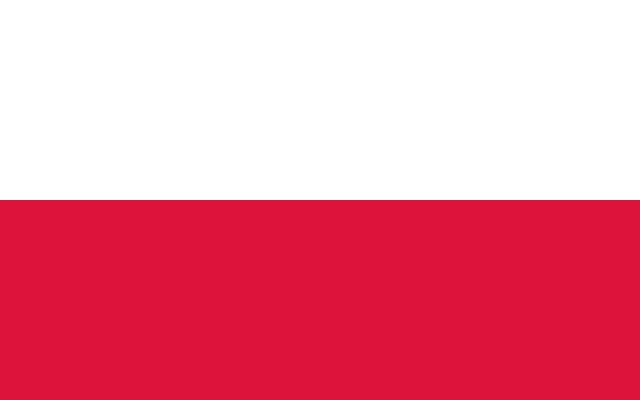
Poland is a country in Europe with a population of 38.75M and an area of 312,679 km². Life expectancy is 78.5 years.
Short factual summary generated from the same country data used in game rounds.
Core numbers
Fast scan first, deep dive later.
Life Satisfaction
7.6 ptsAverage self-reported life satisfaction on a 0-10 scale, from OECD How's Life / Well-Being.
Human Development Index
0.91Composite 0-1 index of life expectancy, education, and income, from Our World in Data using the latest available country values in TerraBrawl.
CO2 Per Capita
7.1 t/person/yrAnnual carbon dioxide emissions in tonnes per person, from Our World in Data using the latest available country values in TerraBrawl.
GDP Per Capita
$45,112.6GDP per person adjusted for purchasing power in constant 2017 international dollars, from Our World in Data using the latest available country values in TerraBrawl.
University Enrollment Rate
76.88%Total university and college enrollment as a percentage of the typical college-age population.
Country briefing
A quick real-world briefing before you dive deeper into rankings, surprises, and matchups.
Geography
Natural resources include coal, sulfur, copper, natural gas, and more.
Culture
Major languages include Polish (official) 98.2%, Silesian 1.4%, other 1.1%, unspecified 1.2% (2011 est.).
Identity
Formal name: Republic of Poland.
Cities
Browse this country's cities before City Detective asks you to guess.
Kraków
Lesser Poland, Poland
Warsaw
Mazovia, Poland
Gdańsk
Pomerania, Poland
Łódź
Lodz Voivodeship, Poland
Katowice
Silesia, Poland
Wrocław
Lower Silesia, Poland
Poznań
Greater Poland, Poland
Gliwice
Silesia, Poland
Top stats
The strongest source-backed stats before the deeper data table.
Beer Consumption
5.5 L/person/yrLiters of beer consumed per person per year, from Our World in Data using the latest available country values in TerraBrawl.
Spirits Consumption
4.4 L/person/yrLiters of spirits consumed per person per year, from Our World in Data using the latest available country values in TerraBrawl.
Alcohol Consumption
11.66 L/adult/yrLiters of pure alcohol the average adult aged 15+ consumes per year, from Our World in Data using the latest available country values in TerraBrawl.
Protected Land (%)
39.6%The percentage of land area designated as protected natural reserves or parks.
Airports
323Large, medium, and small airport records by country from the open OurAirports dataset.
Reality checks
The stats that tend to surprise players in real rounds.
Ranks #15 globally in hospital beds (per 1,000)
The number of hospital beds available per 1,000 people.
Ranks #21 globally in death rate
The number of deaths per 1,000 people each year.
Ranks #14 globally in railway length
Total railway length from CIA World Factbook.
Ranks #21 globally in gdp (nominal)
The country's total economic output in current US dollars.
Only ranks #205 in fertility rate
The average number of children a woman would have over her lifetime based on current birth rates.
Compared with the region
Country vs continent vs world averages
GDP per person, adjusted for purchasing power parity (PPP) so costs of living are comparable across countries.
How many years a newborn can expect to live, based on current mortality rates.
Composite 0-1 index of life expectancy, education, and income, from Our World in Data using the latest available country values in TerraBrawl.
The percentage of people who have used the internet in the last 3 months.
Think you can guess which countries rank higher?
Play this countryFactbook notes
Country briefing
Poland's history as a state began near the middle of the 10th century.
Poland's history as a state began near the middle of the 10th century. By the mid-16th century, the Polish-Lithuanian Commonwealth ruled a vast tract of land in Central and Eastern Europe. During the 18th century, internal disorder weakened the nation, and in a series of agreements between 1772 and 1795, Russia, Prussia, and Austria partitioned Poland among themselves. Poland regained its independence in 1918 only to be overrun by Germany and the Soviet Union in World War II. It became a Soviet satellite state following the war. Labor turmoil in 1980 led to the formation of the independent trade union Solidarity that over time became a political force with over 10 million members. Free elections in 1989 and 1990 won Solidarity control of the parliament and the presidency, bringing the communist era to a close. A "shock therapy" program during the early 1990s enabled the country to transform its economy into one of the most robust in Central Europe. Poland joined NATO in 1999 and the EU in 2004.
Data vault
Every tracked stat, grouped for fast scanning.
Keep exploring
Open the head-to-head pages people naturally search after reading this profile.
Jump straight to the rankings where this country has its strongest edge.
Turn Poland's strongest number into a challenge card.
Average self-reported life satisfaction on a 0-10 scale, from OECD How's Life / Well-Being.
Poland has a population of 38.75M, ranking #39 globally by population.
Poland is located in Europe. It has an area of 312,679 km².
Life expectancy in Poland is 78.5 years, ranking #58 globally.
Poland's GDP per capita (PPP) is $50,540.93, ranking #48 globally.
Poland ranks particularly high in Life Satisfaction (#10), Population (#39), Human Development Index (#35).
Poland has an HDI of 0.906, ranking #35 globally. The HDI combines life expectancy, education, and income indicators.
Poland has a population density of 119.8 people per km², ranking #89 globally.