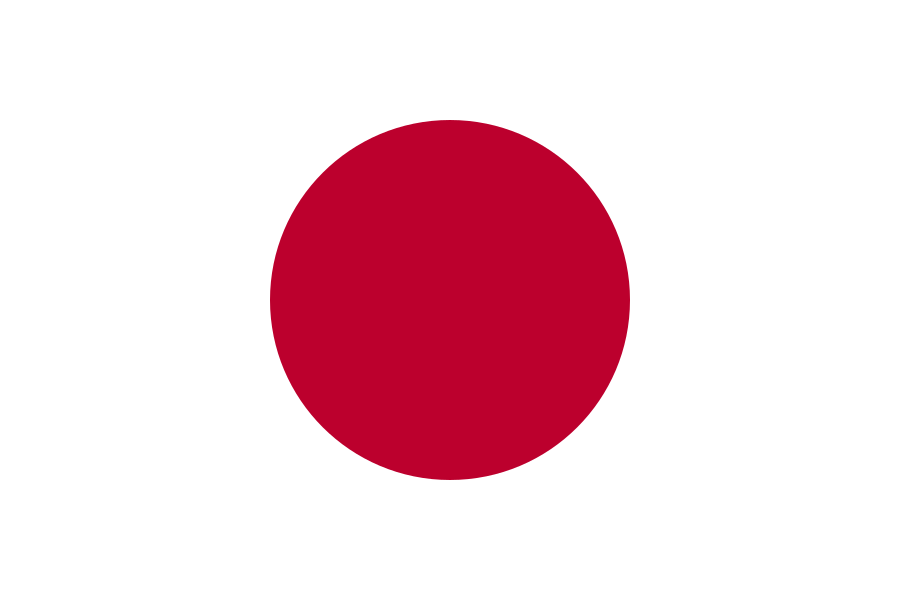
Japan

AsiaGlobal Leader

With a global ranking of #2, Japan leads in hospital beds. Few places match this level of performance. Test your knowledge of this global leader.

Japan is a country in Asia with a population of 123.20M and an area of 377,930 km². Life expectancy is 84.0 years.

At a Glance

The numbers that define this country

Life Expectancy

84.7 years
#4globally

How many years a newborn can expect to live, based on current mortality rates.

Life Expectancy

84.0 years
#7globally

How many years a newborn can expect to live, based on current mortality rates.

Population

123.20M
#11globally

The total number of people living in the country.

Human Development Index

0.93
#23globally

The Human Development Index (HDI), combining life expectancy, education, and income into a single score from 0 to 1.

Population Density

341.545
#34globally

How many people live in each square kilometer of land.

CO2 Per Capita

7.77
#36globally

How many tonnes of CO2 the average person produces per year.

Where They Stand Out

Global rankings worth knowing

💰Government Debt (% GDP)

215.9%
#1globallyTop performer

How much money the central government owes as a percentage of GDP.

👥Elderly Population (%)

29.8%
#2globallyTop performer

The percentage of the population aged 65 and older.

👥Median Age

50.2 years
#3globallyTop performer

Median age from CIA World Factbook.

🚀Foreign Patents

66.7K
#3globallyTop performer

How many patent applications are filed by non-residents each year.

❤️Hospital Beds (per 1,000)

12.7
#2globallyTop performer

The number of hospital beds available per 1,000 people.

Did You Know?

Facts that catch players off guard

💰

Ranks #1 in government debt (% gdp) (lower is better)

Government Debt (% GDP): 215.9%

How much money the central government owes as a percentage of GDP.

World Bank 2023
👥

Ranks #2 globally in elderly population (%)

Elderly Population (%): 29.8%

The percentage of the population aged 65 and older.

World Bank 2023
🚀

Ranks #3 globally in foreign patents

Foreign Patents: 66.7K

How many patent applications are filed by non-residents each year.

World Bank 2023
💰

Ranks #4 globally in gdp (nominal)

GDP (Nominal): 4027.60B

The country's total economic output in current US dollars.

World Bank 2023
❤️

Ranks #2 globally in hospital beds (per 1,000)

Hospital Beds (per 1,000): 12.7

The number of hospital beds available per 1,000 people.

World Bank 2023

Surprised? See how you stack up.

Play Now

How Japan Compares

Country vs continent vs world averages

Japan
Asia avg
World avg

GDP per Capita

Above avg

GDP per person, adjusted for purchasing power parity (PPP) so costs of living are comparable across countries.

World Bank 2023
Japan51.7K
Asia34.3K
World31.8K

Life Expectancy

Above avg

How many years a newborn can expect to live, based on current mortality rates.

World Bank 2023
Japan84.0 years
Asia75.3 years
World73.7 years

Human Development Index

Above avg

The Human Development Index (HDI), combining life expectancy, education, and income into a single score from 0 to 1.

Our World in Data 2023
Japan0.93
Asia0.75
World0.74

Internet Users

Above avg

The percentage of people who have used the internet in the last 3 months.

World Bank 2023
Japan87.0%
Asia75.8%
World70.3%

Think you can guess which countries rank higher?

Test Your Intuition
Regional comparison for Japan across 4 key metrics, comparing with Asia and world averages.

About Japan

In 1603, after decades of civil warfare, the Tokugawa shogunate (a military-led, dynastic government) ushered in a long period of relative political stability and isolation from foreign influence. For more than two centuries, this policy enabled Japan to enjoy a flowering of its indigenous culture. Japan opened its ports after signing the Treaty of Kanagawa with the US in 1854 and began to intensively modernize and industrialize. During the late 19th and early 20th centuries, Japan became a regional power that was able to defeat the forces of both China and Russia. It occupied Korea, Formosa (Taiwan), and southern Sakhalin Island. In 1931-32, Japan occupied Manchuria, and in 1937, it launched a full-scale invasion of China. Japan attacked US forces at Pearl Harbor, Hawaii, in 1941, triggering America's entry into World War II, and Japan soon occupied much of East and Southeast Asia. After its defeat in World War II, the country recovered to become an economic power and a US ally.

While the emperor retains his throne as a symbol of national unity, elected politicians hold the decision-making power. After three decades of unprecedented growth, Japan's economy experienced a major slowdown starting in the 1990s, but the country remains an economic power. In 2011, Japan's strongest-ever earthquake and an accompanying tsunami devastated the northeast part of Honshu, killed thousands, and damaged several nuclear power plants. ABE Shinzo was reelected as prime minister in 2012, and he embarked on ambitious economic and security reforms to improve Japan's economy and bolster the country's international standing. In 2019, ABE became Japan's longest-serving post-war prime minister; he resigned in 2020 and was succeeded by SUGA Yoshihide. KISHIDA Fumio became prime minister in 2021.

🌍Geography & Climate6 facts
Location
Eastern Asia, island chain between the North Pacific Ocean and the Sea of Japan, east of the Korean Peninsula
Climate
varies from tropical in south to cool temperate in north
Terrain
mostly rugged and mountainous
Natural Resources
negligible mineral resources, fish
Natural Hazards
many dormant and some active volcanoes; about 1,500 seismic occurrences (mostly tremors but occasional severe earthquakes) every year; tsunamis; typhoons volcanism: both Unzen (1,500 m) and Sakura-jima (1,117 m), which lies near the densely populated city of Kagoshima, have been deemed Decade Volcanoes by the International Association of Volcanology and Chemistry of the Earth's Interior, worthy of study due to their explosive history and close proximity to human populations; other notable historically active volcanoes include Asama (Honshu Island's most active volcano), Aso, Bandai, Fuji, Iwo-Jima, Kikai, Kirishima, Komaga-take, Oshima, Suwanosejima, Tokachi, Yake-dake, and Usu; see note 2 under "Geography - note"
Size Comparison
slightly smaller than California
👥People & Culture4 facts
Languages
Japanese
Religions
Shintoism 48.6%, Buddhism 46.4%, Christianity 1.1%, other 4% (2021 est.)
Ethnic Groups
Japanese 97.5%, Chinese 0.6%, Vietnam 0.4%, South Korean 0.3%, other 1.2% (includes Filipino, Brazilian, Nepalese, Indonesian, American, and Taiwanese) (2022 est.)
Major Cities
37.194 million TOKYO (capital), 19.013 million Osaka, 9.569 million Nagoya, 5.490 million Kitakyushu-Fukuoka, 2.937 million Shizuoka-Hamamatsu, 2.666 million Sapporo (2023)
🏛️Government & History9 facts
Government Type
parliamentary constitutional monarchy
Capital
Tokyo
Capital Coordinates
35 41 N, 139 45 E
Capital Timezone
UTC+9 (14 hours ahead of Washington, DC, during Standard Time)
Name Origin
the English word for Japan comes from the Chinese name for the country, Cipangu; both Nihon and Nippon come from the Japanese words nichi, or "sun," and hon, or "origin," which is frequently translated as "Land of the Rising Sun"
Independence
3 May 1947 (current constitution adopted as amendment to Meiji Constitution); notable earlier dates: 11 February 660 B.C. (mythological date of Emperor JIMMU founding the nation); 29 November 1890 (Meiji Constitution provides for constitutional monarchy)
National Symbols
red sun disc, chrysanthemum
National Anthem
"Kimigayo" ("His Majesty's Reign)
UNESCO Heritage
26 (21 cultural, 5 natural)
💼Economy & Trade7 facts
Overview
second-largest East Asian economy; trade-oriented and highly diversified; high public debt levels; following years of near-zero interest rates, gradual increases to address inflation and depreciation of yen; strong rebound in tourism; aging population poses challenges to labor force participation
Industries
motor vehicles, electronic equipment, machine tools, steel and nonferrous metals, ships, chemicals, textiles, processed foods
Agricultural Products
rice, milk, sugar beets, vegetables, eggs, chicken, potatoes, onions, cabbages, pork (2023)
Export Partners
USA 19%, China 18%, Taiwan 6%, S. Korea 6%, Hong Kong 4% (2023)
Export Commodities
cars, integrated circuits, machinery, vehicle parts/accessories, construction vehicles (2023)
Import Partners
China 22%, USA 11%, Australia 8%, UAE 5%, Saudi Arabia 5% (2023)
Import Commodities
crude petroleum, natural gas, coal, integrated circuits, broadcasting equipment (2023)
🔧Infrastructure & Defense5 facts
Military Forces
Japan Self-Defense Force (JSDF): Ground Self-Defense Force (Rikujou Jieitai, GSDF; includes aviation), Maritime Self-Defense Force (Kaijou Jieitai, MSDF; includes naval aviation), Air Self-Defense Force (Koukuu Jieitai, ASDF) (2025)
Military Service
18-32 years of age for voluntary military service for men and women; no conscription (2025)
Energy Mix
fossil fuels: 65.8% of total installed capacity (2023 est.); nuclear: 8.9% of total installed capacity (2023 est.); solar: 10.3% of total installed capacity (2023 est.); wind: 1.1% of total installed capacity (2023 est.); hydroelectricity: 7.1% of total installed capacity (2023 est.); geothermal: 0.3% of total installed capacity (2023 est.); biomass and waste: 6.5% of total installed capacity (2023 est.)
Broadcast Media
a mix of public and commercial TV and radio stations; 5 national terrestrial TV networks including 1 public broadcaster; large number of radio and TV stations; satellite and cable services provide access to international channels (2023)
Space Program
has one of the world's largest and most advanced space programs, with independent capabilities in all areas except autonomous manned space flight; designs, builds, launches, and operates the full spectrum of satellites; designs, builds, and independently launches satellite/space launch vehicles (SLVs) and other spacecraft; has a wide range of research and development programs; has an astronaut training program; participates in international programs such as the International Space Station and the Square Kilometer Array radio telescope project; leads the Asia-Pacific Regional Space Agency Forum and co-leads the Global Earth Observation System of Systems; cooperates with a variety of foreign space agencies and industries, including those of Canada, the ESA and its member states, India, Russia, the UAE, the US; has a commercial space industry that develops space-related capabilities and technologies, including satellites, satellite payloads and subcomponents, and SLVs; in recent years, the Japanese Government has supported space startup companies (2025)

Deep Dive

78 of 141 metrics

Every stat we track, organized by category

💰Wealth & Economy13 metricsBest: #1
Government Debt (% GDP)
215.9%#1WB
GDP (Nominal)
4027.60B#4WB
Employment Rate (%)
85.1%#3OECD
Gender Pay Gap (%)
20.7%#4OECD
GDP Per Capita
$46.1K#44OWID
GDP Per Capita (PPP)
51.7K#45WB
High-Tech Exports (%)
17.6%#42WB
Inflation Rate
2.7%#134WB
Long-Term Unemployment
0.8%#26OECD
FDI Inflows (% GDP)
0.4%#158WB
Unemployment Rate
2.6%#161WB
GDP Growth Rate
0.1%#185WB
Youth Unemployment Rate
3.9%#171
❤️Health & Survival10 metricsBest: #2
Life Expectancy
84.7 years#4OWID
Hospital Beds (per 1,000)
12.7#2WB
Life Expectancy
84.0 years#7WB
Health Spending (% GDP)
11.4%#14WB
Suicide Rate
17.43#17WB
Doctors (per 1,000)
2.65#75WB
Smoking Rate
19.2%#86WB
Obesity Rate
4.9%#191OWID
Child Mortality
2.40#188WB
Infant Mortality
1.80#191WB
🚀Education & Future8 metricsBest: #2
Foreign Patents
66.7K#3WB
Domestic Patents
222.5K#3WB
Life Expectancy
84.1 years#2OECD
R&D Spending (% GDP)
3.4%#6WB
Human Development Index
0.93#23OWID
University Enrollment Rate
64.9%#54WB
Leisure Time
15.217#9OECD
Education Spending (% GDP)
3.3%#126WB
👥Demographics12 metricsBest: #2
Elderly Population (%)
29.8%#2WB
Median Age
50.2 years#3
Population
123.20M#11WB
Death Rate
12.04#15WB
Urban Population (%)
92.2%#28WB
Population Density
341.545#34WB
Dependency Ratio
70.117#44WB
Land Area
364.6K#62WB
Fertility Rate
1.41#198WB
Teen Birth Rate
1.74#204WB
Birth Rate
6.84#223WB
Youth Population (%)
11.4%#213WB
🔧Infrastructure3 metricsBest: #4
Merchant Ships
5.2K#4
Railway Length
27.3K#11
Airports
280#24
Energy2 metricsBest: #4
Electricity Capacity
361.62M#4
Nuclear Electricity Share
5.5%#25
🌱Environment10 metricsBest: #5
Carbon Emissions (Total)
960.23M#5
Forest Coverage (%)
68.4%#19WB
Forest Area
249.3K#23WB
Irrigated Land
15.7K#28
CO2 Per Capita
7.77#36OWID
Protected Land (%)
29.5%#39WB
Electricity Access (%)
100.0%#58WB
Renewable Energy (%)
12.7%#43OWID
Renewable Energy (%)
8.8%#154WB
Air Pollution (PM2.5)
12.835#145WB
🌍Land & Sea4 metricsBest: #6
Coastline Length
29.8K#6
Highest Elevation
3.8K#47
Land Boundaries Length
0#197
Lowest Elevation
-4#213
🍻Lifestyle5 metricsBest: #6
Air Passengers
120.31M#6WB
Tourist Arrivals
4.12M#25WB
Alcohol Consumption
6.38#71OWID
Spirits Consumption
1.08#88OWID
Beer Consumption
1.07#109OWID
📡Technology3 metricsBest: #15
Mobile Subscriptions (%)
178.432#15WB
Broadband Access (%)
39#58WB
Internet Users (%)
87.0%#80WB
🤝Society & Equality6 metricsBest: #15
Safety at Night
77.5%#15OECD
Inequality (Gini)
32.3#73WB
Women in Parliament (%)
15.7%#145WB
Road Deaths
2.62#30OECD
Life Satisfaction
5.89#34OECD
Homicide Rate
0.20#37OECD
🛡️Military & Defense2 metricsBest: #37
Active Military Personnel
120.1K#37
Military Spend (% GDP)
1.4%#105

Countries with Similar GDP

Share a Fact

Share something surprising about Japan!

Japan
#4 in Life Expectancy

How many years a newborn can expect to live, based on current mortality rates.

Top 5% globally
84.7 years

Frequently Asked Questions about Japan

What is the population of Japan?

Japan has a population of 123.20M, ranking #11 globally by population.

What continent is Japan in?

Japan is located in Asia. It has an area of 377,930 km².

What is the life expectancy in Japan?

Life expectancy in Japan is 84.0 years, ranking #7 globally.

What is the GDP per capita of Japan?

Japan's GDP per capita (PPP) is 51.7K, ranking #45 globally.

What is Japan known for in global statistics?

Japan ranks particularly high in Life Expectancy (#4), Life Expectancy (#7), Population (#11).

What is Japan's Human Development Index?

Japan has an HDI of 0.925, ranking #23 globally. The HDI combines life expectancy, education, and income indicators.

How densely populated is Japan?

Japan has a population density of 341.5 people per km², ranking #34 globally.
Think you know Japan?

Compare countries, guess statistics, and prove you know your stuff.