Geography
Natural resources include small deposits of coal, natural gas, limestone, marble, and more.
CIA 2026
Loading TerraBrawl
Data as of May 28, 2026
Taiwan ranks high and low in ways you wouldn't predict. Can you guess what else is surprising?
Taiwan ranks high and low in ways you wouldn't predict. A top performer in co2 emissions (#20), it falls behind in fertility rate. Can you guess what else is surprising?
Area
36K km²
Pop.
23.60M
Stats
52
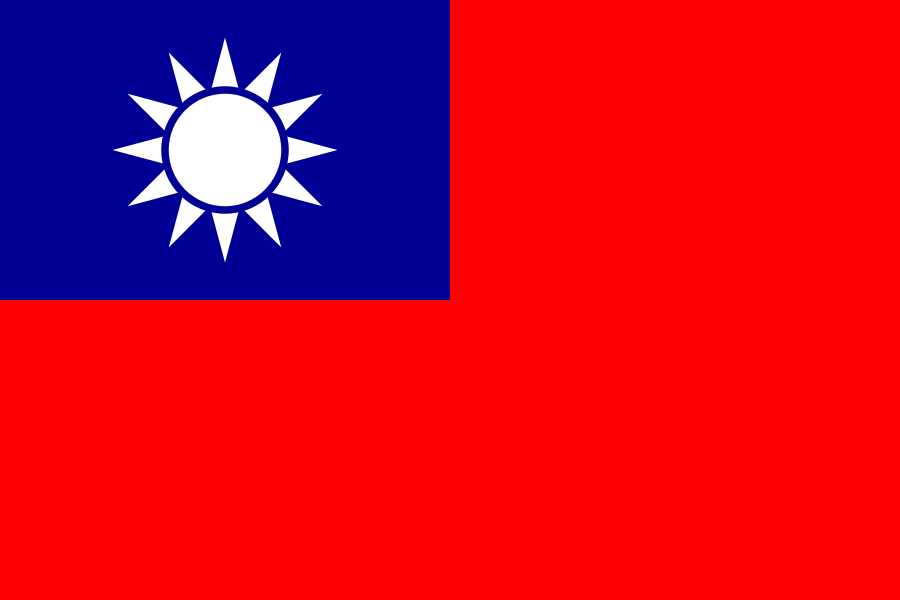
Taiwan is a country in Asia with a population of 23.60M and an area of 36,197 km².
Short factual summary generated from the same country data used in game rounds.
Core numbers
Fast scan first, deep dive later.
CO2 Per Capita
11.3 t/person/yrAnnual carbon dioxide emissions in tonnes per person, from Our World in Data using the latest available country values in TerraBrawl.
Life Expectancy
80.6 yearsAverage number of years a newborn would be expected to live if current mortality patterns stayed the same, from Our World in Data.
Internet Users (%)
90%The percentage of people who have used the internet in the last 3 months.
Official Languages Count
22Count of official languages listed for the country in Wikidata.
Current Account Balance (% of GDP)
17.4% of GDPCurrent account balance as a share of GDP from the IMF World Economic Outlook; positive values mean a surplus and negative values mean a deficit.
Country briefing
A quick real-world briefing before you dive deeper into rankings, surprises, and matchups.
Geography
Natural resources include small deposits of coal, natural gas, limestone, marble, and more.
Culture
Major languages include Mandarin (official), Min Nan, Hakka dialects, approximately 16 indigenous languages.
Economy
Key industries include electronics, communications and information technology products, petroleum refining, chemicals, and more.
Cities
Browse this country's cities before City Detective asks you to guess.
Kaohsiung
Takao, Taiwan
Taichung
Taiwan
Tainan
Taiwan
Hsinchu
Taiwan
Hualien City
Taiwan
Chang-hua
Taiwan
Magong
Taiwan
Taitung
Taiwan
Top stats
The strongest source-backed stats before the deeper data table.
Median Age
43.5 yearsThe age that splits the population in half: half are younger, half are older. UN WPP estimate as of 1 July 2023.
Electric Generating Capacity
64.53M kWInstalled electricity generating capacity in kilowatts from the frozen public-domain CIA World Factbook snapshot.
Highest Elevation
4.0K mHighest point elevation from CIA World Factbook.
Merchant Fleet Size
465Number of merchant marine ships from the frozen public-domain CIA World Factbook snapshot.
Irrigated Land
3.8K km²Irrigated land area from CIA World Factbook.
Reality checks
The stats that tend to surprise players in real rounds.
Only ranks #224 in fertility rate
The average number of children a woman would have over her lifetime based on current birth rates.
Only ranks #234 in land border length
Total length of land borders with neighboring countries from the frozen public-domain CIA World Factbook snapshot.
Compared with the region
Country vs continent vs world averages
The percentage of people who have used the internet in the last 3 months.
Think you can guess which countries rank higher?
Play this countryFactbook notes
Country briefing
First inhabited by Austronesian people, Taiwan became home to Han immigrants beginning in the late Ming Dynasty (17th century).
First inhabited by Austronesian people, Taiwan became home to Han immigrants beginning in the late Ming Dynasty (17th century). In 1895, military defeat forced China's Qing Dynasty to cede Taiwan to Japan, which then governed Taiwan for 50 years. Taiwan came under Chinese Nationalist (Kuomintang, KMT) control after World War II. With the communist victory in the Chinese civil war in 1949, the Nationalist-controlled Republic of China government and 2 million Nationalists fled to Taiwan and continued to claim to be the legitimate government for mainland China and Taiwan, based on a 1947 constitution drawn up for all of China. Until 1987, however, the Nationalist Government ruled Taiwan under a civil war martial law declaration dating to 1948. Beginning in the 1970s, Nationalist authorities gradually began to incorporate the native population into the governing structure beyond the local level.
The democratization process expanded rapidly in the 1980s, leading to the then-illegal founding of the Democratic Progressive Party (DPP), Taiwan’s first opposition party, in 1986 and the lifting of martial law the following year. Taiwan held legislative elections in 1992, the first in over 40 years, and its first direct presidential election in 1996. In the 2000 presidential elections, Taiwan underwent its first peaceful transfer of power with the KMT loss to the DPP and afterwards experienced two additional democratic transfers of power in 2008 and 2016. Throughout this period, the island prospered and turned into one of East Asia's economic "Tigers," becoming a major investor in mainland China after 2000 as cross-Strait ties matured. The dominant political issues continue to be economic reform and growth, as well as management of sensitive relations between Taiwan and China.
Data vault
Every tracked stat, grouped for fast scanning.
Keep exploring
Open the head-to-head pages people naturally search after reading this profile.
Jump straight to the rankings where this country has its strongest edge.
Turn Taiwan's strongest number into a challenge card.
Annual carbon dioxide emissions in tonnes per person, from Our World in Data using the latest available country values in TerraBrawl.
Taiwan has a population of 23.60M, ranking #58 globally by population.
Taiwan is located in Asia. It has an area of 36,197 km².
Taiwan ranks particularly high in CO2 Per Capita (#20), Life Expectancy (#52), Population (#58).