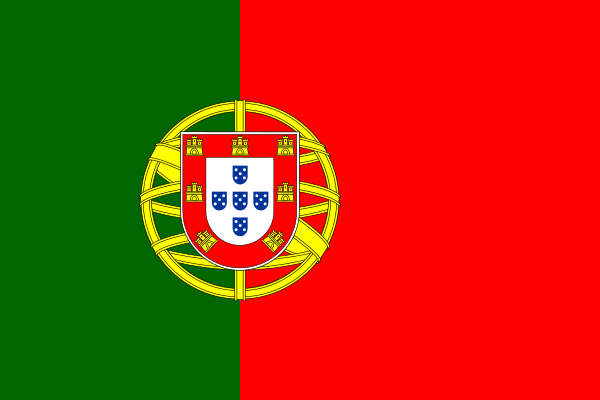
Geography
Natural resources include fish, forests (cork), iron ore, copper, and more.
CIA 2026
Loading TerraBrawl
Data as of May 28, 2026
Portugal claims the 9th spot worldwide for renewable energy. How well do you really know Portugal?
Portugal claims the 9th spot worldwide for renewable energy. That 39.7% figure is hard to beat. How well do you really know Portugal?
Area
92K km²
Pop.
10.19M
Stats
190
Portugal is a country in Europe with a population of 10.19M and an area of 92,090 km². Life expectancy is 82.3 years.
Short factual summary generated from the same country data used in game rounds.
Core numbers
Fast scan first, deep dive later.
Life Expectancy
82.4 yearsAverage number of years a newborn would be expected to live if current mortality patterns stayed the same, from Our World in Data.
Human Development Index
0.89Composite 0-1 index of life expectancy, education, and income, from Our World in Data using the latest available country values in TerraBrawl.
University Enrollment Rate
77.68%Total university and college enrollment as a percentage of the typical college-age population.
GDP Per Capita (PPP)
$50,649.51GDP per person, adjusted for purchasing power parity (PPP) so costs of living are comparable across countries.
GDP Per Capita
$41,883.85GDP per person adjusted for purchasing power in constant 2017 international dollars, from Our World in Data using the latest available country values in TerraBrawl.
Country briefing
A quick real-world briefing before you dive deeper into rankings, surprises, and matchups.
Geography
Natural resources include fish, forests (cork), iron ore, copper, and more.
Culture
Major languages include Portuguese (official), Mirandese (official, but locally used).
Identity
Formal name: Portuguese Republic.
Cities
Browse this country's cities before City Detective asks you to guess.
Top stats
The strongest source-backed stats before the deeper data table.
Elderly Population (%)
24.53%Share of the population ages 65 and older, from World Bank Open Data.
Median Age
46.2 yearsThe age that splits the population in half: half are younger, half are older. UN WPP estimate as of 1 July 2023.
Government Debt (% GDP)
125.7% of GDPCentral government debt as a share of GDP, from World Bank Open Data.
Renewable Energy (%)
39.74%Share of final energy consumption supplied by renewable energy, from Our World in Data using the latest available country values in TerraBrawl.
Reality checks
The stats that tend to surprise players in real rounds.
Only ranks #207 in youth population (%)
The percentage of the population aged 0 to 14.
Keeps infant mortality unusually low
Infant deaths before age 1 per 1,000 live births, from World Bank Open Data.
Keeps air pollution (pm2.5) unusually low
The average level of fine particle air pollution (PM2.5) that people are exposed to.
Has one of the highest long-term unemployment figures
Share of the workforce unemployed for a long period, from OECD How's Life / Well-Being.
Keeps child mortality unusually low
Deaths before age 5 per 1,000 live births, from World Bank Open Data.
Compared with the region
Country vs continent vs world averages
GDP per person, adjusted for purchasing power parity (PPP) so costs of living are comparable across countries.
How many years a newborn can expect to live, based on current mortality rates.
Composite 0-1 index of life expectancy, education, and income, from Our World in Data using the latest available country values in TerraBrawl.
The percentage of people who have used the internet in the last 3 months.
Think you can guess which countries rank higher?
Play this countryFactbook notes
Country briefing
A global maritime power during the 15th and 16th centuries, Portugal lost much of its wealth and status with the destruction of Lisbon in a 1755 earthquake, occupation during the Napoleonic Wars, and the independence of Brazil, its wealthiest colony, in 1822.
A global maritime power during the 15th and 16th centuries, Portugal lost much of its wealth and status with the destruction of Lisbon in a 1755 earthquake, occupation during the Napoleonic Wars, and the independence of Brazil, its wealthiest colony, in 1822. A revolution deposed the monarchy in 1910, and for most of the next six decades, repressive governments ran the country. In 1974, a left-wing military coup ushered in broad democratic reforms. The following year, Portugal granted independence to all its African colonies. Portugal is a founding member of NATO and entered the EC (now the EU) in 1986.
Data vault
Every tracked stat, grouped for fast scanning.
Keep exploring
Open the head-to-head pages people naturally search after reading this profile.
Jump straight to the rankings where this country has its strongest edge.
Turn Portugal's strongest number into a challenge card.
Average number of years a newborn would be expected to live if current mortality patterns stayed the same, from Our World in Data.
Portugal has a population of 10.19M, ranking #92 globally by population.
Portugal is located in Europe. It has an area of 92,090 km².
Life expectancy in Portugal is 82.3 years, ranking #31 globally.
Portugal's GDP per capita (PPP) is $50,649.51, ranking #46 globally.
Portugal ranks particularly high in Life Expectancy (#31), Life Expectancy (#31), Human Development Index (#40).
Portugal has an HDI of 0.890, ranking #40 globally. The HDI combines life expectancy, education, and income indicators.
Portugal has a population density of 115.5 people per km², ranking #91 globally.