Geography
Size snapshot: slightly more than 2.5 times the size of Washington, D.C.
CIA 2026
Loading TerraBrawl
Data as of May 28, 2026
Palau tops Oceania for human development index. How does it compare to its neighbors?
Palau tops Oceania for human development index. Neighbors look to it as a regional benchmark. How does it compare to its neighbors?
Area
459 km²
Pop.
21.9K
Stats
78
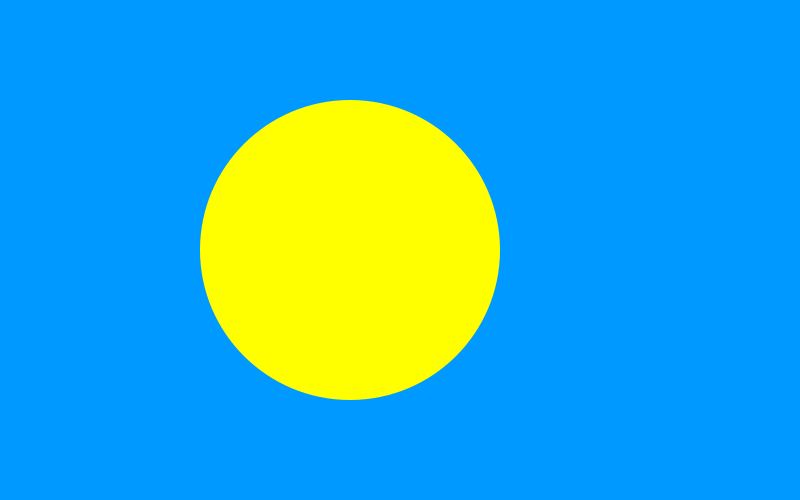
Palau is a country in Oceania with a population of 21.9K and an area of 459 km². Life expectancy is 69.3 years.
Short factual summary generated from the same country data used in game rounds.
Core numbers
Fast scan first, deep dive later.
CO2 Per Capita
12.76 t/person/yrAnnual carbon dioxide emissions in tonnes per person, from Our World in Data using the latest available country values in TerraBrawl.
Human Development Index
0.79Composite 0-1 index of life expectancy, education, and income, from Our World in Data using the latest available country values in TerraBrawl.
GDP Per Capita
$15,796.53GDP per person adjusted for purchasing power in constant 2017 international dollars, from Our World in Data using the latest available country values in TerraBrawl.
GDP Per Capita (PPP)
$18,230.27GDP per person, adjusted for purchasing power parity (PPP) so costs of living are comparable across countries.
University Enrollment Rate
41.13%Total university and college enrollment as a percentage of the typical college-age population.
Life Expectancy
69.3 yearsHow many years a newborn can expect to live, based on current mortality rates.
Country briefing
A quick real-world briefing before you dive deeper into rankings, surprises, and matchups.
Geography
Size snapshot: slightly more than 2.5 times the size of Washington, D.C.
Culture
Major languages include Palauan (official on most islands) 65.2%, other Micronesian 1.9%, English (official) 19.1%, Filipino 9.9%, and more.
Identity
Formal name: Republic of Palau.
Top stats
The strongest source-backed stats before the deeper data table.
Forest Coverage (%)
90.54%The percentage of land covered by forests - natural or planted trees at least 5 meters tall (excludes orchards and urban parks).
FDI Inflows (% GDP)
28.87% of GDPForeign direct investment net inflows as a share of GDP, from World Bank Open Data.
Health Spending (% GDP)
14.29% of GDPCurrent health expenditure as a share of GDP, from World Bank Open Data.
Mobile Subscriptions (%)
135 per 100 peopleMobile cellular subscriptions per 100 people, from World Bank Open Data.
Merchant Fleet Size
427Number of merchant marine ships from the frozen public-domain CIA World Factbook snapshot.
Reality checks
The stats that tend to surprise players in real rounds.
Only ranks #207 in gdp (nominal)
The country's total economic output in current US dollars.
Only ranks #128 in tourist arrivals
How many international tourists visit the country each year.
Only ranks #205 in irrigated land
Irrigated land area from CIA World Factbook.
Keeps air pollution (pm2.5) unusually low
The average level of fine particle air pollution (PM2.5) that people are exposed to.
Only ranks #216 in population
The total number of people living in the country.
Compared with the region
Country vs continent vs world averages
GDP per person, adjusted for purchasing power parity (PPP) so costs of living are comparable across countries.
How many years a newborn can expect to live, based on current mortality rates.
Composite 0-1 index of life expectancy, education, and income, from Our World in Data using the latest available country values in TerraBrawl.
The percentage of people who have used the internet in the last 3 months.
Think you can guess which countries rank higher?
Play this countryFactbook notes
Country briefing
Humans arrived in the Palauan archipelago from Southeast Asia around 1000 B.C.
Humans arrived in the Palauan archipelago from Southeast Asia around 1000 B.C. and developed a complex, highly organized matrilineal society where high-ranking women picked the chiefs. The islands were the westernmost part of the widely scattered Pacific islands north of New Guinea that Spanish explorers named the Caroline Islands in the 17th century. The 18th and 19th centuries saw occasional visits of whalers and traders as Spain gained some influence in the islands and administered it from the Philippines. Spain sold Palau to Germany in 1899 after losing the Philippines in the Spanish-American War.
Japan seized Palau in 1914, was granted a League of Nations mandate to administer the islands in 1920, and made Koror the capital of its South Seas Mandate in 1922. By the outbreak of World War II, there were four times as many Japanese living in Koror as Palauans. In 1944, the US invasion of the island of Peleliu was one of the bloodiest island fights of the Pacific War. After the war, Palau became part of the US-administered Trust Territory of the Pacific Islands.
Palau voted against joining the Federated States of Micronesia in 1978 and adopted its own constitution in 1981, which stated that Palau was a nuclear-free country. In 1982, Palau signed a Compact of Free Association (COFA) with the US, which granted Palau financial assistance and access to many US domestic programs in exchange for exclusive US military access and defense responsibilities. However, many Palauans saw the COFA as incompatible with the Palauan Constitution because of the US military’s nuclear arsenal, and seven referenda failed to achieve ratification. Following a constitutional amendment and eighth referendum in 1993, the COFA was ratified and entered into force in 1994 when the islands gained their independence. Its funding was renewed in 2010.
Palau has been on the frontlines of combatting climate change and protecting marine resources. In 2011, Palau banned commercial shark fishing and created the world’s first shark sanctuary. In 2017, Palau began stamping the Palau Pledge into passports, reminding visitors to act in ecologically and culturally responsible ways. In 2020, Palau banned coral reef-toxic sunscreens and expanded its fishing prohibition to include 80% of its exclusive economic zone.
Data vault
Every tracked stat, grouped for fast scanning.
Keep exploring
Open the head-to-head pages people naturally search after reading this profile.
Jump straight to the rankings where this country has its strongest edge.
Turn Palau's strongest number into a challenge card.
Annual carbon dioxide emissions in tonnes per person, from Our World in Data using the latest available country values in TerraBrawl.
Palau has a population of 21.9K, ranking #216 globally by population.
Palau is located in Oceania. It has an area of 459 km².
Life expectancy in Palau is 69.3 years, ranking #155 globally.
Palau's GDP per capita (PPP) is $18,230.27, ranking #108 globally.
Palau ranks particularly high in CO2 Per Capita (#17), Human Development Index (#85), GDP Per Capita (#108).
Palau has an HDI of 0.786, ranking #85 globally. The HDI combines life expectancy, education, and income indicators.
Palau has a population density of 38.5 people per km², ranking #163 globally.