Geography
Location: Oceania, island in the North Pacific Ocean, about three-quarters of the way from Hawaii to the Philippines.
CIA 2026
Loading TerraBrawl
Data as of May 28, 2026
Guam leads Oceania in tourist arrivals. Discover what makes it the regional champion.
Guam leads Oceania in tourist arrivals. With 328,000, it sets the regional standard. Discover what makes it the regional champion.
Area
549 km²
Pop.
169.5K
Stats
56
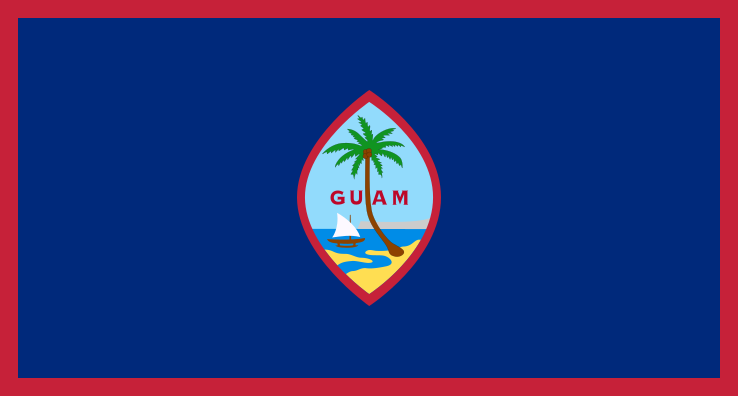
Guam is a country in Oceania with a population of 169.5K and an area of 549 km². Life expectancy is 77.2 years.
Short factual summary generated from the same country data used in game rounds.
Core numbers
Fast scan first, deep dive later.
Population Density
308.34 /km²How many people live in each square kilometer of land.
Life Expectancy
77.2 yearsHow many years a newborn can expect to live, based on current mortality rates.
Internet Users (%)
81%The percentage of people who have used the internet in the last 3 months.
Land Area
540 km²Total land area in square kilometers, excluding lakes, rivers, and territorial waters.
Country briefing
A quick real-world briefing before you dive deeper into rankings, surprises, and matchups.
Geography
Location: Oceania, island in the North Pacific Ocean, about three-quarters of the way from Hawaii to the Philippines.
Culture
Major languages include English 43.3%, Filipino 24.9%, Chamorro 16%, other Pacific Island languages 9.4%, and more.
Economy
Key industries include national defense, tourism, construction, transshipment services, and more.
Top stats
The strongest source-backed stats before the deeper data table.
Urban Population (%)
94.17%The percentage of people living in cities and urban areas.
Electricity Access (%)
100%The percentage of the population with access to electricity.
Reality checks
The stats that tend to surprise players in real rounds.
Keeps total co2 emissions unusually low
Total carbon dioxide emissions excluding LULUCF from the World Bank latest available country value.
Only ranks #173 in merchant fleet size
Number of merchant marine ships from the frozen public-domain CIA World Factbook snapshot.
Only ranks #202 in mobile subscriptions (%)
Mobile cellular subscriptions per 100 people, from World Bank Open Data.
Only ranks #194 in broadband access (%)
Fixed broadband subscriptions per 100 people, from World Bank Open Data.
Only ranks #185 in protected land (%)
The percentage of land area designated as protected natural reserves or parks.
Compared with the region
Country vs continent vs world averages
How many years a newborn can expect to live, based on current mortality rates.
The percentage of people who have used the internet in the last 3 months.
Think you can guess which countries rank higher?
Play this countryFactbook notes
Country briefing
Guam was settled by Austronesian people around 1500 B.C.
Guam was settled by Austronesian people around 1500 B.C. These people became the indigenous Chamorro and were influenced by later migrations, including the Micronesians in the first millennium A.D., and island Southeast Asians around 900. Society was stratified, with higher classes living along the coast and lower classes living inland. Spanish explorer Ferdinand MAGELLAN was the first European to see Guam in 1521, and Spain claimed the island in 1565 because it served as a refueling stop for ships between Mexico and the Philippines. Spain formally colonized Guam in 1668. Spain’s brutal repression of the Chamorro, along with new diseases and intermittent warfare, reduced the indigenous population from more than 100,000 to less than 5,000 by the 1700s. Spain tried to repopulate the island by forcing people from nearby islands to settle on Guam and preventing them from escaping.
Guam became a hub for whalers and traders in the western Pacific in the early 1800s. During the 1898 Spanish-American War, the US Navy occupied Guam and set up a military administration. The US Navy opposed local control of government despite repeated petitions from the Chamorro. Japan invaded Guam in 1941 and instituted a repressive regime. During the US recapture of Guam in 1944, the island’s two largest villages were destroyed. After World War II, political pressure from local Chamorro leaders led to Guam being established as an unincorporated organized US territory in 1950, with US citizenship granted to all Chamorro. In a referendum in 1982, more than 75% of voters chose closer relations with the US over independence, although no change in status was made because of disagreements on the future right of Chamorro self-determination. The US military holds about 29% of Guam’s land and stations several thousand troops on the island. The installations are some of the most strategically important US bases in the Pacific; they also constitute the island’s most important source of income and economic stability.
Data vault
Every tracked stat, grouped for fast scanning.
Keep exploring
Open the head-to-head pages people naturally search after reading this profile.
Jump straight to the rankings where this country has its strongest edge.
Turn Guam's strongest number into a challenge card.
How many people live in each square kilometer of land.
Guam has a population of 169.5K, ranking #183 globally by population.
Guam is located in Oceania. It has an area of 549 km².
Life expectancy in Guam is 77.2 years, ranking #80 globally.
Guam ranks particularly high in Population Density (#38), Life Expectancy (#80), Life Expectancy (#90).
Guam has a population density of 308.3 people per km², ranking #38 globally.