Identity
Name origin: probably derived from an early Celtic or Germanic form of the name, Lucilinburhuc, that was thought to mean "little fortress.
CIA 2026
Loading TerraBrawl
Data as of May 28, 2026
Among all countries, Luxembourg stands 1st in gdp per capita. Can you guess its other standout statistics?
Among all countries, Luxembourg stands 1st in gdp per capita. This achievement puts it ahead of the vast majority of countries. Can you guess its other standout statistics?
Area
3K km²
Pop.
671.3K
Stats
188
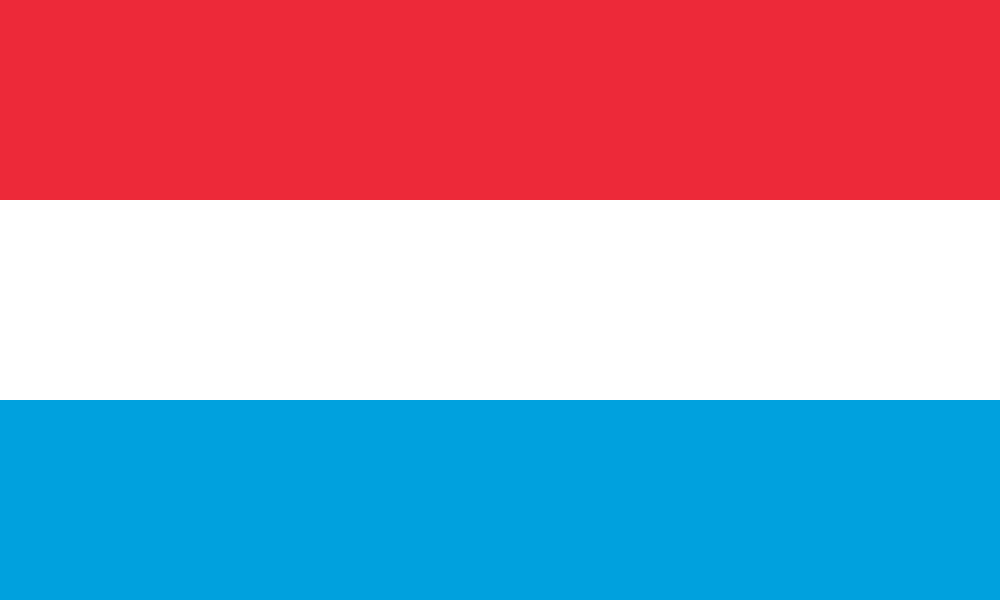
Luxembourg is a country in Europe with a population of 671.3K and an area of 2,586 km². Life expectancy is 83.4 years.
Short factual summary generated from the same country data used in game rounds.
Core numbers
Fast scan first, deep dive later.
GDP Per Capita (PPP)
$150,929.36GDP per person, adjusted for purchasing power parity (PPP) so costs of living are comparable across countries.
GDP Per Capita
$128,181.7GDP per person adjusted for purchasing power in constant 2017 international dollars, from Our World in Data using the latest available country values in TerraBrawl.
Internet Users (%)
99%The percentage of people who have used the internet in the last 3 months.
Life Expectancy
83.4 yearsHow many years a newborn can expect to live, based on current mortality rates.
CO2 Per Capita
10.46 t/person/yrAnnual carbon dioxide emissions in tonnes per person, from Our World in Data using the latest available country values in TerraBrawl.
Human Development Index
0.92Composite 0-1 index of life expectancy, education, and income, from Our World in Data using the latest available country values in TerraBrawl.
Country briefing
A quick real-world briefing before you dive deeper into rankings, surprises, and matchups.
Identity
Name origin: probably derived from an early Celtic or Germanic form of the name, Lucilinburhuc, that was thought to mean "little fortress.
Geography
Size snapshot: slightly smaller than Rhode Island.
Culture
Major languages include Luxembourgish (official administrative, judicial, and national language) 48.9%, Portuguese 15.4%, and more.
Cities
Browse this country's cities before City Detective asks you to guess.
Top stats
The strongest source-backed stats before the deeper data table.
FDI Inflows (% GDP)
113.62% of GDPForeign direct investment net inflows as a share of GDP, from World Bank Open Data.
Protected Land (%)
38.7%The percentage of land area designated as protected natural reserves or parks.
Alcohol Consumption
10.82 L/adult/yrLiters of pure alcohol the average adult aged 15+ consumes per year, from Our World in Data using the latest available country values in TerraBrawl.
Lowest Elevation
133 mLowest point elevation from CIA World Factbook.
Urban Population (%)
94.84%The percentage of people living in cities and urban areas.
Reality checks
The stats that tend to surprise players in real rounds.
Only ranks #38 in gender pay gap (%)
Women's earnings shortfall compared with men in the same wage decile, from OECD How's Life / Well-Being.
Keeps child mortality unusually low
Deaths before age 5 per 1,000 live births, from World Bank Open Data.
Only ranks #165 in armed forces personnel
Total armed forces personnel from the World Bank latest available country value.
Keeps infant mortality unusually low
Infant deaths before age 1 per 1,000 live births, from World Bank Open Data.
Only ranks #213 in fertility rate
The average number of children a woman would have over her lifetime based on current birth rates.
Compared with the region
Country vs continent vs world averages
GDP per person, adjusted for purchasing power parity (PPP) so costs of living are comparable across countries.
How many years a newborn can expect to live, based on current mortality rates.
Composite 0-1 index of life expectancy, education, and income, from Our World in Data using the latest available country values in TerraBrawl.
The percentage of people who have used the internet in the last 3 months.
Think you can guess which countries rank higher?
Play this countryFactbook notes
Country briefing
Founded in 963, Luxembourg became a grand duchy in 1815 and a constituent part of the Kingdom of the Netherlands after the Congress of Vienna.
Founded in 963, Luxembourg became a grand duchy in 1815 and a constituent part of the Kingdom of the Netherlands after the Congress of Vienna. When Belgium declared independence from the Netherlands in 1839, Luxembourg lost more than half of its territory to Belgium but gained a larger measure of autonomy within the Kingdom of the Netherlands. Luxembourg gained full independence in 1867 by promising to remain permanently neutral. Overrun by Germany in both world wars, its neutrality ended in 1948 when it entered into the Benelux Customs Union and joined NATO the following year. In 1957, Luxembourg became one of the six founding countries of the EEC (later the EU), and in 1999 it joined the euro currency zone.
Data vault
Every tracked stat, grouped for fast scanning.
Keep exploring
Open the head-to-head pages people naturally search after reading this profile.
Jump straight to the rankings where this country has its strongest edge.
Turn Luxembourg's strongest number into a challenge card.
GDP per person, adjusted for purchasing power parity (PPP) so costs of living are comparable across countries.
Luxembourg has a population of 671.3K, ranking #166 globally by population.
Luxembourg is located in Europe. It has an area of 2,586 km².
Life expectancy in Luxembourg is 83.4 years, ranking #14 globally.
Luxembourg's GDP per capita (PPP) is $150,929.36, ranking #1 globally.
Luxembourg ranks particularly high in GDP Per Capita (PPP) (#1), GDP Per Capita (#2), Internet Users (%) (#11).
Luxembourg has an HDI of 0.922, ranking #25 globally. The HDI combines life expectancy, education, and income indicators.
Luxembourg has a population density of 258.9 people per km², ranking #51 globally.