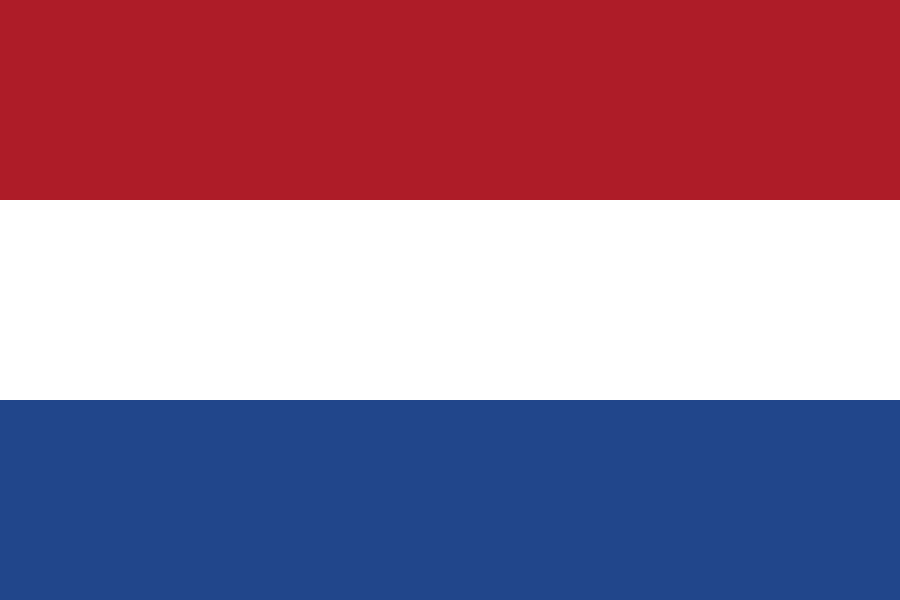
Identity
Formal name: Kingdom of the Netherlands.
CIA 2026
Loading TerraBrawl
Data as of May 28, 2026
Netherlands claims the 9th spot worldwide for human development index. How well do you really know Netherlands?
Netherlands claims the 9th spot worldwide for human development index. That 0.955 figure is hard to beat. How well do you really know Netherlands?
Area
42K km²
Pop.
17.83M
Stats
199
Netherlands is a country in Europe with a population of 17.83M and an area of 41,865 km². Life expectancy is 81.9 years.
Short factual summary generated from the same country data used in game rounds.
Core numbers
Fast scan first, deep dive later.
Human Development Index
0.95Composite 0-1 index of life expectancy, education, and income, from Our World in Data using the latest available country values in TerraBrawl.
Life Satisfaction
7.6 ptsAverage self-reported life satisfaction on a 0-10 scale, from OECD How's Life / Well-Being.
GDP Per Capita (PPP)
$84,221.98GDP per person, adjusted for purchasing power parity (PPP) so costs of living are comparable across countries.
GDP Per Capita
$70,901.84GDP per person adjusted for purchasing power in constant 2017 international dollars, from Our World in Data using the latest available country values in TerraBrawl.
Internet Users (%)
97%The percentage of people who have used the internet in the last 3 months.
University Enrollment Rate
86.59%Total university and college enrollment as a percentage of the typical college-age population.
Country briefing
A quick real-world briefing before you dive deeper into rankings, surprises, and matchups.
Identity
Formal name: Kingdom of the Netherlands.
Curated stat
OECD data puts the Netherlands among the countries with the shortest average annual work hours.
Geography
Size snapshot: slightly less than twice the size of New Jersey.
Cities
Browse this country's cities before City Detective asks you to guess.
Amsterdam
North Holland, Netherlands
Rotterdam
South Holland, Netherlands
The Hague
South Holland, Netherlands
Utrecht
Netherlands
Groningen
Netherlands
Haarlem
North Holland, Netherlands
's-Hertogenbosch
North Brabant, Netherlands
Arnhem
Gelderland, Netherlands
Top stats
The strongest source-backed stats before the deeper data table.
Urban Population (%)
95.64%The percentage of people living in cities and urban areas.
GDP (Nominal)
$1,214,927,698,572.66The country's total economic output in current US dollars.
Population Density
530.95 /km²How many people live in each square kilometer of land.
Merchant Fleet Size
1.2KNumber of merchant marine ships from the frozen public-domain CIA World Factbook snapshot.
Health Spending (% GDP)
10.1% of GDPCurrent health expenditure as a share of GDP, from World Bank Open Data.
Reality checks
The stats that tend to surprise players in real rounds.
Keeps inequality (gini) unusually low
A measure of income inequality where 0 means everyone earns the same and 100 means one person has everything.
Only ranks #186 in fdi inflows (% gdp)
Foreign direct investment net inflows as a share of GDP, from World Bank Open Data.
Only ranks #202 in teen birth rate
The number of births per 1,000 women aged 15-19.
Only ranks #216 in lowest elevation
Lowest point elevation from CIA World Factbook.
Ranks #25 globally in electric generating capacity
Installed electricity generating capacity in kilowatts from the frozen public-domain CIA World Factbook snapshot.
Compared with the region
Country vs continent vs world averages
GDP per person, adjusted for purchasing power parity (PPP) so costs of living are comparable across countries.
How many years a newborn can expect to live, based on current mortality rates.
Composite 0-1 index of life expectancy, education, and income, from Our World in Data using the latest available country values in TerraBrawl.
The percentage of people who have used the internet in the last 3 months.
Think you can guess which countries rank higher?
Play this countryFactbook notes
Country briefing
The Dutch United Provinces declared their independence from Spain in 1581; during the 17th century, they became a leading seafaring and commercial power, with settlements and colonies around the world.
The Dutch United Provinces declared their independence from Spain in 1581; during the 17th century, they became a leading seafaring and commercial power, with settlements and colonies around the world. After 18 years of French domination, the Netherlands regained its independence in 1813. In 1830, Belgium seceded and formed a separate kingdom. The Netherlands remained neutral in World War I but suffered German invasion and occupation in World War II. A modern, industrialized nation, the Netherlands is also a large exporter of agricultural products. The country was a founding member of NATO and the EEC (now the EU) and participated in the introduction of the euro in 1999. In 2010, the former Netherlands Antilles was dissolved and the three smallest islands -- Bonaire, Sint Eustatius, and Saba -- became special municipalities in the Netherlands administrative structure. The larger islands of Sint Maarten and Curacao joined the Netherlands and Aruba as constituent countries forming the Kingdom of the Netherlands.
In 2018, the Sint Eustatius island council (governing body) was dissolved and replaced by a government commissioner to restore the integrity of public administration. According to the Dutch Government, the intervention will be as "short as possible and as long as needed."
Data vault
Every tracked stat, grouped for fast scanning.
Keep exploring
Open the head-to-head pages people naturally search after reading this profile.
Jump straight to the rankings where this country has its strongest edge.
Turn Netherlands's strongest number into a challenge card.
Composite 0-1 index of life expectancy, education, and income, from Our World in Data using the latest available country values in TerraBrawl.
Netherlands has a population of 17.83M, ranking #72 globally by population.
Netherlands is located in Europe. It has an area of 41,865 km².
Life expectancy in Netherlands is 81.9 years, ranking #33 globally.
Netherlands's GDP per capita (PPP) is $84,221.98, ranking #12 globally.
Netherlands ranks particularly high in Human Development Index (#9), Life Satisfaction (#9), GDP Per Capita (PPP) (#12).
Netherlands has an HDI of 0.955, ranking #9 globally. The HDI combines life expectancy, education, and income indicators.
Netherlands has a population density of 531.0 people per km², ranking #22 globally.