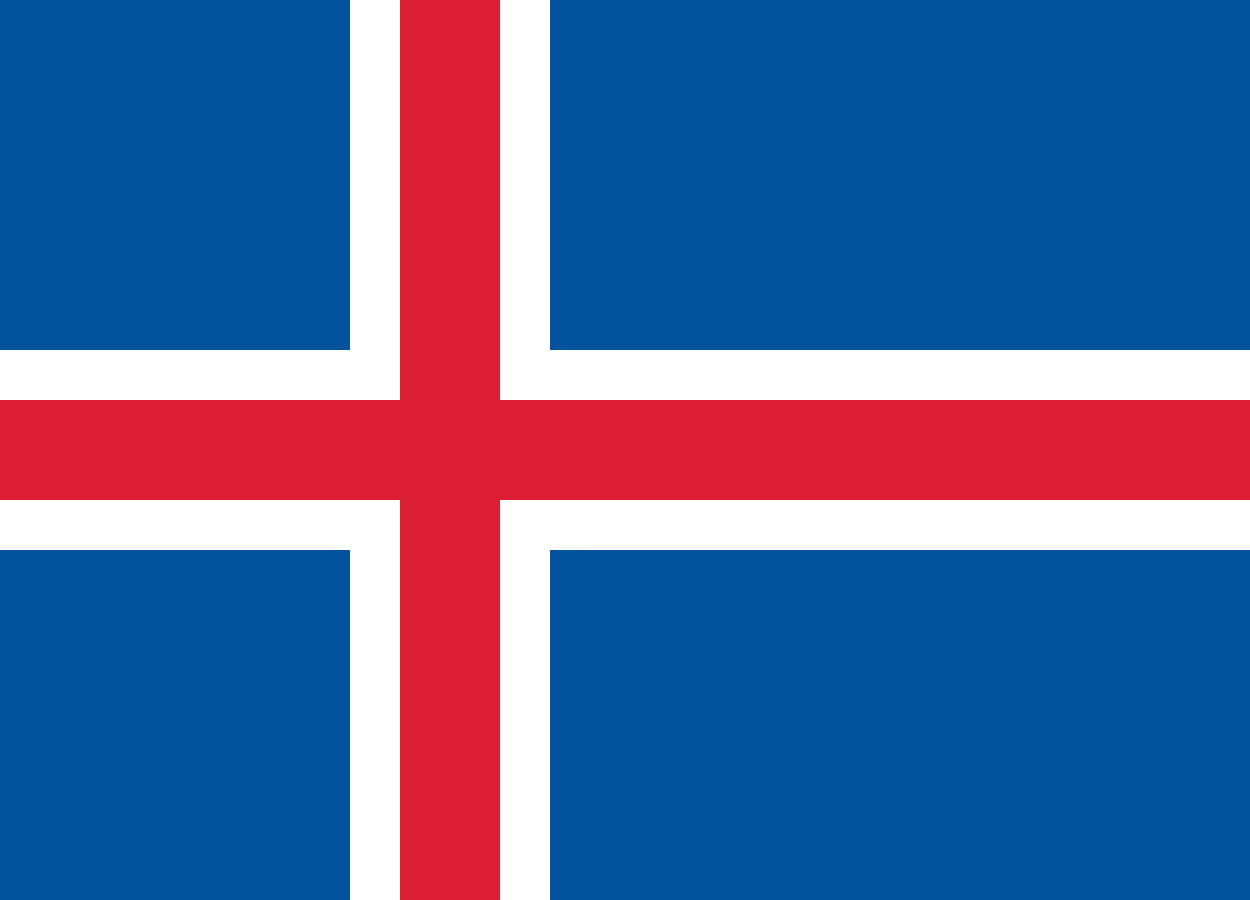
Identity
Name origin: Floki VILGERDARSON, an early Norse explorer of the island in the 10th century, applied the name "Land of Ice," from the local words ís (ice) and land (land).
CIA 2026
Loading TerraBrawl
Data as of May 28, 2026
Among all countries, Iceland stands 1st in human development index. Can you guess its other standout statistics?
Among all countries, Iceland stands 1st in human development index. This achievement puts it ahead of the vast majority of countries. Can you guess its other standout statistics?
Area
103K km²
Pop.
364.0K
Stats
180
Iceland is a country in Europe with a population of 364.0K and an area of 103,000 km². Life expectancy is 82.6 years.
Short factual summary generated from the same country data used in game rounds.
Core numbers
Fast scan first, deep dive later.
Human Development Index
0.97Composite 0-1 index of life expectancy, education, and income, from Our World in Data using the latest available country values in TerraBrawl.
Internet Users (%)
100%The percentage of people who have used the internet in the last 3 months.
Life Satisfaction
8.1 ptsAverage self-reported life satisfaction on a 0-10 scale, from OECD How's Life / Well-Being.
GDP Per Capita (PPP)
$81,924.41GDP per person, adjusted for purchasing power parity (PPP) so costs of living are comparable across countries.
GDP Per Capita
$65,645.09GDP per person adjusted for purchasing power in constant 2017 international dollars, from Our World in Data using the latest available country values in TerraBrawl.
Life Expectancy
82.7 yearsAverage number of years a newborn would be expected to live if current mortality patterns stayed the same, from Our World in Data.
Country briefing
A quick real-world briefing before you dive deeper into rankings, surprises, and matchups.
Identity
Name origin: Floki VILGERDARSON, an early Norse explorer of the island in the 10th century, applied the name "Land of Ice," from the local words ís (ice) and land (land).
Curated stat
Iceland sits on the active geologic boundary between the North American and Eurasian plates.
Geography
Size snapshot: slightly smaller than Pennsylvania.
Cities
Browse this country's cities before City Detective asks you to guess.
Top stats
The strongest source-backed stats before the deeper data table.
Employment Rate (%)
87.61% of adults 25-64Share of adults aged 25-64 who are employed, from OECD How's Life / Well-Being.
Renewable Energy (%)
80.5%Share of final energy consumption supplied by renewable energy, from Our World in Data using the latest available country values in TerraBrawl.
High-Tech Exports (%)
53.97%High-tech products (like computers, pharmaceuticals, and aerospace) as a percentage of total manufactured exports.
Women in Parliament (%)
46.03%The percentage of parliament seats held by women.
Education Spending (% GDP)
7.3% of GDPGovernment education spending as a share of GDP, from World Bank Open Data.
Reality checks
The stats that tend to surprise players in real rounds.
Keeps air pollution (pm2.5) unusually low
The average level of fine particle air pollution (PM2.5) that people are exposed to.
Only ranks #211 in population density
How many people live in each square kilometer of land.
Only ranks #167 in armed forces personnel
Total armed forces personnel from the World Bank latest available country value.
Keeps infant mortality unusually low
Infant deaths before age 1 per 1,000 live births, from World Bank Open Data.
Only ranks #129 in foreign patents
How many patent applications are filed by non-residents each year.
Compared with the region
Country vs continent vs world averages
GDP per person, adjusted for purchasing power parity (PPP) so costs of living are comparable across countries.
How many years a newborn can expect to live, based on current mortality rates.
Composite 0-1 index of life expectancy, education, and income, from Our World in Data using the latest available country values in TerraBrawl.
The percentage of people who have used the internet in the last 3 months.
Think you can guess which countries rank higher?
Play this countryFactbook notes
Country briefing
Settled by Norwegian and Celtic (Scottish and Irish) immigrants during the late 9th and 10th centuries A.D., Iceland boasts the world's oldest functioning legislative assembly, the Althingi, which was established in 930.
Settled by Norwegian and Celtic (Scottish and Irish) immigrants during the late 9th and 10th centuries A.D., Iceland boasts the world's oldest functioning legislative assembly, the Althingi, which was established in 930. Independent for over 300 years, Iceland was subsequently ruled by Norway and Denmark. Fallout from the Askja volcano of 1875 devastated the Icelandic economy and caused widespread famine. Over the next quarter-century, 20% of the island's population emigrated, mostly to Canada and the US. Denmark granted limited home rule in 1874 and complete independence in 1944. The second half of the 20th century saw substantial economic growth driven primarily by the fishing industry. The economy diversified greatly after the country joined the European Economic Area in 1994, but the global financial crisis hit Iceland especially hard in the years after 2008. The economy is now on an upward trajectory, primarily thanks to a tourism and construction boom. Literacy, longevity, and social cohesion are first-rate by world standards.
Data vault
Every tracked stat, grouped for fast scanning.
Keep exploring
Open the head-to-head pages people naturally search after reading this profile.
Jump straight to the rankings where this country has its strongest edge.
Turn Iceland's strongest number into a challenge card.
Composite 0-1 index of life expectancy, education, and income, from Our World in Data using the latest available country values in TerraBrawl.
Iceland has a population of 364.0K, ranking #176 globally by population.
Iceland is located in Europe. It has an area of 103,000 km².
Life expectancy in Iceland is 82.6 years, ranking #27 globally.
Iceland's GDP per capita (PPP) is $81,924.41, ranking #13 globally.
Iceland ranks particularly high in Human Development Index (#1), Internet Users (%) (#5), Life Satisfaction (#2).
Iceland has an HDI of 0.972, ranking #1 globally. The HDI combines life expectancy, education, and income indicators.
Iceland has a population density of 3.8 people per km², ranking #211 globally.