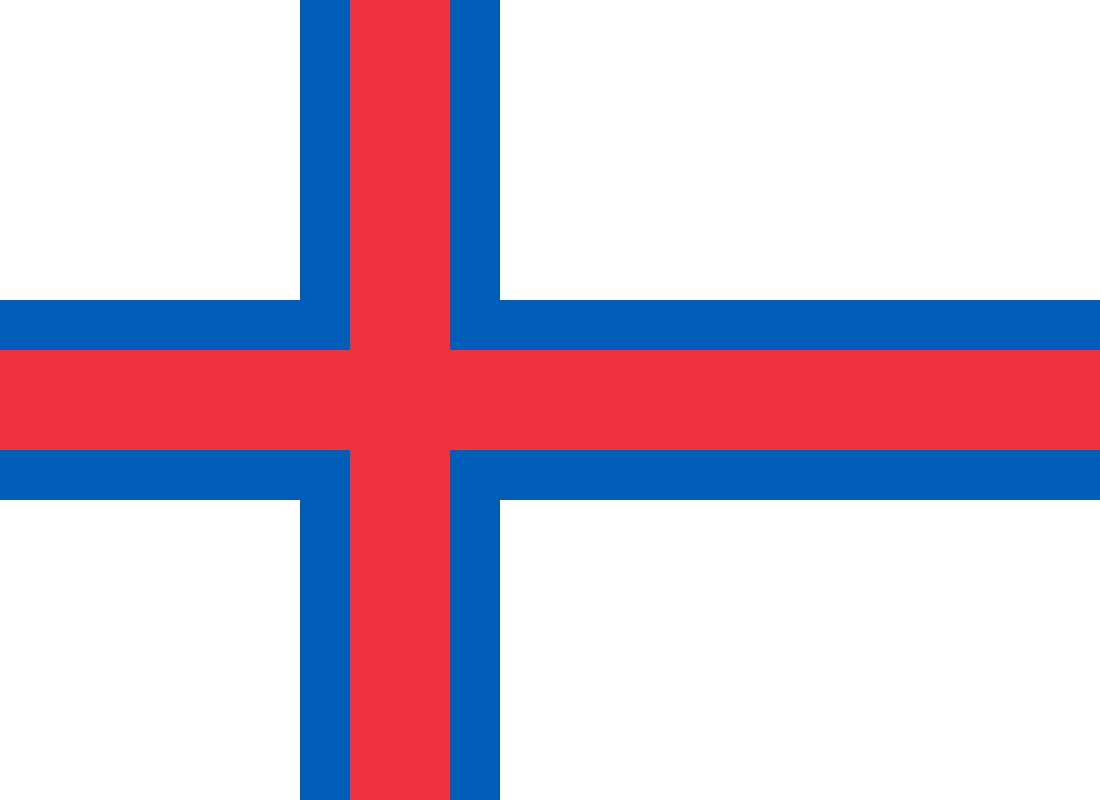
Geography
Climate: mild winters, cool summers.
CIA 2026
Loading TerraBrawl
Data as of May 28, 2026
Faroe Islands is a place of striking contrasts. Explore the contradictions that define this area.
Faroe Islands is a place of striking contrasts. A top performer in gdp per capita (#14), it falls behind in forest coverage. Explore the contradictions that define this area.
Area
1K km²
Pop.
52.9K
Stats
52
Faroe Islands is a country in Europe with a population of 52.9K and an area of 1,393 km². Life expectancy is 83.1 years.
Short factual summary generated from the same country data used in game rounds.
Core numbers
Fast scan first, deep dive later.
Internet Users (%)
98%The percentage of people who have used the internet in the last 3 months.
GDP Per Capita (PPP)
$81,908.78GDP per person, adjusted for purchasing power parity (PPP) so costs of living are comparable across countries.
CO2 Per Capita
13.09 t/person/yrAnnual carbon dioxide emissions in tonnes per person, from Our World in Data using the latest available country values in TerraBrawl.
GDP Per Capita
$70,428.96GDP per person adjusted for purchasing power in constant 2017 international dollars, from Our World in Data using the latest available country values in TerraBrawl.
Life Expectancy
83.1 yearsHow many years a newborn can expect to live, based on current mortality rates.
Country briefing
A quick real-world briefing before you dive deeper into rankings, surprises, and matchups.
Geography
Climate: mild winters, cool summers.
Culture
Major languages include Faroese 93.8% (derived from Old Norse), Danish 3.2%, other 3% (2011 est.).
Economy
Key industries include fishing, fish processing, tourism, small ship repair and refurbishment, and more.
Top stats
The strongest source-backed stats before the deeper data table.
Electricity Access (%)
100%The percentage of the population with access to electricity.
Elderly Population (%)
17.74%Share of the population ages 65 and older, from World Bank Open Data.
Dependency Ratio
60.52% of working-age pop.Dependents as a share of the working-age population, from World Bank Open Data.
Reality checks
The stats that tend to surprise players in real rounds.
Only ranks #208 in forest area
Total forest area in square kilometers, including natural and planted trees at least 5 meters tall.
Only ranks #221 in airports
Large, medium, and small airport records by country from the open OurAirports dataset.
Only ranks #206 in population
The total number of people living in the country.
Only ranks #188 in teen birth rate
The number of births per 1,000 women aged 15-19.
Compared with the region
Country vs continent vs world averages
GDP per person, adjusted for purchasing power parity (PPP) so costs of living are comparable across countries.
How many years a newborn can expect to live, based on current mortality rates.
The percentage of people who have used the internet in the last 3 months.
Think you can guess which countries rank higher?
Play this countryFactbook notes
Country briefing
The Faroe Islands were already populated by about A.D.
The Faroe Islands were already populated by about A.D. 500, but whether the original settlers were Celtic or early Norse (or someone else) has yet to be determined. Viking settlers arrived on the islands in the 9th century, and the islands served as an important stepping stone for medieval Viking exploration of the North Atlantic. The islands have been connected politically to Denmark since the 14th century, and today the Faroe Islands are a self-governing dependency of Denmark. The Home Rule Act of 1948 granted a high degree of self-government to the Faroese, who have autonomy over most internal affairs and external trade, while Denmark is responsible for justice, defense, and some foreign affairs. The Faroe Islands are not part of the European Union.
Data vault
Every tracked stat, grouped for fast scanning.
Keep exploring
Open the head-to-head pages people naturally search after reading this profile.
Jump straight to the rankings where this country has its strongest edge.
Turn Faroe Islands's strongest number into a challenge card.
The percentage of people who have used the internet in the last 3 months.
Faroe Islands has a population of 52.9K, ranking #206 globally by population.
Faroe Islands is located in Europe. It has an area of 1,393 km².
Life expectancy in Faroe Islands is 83.1 years, ranking #19 globally.
Faroe Islands's GDP per capita (PPP) is $81,908.78, ranking #14 globally.
Faroe Islands ranks particularly high in Internet Users (%) (#16), GDP Per Capita (PPP) (#14), CO2 Per Capita (#15).
Faroe Islands has a population density of 39.7 people per km², ranking #162 globally.