Geography
Natural resources include petroleum, fish, rock salt, marble; small deposits of coal, and more.
CIA 2026
Loading TerraBrawl
Data as of May 28, 2026
Covering 528K km², Yemen is truly vast. How well do you know this massive place?
Covering 528K km², Yemen is truly vast. This massive territory shapes its character. How well do you know this massive place?
Area
528K km²
Pop.
34.51M
Stats
103
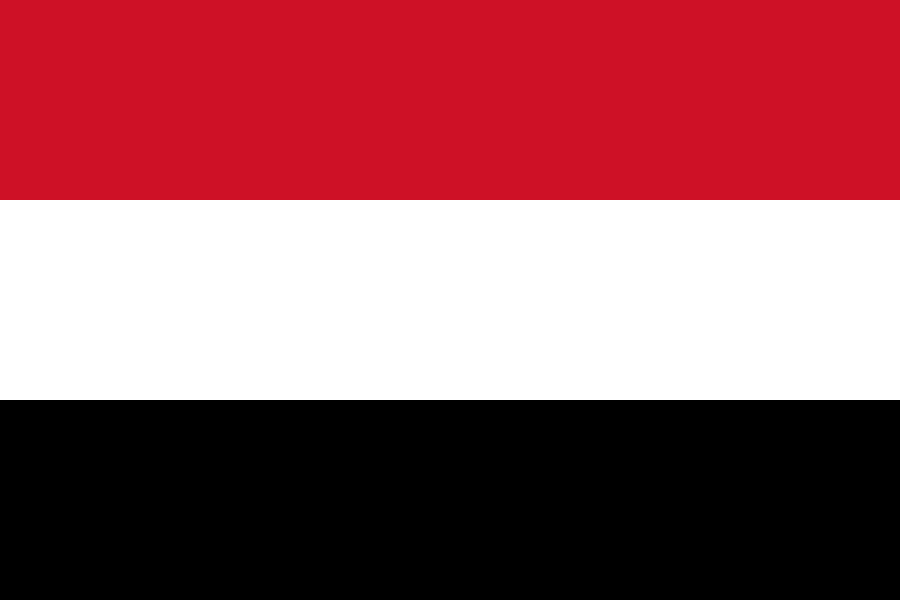
Yemen is a country in Asia with a population of 34.51M and an area of 527,968 km². Life expectancy is 69.3 years.
Short factual summary generated from the same country data used in game rounds.
Core numbers
Fast scan first, deep dive later.
Land Area
528.0K km²Total land area in square kilometers, excluding lakes, rivers, and territorial waters.
Population Density
74.61 /km²How many people live in each square kilometer of land.
Life Expectancy
69.3 yearsHow many years a newborn can expect to live, based on current mortality rates.
CO2 Per Capita
0.25 t/person/yrAnnual carbon dioxide emissions in tonnes per person, from Our World in Data using the latest available country values in TerraBrawl.
Country briefing
A quick real-world briefing before you dive deeper into rankings, surprises, and matchups.
Geography
Natural resources include petroleum, fish, rock salt, marble; small deposits of coal, and more.
Culture
Major languages include Arabic (official).
Identity
Formal name: Republic of Yemen.
Cities
Browse this country's cities before City Detective asks you to guess.
Sanaa
Amanat Alasimah, Yemen
Taiz
Ta'izz, Yemen
Aden
Yemen
Al Ḩudaydah
Al Hudaydah, Yemen
Mukalla
Muhafazat Hadramaout, Yemen
Ibb
Ibb Governorate, Yemen
Sa'dah
Yemen
Zabīd
Al Hudaydah, Yemen
Top stats
The strongest source-backed stats before the deeper data table.
Unemployment Rate
17.09%The percentage of the workforce that is unemployed but actively looking for work.
Inflation Rate
29.1%How much prices increased over the year, based on the cost of everyday goods and services.
Military Spending
4.0% of GDPMilitary expenditure as a share of GDP, from World Bank Open Data.
Air Pollution (PM2.5)
34.83 µg/m³The average level of fine particle air pollution (PM2.5) that people are exposed to.
Reality checks
The stats that tend to surprise players in real rounds.
Only ranks #189 in spirits consumption
Liters of spirits consumed per person per year, from Our World in Data using the latest available country values in TerraBrawl.
Only ranks #190 in women in parliament (%)
The percentage of parliament seats held by women.
Only ranks #211 in broadband access (%)
Fixed broadband subscriptions per 100 people, from World Bank Open Data.
Only ranks #226 in internet users (%)
The percentage of people who have used the internet in the last 3 months.
Only ranks #205 in protected land (%)
The percentage of land area designated as protected natural reserves or parks.
Compared with the region
Country vs continent vs world averages
How many years a newborn can expect to live, based on current mortality rates.
Composite 0-1 index of life expectancy, education, and income, from Our World in Data using the latest available country values in TerraBrawl.
The percentage of people who have used the internet in the last 3 months.
Deaths before age 5 per 1,000 live births, from World Bank Open Data.
Think you can guess which countries rank higher?
Play this countryFactbook notes
Country briefing
The Kingdom of Yemen (colloquially known as North Yemen) became independent from the Ottoman Empire in 1918 and in 1962 became the Yemen Arab Republic.
The Kingdom of Yemen (colloquially known as North Yemen) became independent from the Ottoman Empire in 1918 and in 1962 became the Yemen Arab Republic. The British, who had set up a protectorate area around the southern port of Aden in the 19th century, withdrew in 1967 from what became the People's Republic of Southern Yemen (colloquially known as South Yemen). Three years later, the southern government adopted a Marxist orientation and changed the country's name to the People's Democratic Republic of Yemen. The exodus of hundreds of thousands of Yemenis from the south to the north contributed to two decades of hostility between the states, which were formally unified as the Republic of Yemen in 1990. A southern secessionist movement and brief civil war in 1994 was quickly subdued. In 2000, Saudi Arabia and Yemen agreed to delineate their border. Fighting in the northwest between the government and the Houthis, a Zaydi Shia Muslim minority, continued intermittently from 2004 to 2010, and then again from 2014 to the present. The southern secessionist movement was revitalized in 2007.
Public rallies in Sana'a against then President Ali Abdallah SALIH -- inspired by similar Arab Spring demonstrations in Tunisia and Egypt -- slowly gained momentum in 2011, fueled by complaints over high unemployment, poor economic conditions, and corruption. Some protests resulted in violence, and the demonstrations spread to other major cities. The Gulf Cooperation Council (GCC) mediated the crisis with the GCC Initiative, an agreement in which the president would step down in exchange for immunity from prosecution. SALIH eventually agreed to step down and transfer some powers to Vice President Abd Rabuh Mansur HADI. After HADI's uncontested election victory in 2012, SALIH formally transferred all presidential powers. In accordance with the GCC Initiative, Yemen launched a National Dialogue Conference (NDC) in 2013 to discuss key constitutional, political, and social issues. HADI concluded the NDC in 2014 and planned to proceed with constitutional drafting, a constitutional referendum, and national elections.
The Houthis, perceiving their grievances were not addressed in the NDC, joined forces with SALIH and expanded their influence in northwestern Yemen, which culminated in a major offensive against military units and rival tribes and enabled their forces to overrun the capital, Sana'a, in 2014. In 2015, the Houthis surrounded key government facilities, prompting HADI and the cabinet to resign. HADI fled first to Aden -- where he rescinded his resignation -- and then to Oman before moving to Saudi Arabia and asking the GCC to intervene militarily in Yemen. Saudi Arabia assembled a coalition of Arab militaries and began airstrikes, and ground fighting continued through 2016. In 2016, the UN initiated peace talks that ended without agreement. Rising tensions between the Houthis and SALIH culminated in Houthi forces killing SALIH. In 2018, the Houthis and the Yemeni Government participated in UN-brokered peace talks, agreeing to a limited cease-fire and the establishment of a UN mission.
In 2019, Yemen’s parliament convened for the first time since the conflict broke out in 2014. Violence then erupted between HADI's government and the pro-secessionist Southern Transitional Council (STC) in southern Yemen. HADI's government and the STC signed a power-sharing agreement to end the fighting, and in 2020, the signatories formed a new cabinet. In 2020 and 2021, fighting continued as the Houthis gained territory and also conducted regular UAV and missile attacks against targets in Saudi Arabia. In 2022, the UN brokered a temporary truce between the Houthis and the Saudi-led coalition. HADI and his vice-president resigned and were replaced by an eight-person Presidential Leadership Council. Although the truce formally expired in 2022, the parties nonetheless refrained from large-scale conflict through the end of 2023. Saudi Arabia, after the truce exp
Data vault
Every tracked stat, grouped for fast scanning.
Keep exploring
Open the head-to-head pages people naturally search after reading this profile.
Jump straight to the rankings where this country has its strongest edge.
Turn Yemen's strongest number into a challenge card.
The total number of people living in the country.
Yemen has a population of 34.51M, ranking #46 globally by population.
Yemen is located in Asia. It has an area of 527,968 km².
Life expectancy in Yemen is 69.3 years, ranking #154 globally.
Yemen ranks particularly high in Population (#46), Land Area (#49), Population Density (#131).
Yemen has an HDI of 0.470, ranking #184 globally. The HDI combines life expectancy, education, and income indicators.
Yemen has a population density of 74.6 people per km², ranking #131 globally.